

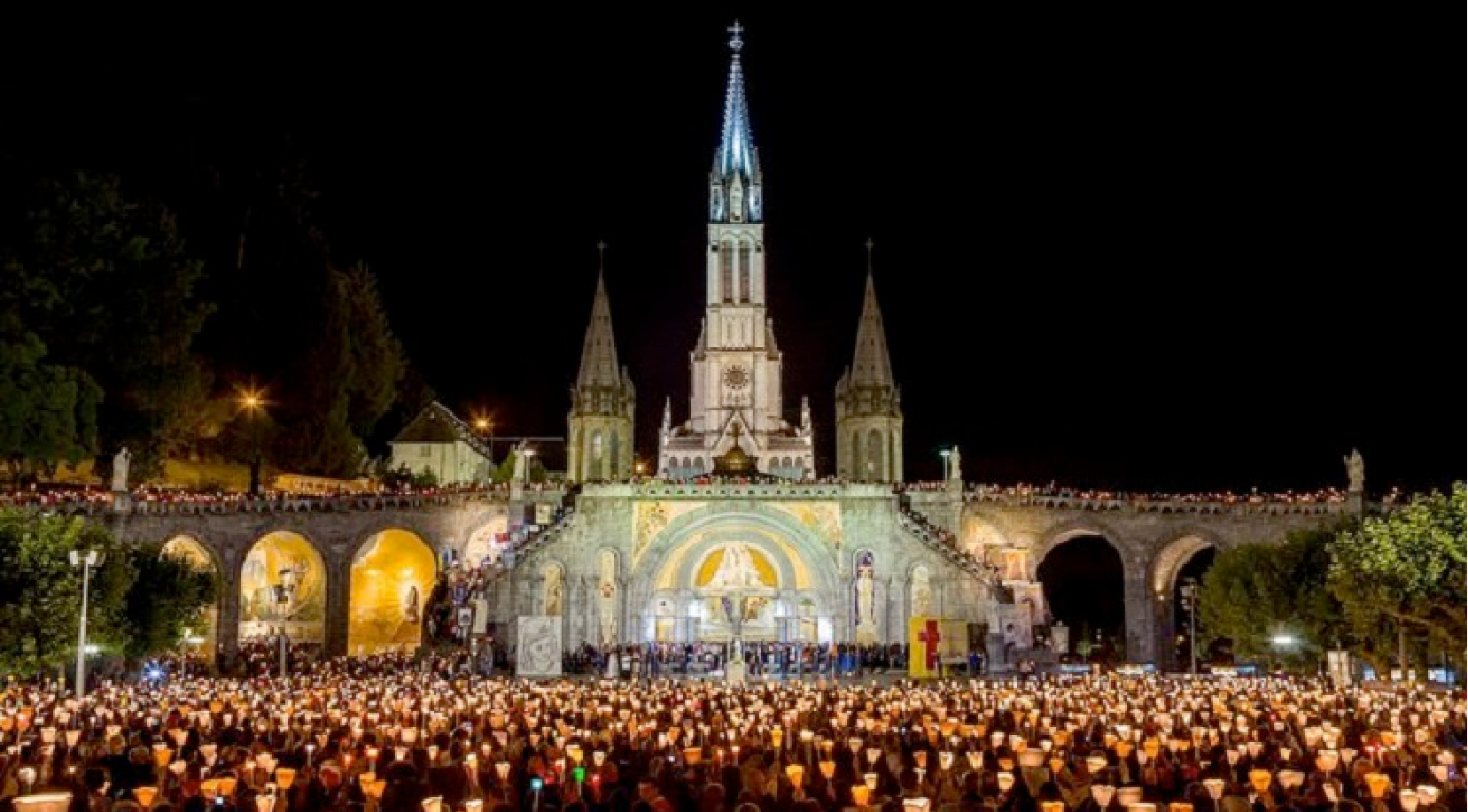
(ZENIT News / Lourdes, 10.01.2025).- Each evening in Lourdes, as shadows fall across the verdant foothills of the Pyrenees, a river of flickering flames begins its slow journey from the Grotto of Apparitions. The candlelight procession—an intricate ritual born more than 150 years ago—has long been the most captivating expression of the sanctuary’s life, a mosaic of prayer, song, and shared silence that transcends mere devotion to become a cultural landmark. Now, Lourdes has formally embarked on a bid to have this cherished tradition recognized as part of France’s Intangible Cultural Heritage.
The application, filed with the Ministry of Culture on September 26, represents more than a bureaucratic gesture. It is a declaration that what began with the humble act of Bernadette Soubirous carrying a single candle has blossomed into a kaleidoscopic tapestry where faith and culture intertwine. Over the decades, thousands have traced the same path around the Rosary Esplanade, creating a living labyrinth of light that beckons pilgrims from across the globe.
Historians often delve into the origins of this devotion, noting that by 1863 visitors were already imitating Bernadette’s gesture, and in 1864 the first orchestrated procession illuminated the night sky during the consecration of the statue of the Virgin. What was once a fragile flame in a young girl’s hand has become a spectacle that can draw 17,000 people on the feast of the Assumption alone. The rosary, recited in a chorus of languages, lends the event a crucible-like power: diverse voices reimagined into one transcendent prayer.
The sanctuary’s leaders are convinced that recognition as national heritage would be only the first step toward a possible UNESCO listing, where the procession would stand alongside global traditions that, while diverse in form, share a capacity to weave communities together across time and place. In such a register, the Lourdes procession would not be reduced to a religious ritual, but elevated as an emblem of humanity’s desire to celebrate what lies beyond itself.
At the same time, Lourdes is safeguarding its past in other ways. A newly announced Centre de Ressources Historiques will gather archives, manuscripts, and artifacts into a single repository. This endeavor orchestrates memory as carefully as the procession organizes prayer, ensuring that future generations can delve into the sanctuary’s enigmatic story.
Thank you for reading our content. If you would like to receive ZENIT’s daily e-mail news, you can subscribe for free through this link.

Publicaciones relacionadas:
 Pope Francis sends a «golden rose» to Our Lady of Peace and Good Voyage in the Philippines
 Vatican Approves Marian Apparitions in France
 This is the largest statue of the Virgin Mary in the world, which is in Argentina
 Asian bishops warn against visits to the Korean shrine of Naju: even with ex-communion
