

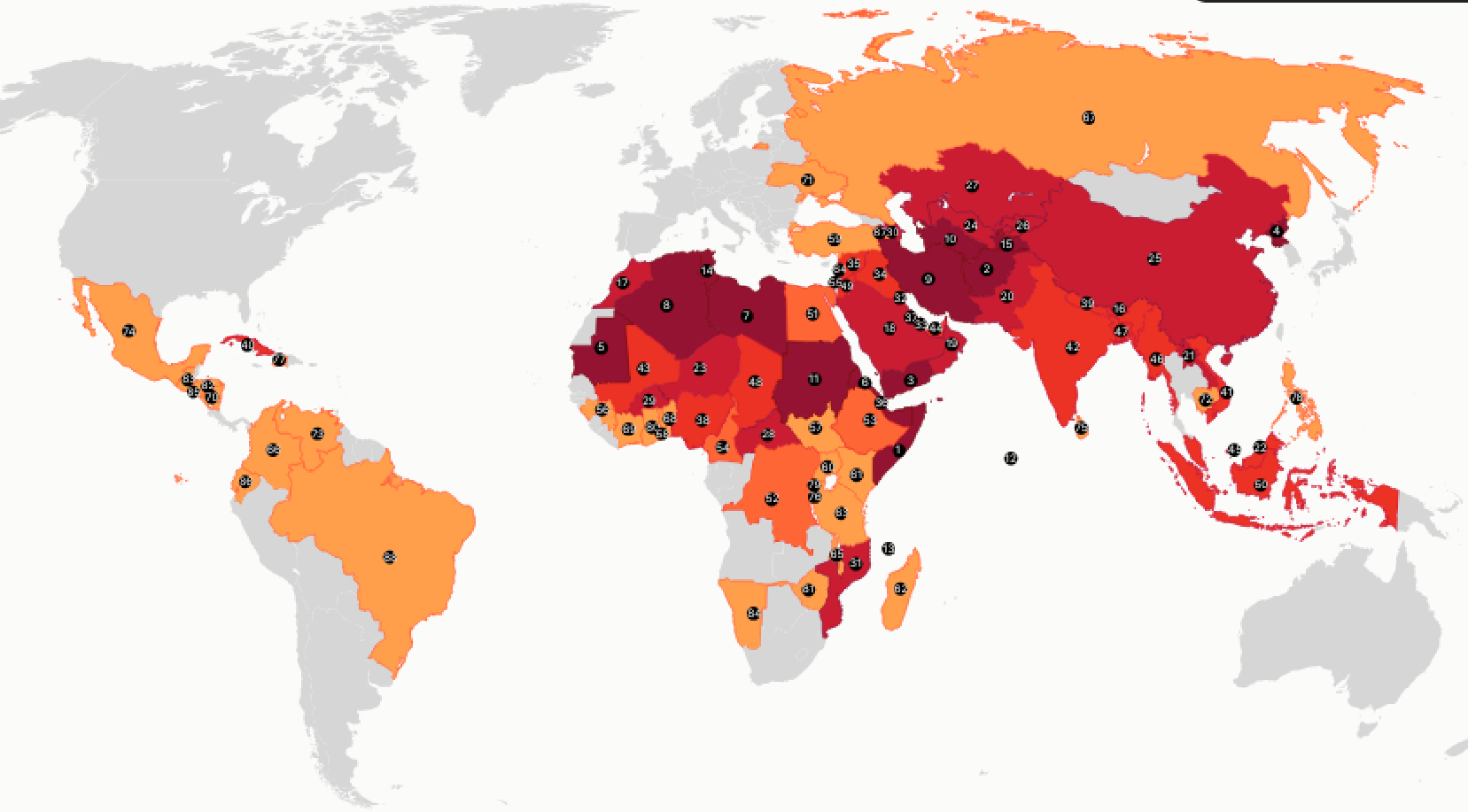
(ZENIT News / Rome, 10.09.2025).- In an era when information flows freely and nearly everything is just a click away, an unexpected kind of famine persists—one that has nothing to do with food but with faith. According to the newly released «Bible Access List 2025», roughly 100 million Christians around the world still lack access to the Scriptures in a language or format they can use.
The study, conducted by the International Bible Access Initiative across 88 countries, paints a stark picture of inequality in spiritual resources. For some believers, the Bible remains forbidden; for others, simply out of reach. Researchers describe it as “a modern famine”—not of bread, but of the Word of God.
In countries like Somalia, Afghanistan, Yemen, North Korea, and Mauritania, owning even a single page of the Bible can be punishable by death. There, religious freedom is so severely curtailed that distributing or even reading Scripture can be an act of resistance. “Unrestricted access to the Bible is far from a global standard,” notes Ken Bitgood, founder of the Digital Bible Society, one of the initiative’s partners.
Yet persecution tells only half the story. In many other nations—among them the Democratic Republic of the Congo, Nigeria, Ethiopia, India, and China—the barriers are not political but practical. Poverty, illiteracy, lack of printing infrastructure, and the high cost of paper mean that millions of believers who long to read the Scriptures simply cannot obtain them. “People are coming to faith,” says Wybo Nicolai of Frontlines International, “but how can faith grow or endure if the Word is missing?”
The «Bible Access List» separates two key challenges: restriction and scarcity. The first refers to environments where the Bible is actively banned or censored; the second, to situations where believers are free in principle but deprived by circumstance. Researchers used eleven metrics—from import bans and printing licenses to electricity access and literacy rates—to map the global landscape of biblical deprivation. About 75 percent of barriers, they found, stem from government restrictions or hostility toward Christianity; the remaining 25 percent are socioeconomic.
“The causes are diverse, and so must be the responses,” explains Jaap van Bezooijen, who coordinated the 2025 research. “Digital tools help, but not everywhere. In many parts of the world, printed or audio Bibles remain indispensable—especially where people live offline or under surveillance.”
The initiative’s findings have spurred churches and humanitarian groups to rethink how they distribute Scripture. Some are turning to micro-SD cards, solar-powered audio devices, or discreet house networks to share biblical texts in closed societies. Others are working on large-scale printing efforts in Africa and South Asia, often in collaboration with local churches.
Founded by Open Doors International and the Digital Bible Society, the International Bible Access Initiative aims to provide reliable data to churches, publishers, and mission organizations. Its steering committee now includes Frontlines International, the International Bible League, and several partner ministries such as Biblica, OneHope, and the Bible League Canada.
Despite digital progress and growing global connectivity, the researchers warn against complacency. For millions, Scripture remains a distant dream—a sacred text known only by fragments, songs, or memory. As Nicolai puts it, “There are still places where the hunger for the Word of God is as real and urgent as hunger for bread. And while we may not hear their cries, they echo across the Church worldwide.”
The «Bible Access List 2025» does more than measure scarcity; it exposes a silent divide between those who can open the Word freely and those who still wait for it to arrive.
Thank you for reading our content. If you would like to receive ZENIT’s daily e-mail news, you can subscribe for free through this link.

Publicaciones relacionadas:
 Israel continues to violate human rights of Christians just because they are Palestinians
 USA: Survey Shows That Those with “No Religion” Aren’t Increasing
 Religion and Elections in the USA: Pew Research Reveals How Each Candidate Is Supported
 These are the Catholic groups attacked in a report sponsored by Bill Gates and Soros simply for defending what they believe in
