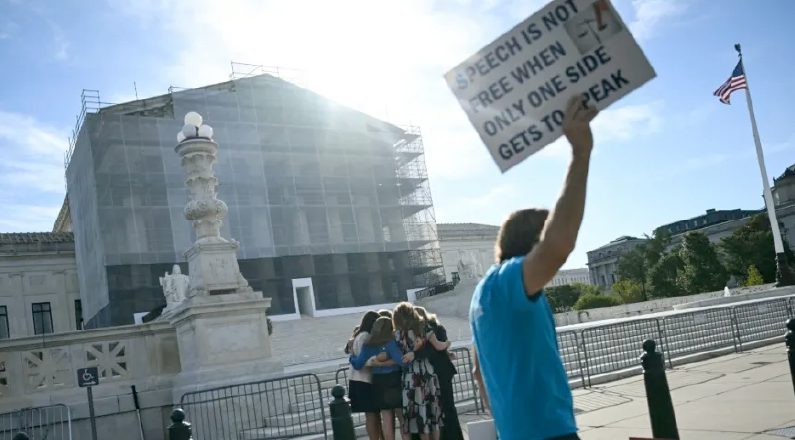
(ZENIT News / Washington, 10.09.2025).- In a case that could redefine the boundaries between free speech, state regulation, and the protection of minors, the U.S. Supreme Court is now weighing arguments in «Chiles v. Salazar», a challenge to Colorado’s ban on so-called “conversion therapy” for minors. The decision could reverberate far beyond one therapist’s practice, reshaping the national landscape of counseling, religious freedom, and government oversight in mental health.
At the center of the controversy stands Kaley Chiles, a licensed therapist from Colorado and a devout Christian. Chiles insists that she does not practice conversion therapy—a term widely condemned by major medical associations—but rather offers what she calls “faith-based conversations” with young people who voluntarily seek to address unwanted attractions or explore their gender identity in line with their personal beliefs. The state, however, has outlawed even these discussions when directed toward changing or reducing same-sex attraction or affirming one’s biological sex, framing them as inherently harmful interventions.
Colorado’s law mirrors similar prohibitions in roughly two dozen U.S. states and most European countries, reflecting a broad international consensus against «coercive conversion” treatments. Yet, Chiles and her supporters argue that such laws silence therapists who hold different worldviews and prevent minors from accessing counseling aligned with their convictions.
Her attorney, James Campbell, told the Court that the state’s law “turns licensed professionals into instruments of government-approved ideology.” Restricting what a therapist can say, he argued, is not regulation of medical practice but censorship of speech. “Ms. Chiles is being silenced,” he said, “and the children who seek her help are left without support.”
The state’s defense, led by Colorado’s attorney general, emphasized that the law’s primary purpose is to protect minors from practices that have been discredited by decades of psychological research. Every major medical body in the United States—from the American Medical Association to the American Psychological Association—has condemned conversion therapy as both ineffective and potentially traumatic. The attorney general argued that the state has a compelling interest in shielding young people from harm, just as it regulates the use of medication or physical treatments.
The justices appeared divided during the 90-minute oral argument. According to SCOTUSblog, several members of the Court seemed sympathetic to Chiles’ claim that the Colorado law discriminates based on viewpoint. Justice Elena Kagan, often considered one of the Court’s more liberal voices, questioned why the law allows only one form of counseling—affirmation—but not another, such as helping a person reconcile their feelings with their faith. “That looks like worldview discrimination,” she observed.
Justice Samuel Alito went further, suggesting that Colorado’s statute amounts to “a blatant form of censorship,” while Justice Sonia Sotomayor and Justice Ketanji Brown Jackson stressed that the state has broad authority to regulate medical conduct, particularly when minors are involved. “Speech within a therapeutic context can be both expression and treatment,” Jackson noted, “and the state has a duty to ensure that treatment does no harm.”
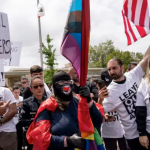
The case has drawn attention not only from constitutional scholars and mental health professionals but also from religious liberty advocates and LGBTQ+ organizations, all of whom see it as a bellwether for future legal battles over the intersection of faith, counseling, and identity.
Representing the federal government, Deputy Solicitor General Hashim Mooppan—appointed under the Trump administration—aligned partially with Chiles, arguing that “talk therapy is inherently speech” and that the government’s restriction raises serious First Amendment concerns.
The Court’s eventual ruling, expected next year, could determine whether such laws nationwide are seen as legitimate exercises of state power or unconstitutional intrusions into private conversation. For therapists like Kaley Chiles, it is not merely a professional question but a moral one: whether the freedom to speak openly about faith and sexuality can coexist with the government’s duty to protect children from psychological harm.
If the Court sides with Chiles, it could dismantle or weaken similar bans across the country. If it upholds Colorado’s law, it would affirm states’ right to regulate even the words used within therapy sessions—an outcome that could redefine the limits of free expression in one of the most intimate settings imaginable.
In the words of one observer outside the Court, “What’s on trial here isn’t just therapy—it’s the very meaning of freedom of speech when speech itself becomes the treatment.”
Thank you for reading our content. If you would like to receive ZENIT’s daily e-mail news, you can subscribe for free through this link.