

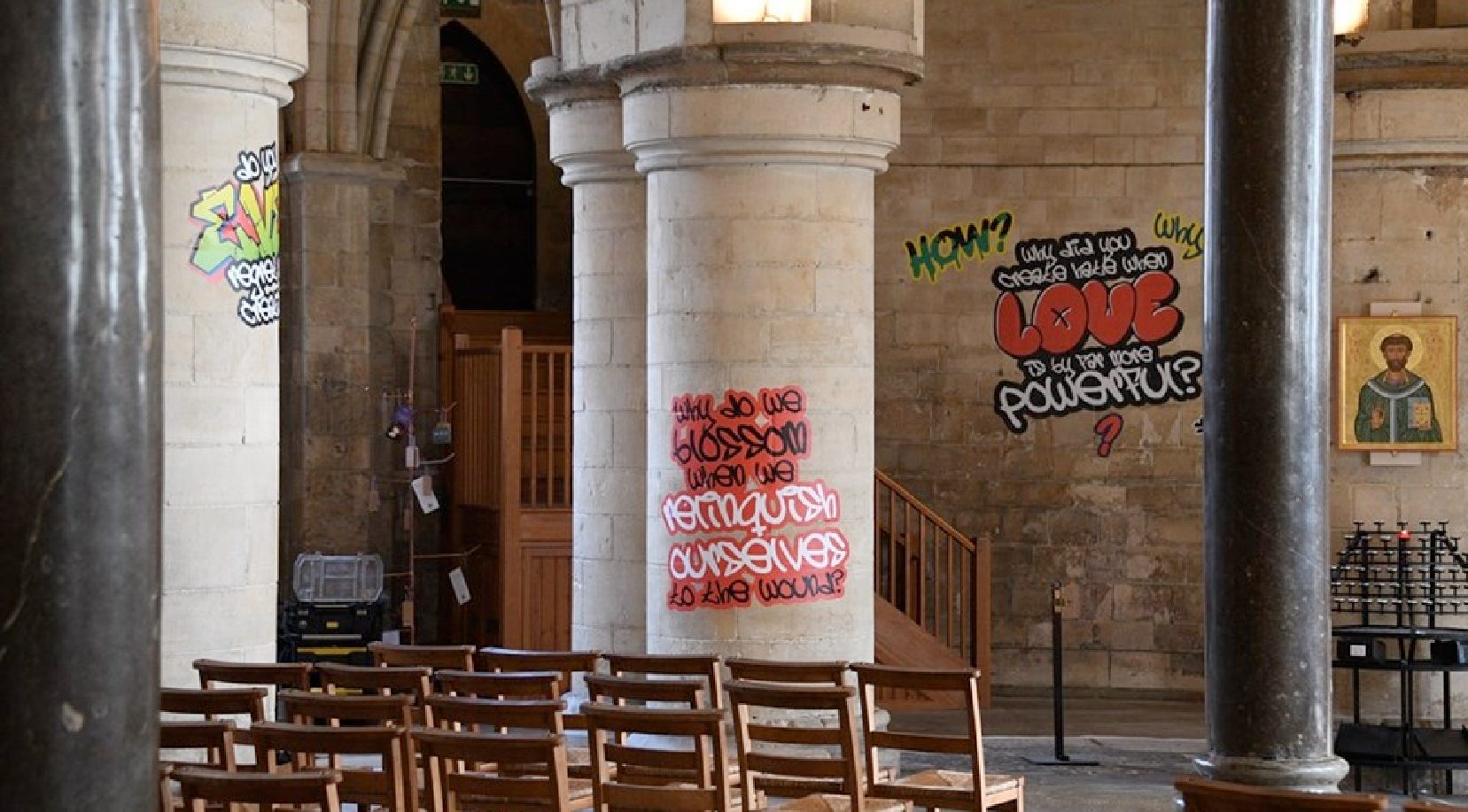
(ZENIT News / London, 10.15.2025).- When the ancient stones of Canterbury Cathedral meet the language of the streets, the clash is inevitable. This autumn, England’s most venerable Anglican sanctuary, seat of the Archbishop of Canterbury and cradle of Christian pilgrimage for nearly fourteen centuries, will host a temporary graffiti-style installation that has already ignited global outrage before its unveiling.
The project, titled «Hear Us», opens October 17 and will remain until mid-January 2026. Conceived by poet Alex Vellis and curator Jacquiline Creswell, the installation transforms the cathedral’s interior with large pasted graphics posing unsettling questions to God: “Are you there?”, “Why did you create hate when love is so much stronger?”, “Does everything have a soul?”, “Does our struggle mean anything?”
The questions were gathered from workshops with marginalized groups—people whose voices rarely echo within sacred walls. For Vellis, whose work often explores the boundaries between prayer and protest, graffiti is not vandalism but vernacular theology. “Language belongs to the people who speak it,” he said. “Graffiti is the language of the ignored. By bringing it into the cathedral, we join a chorus of the forgotten, the lost, and the wondrous.”
Yet not everyone is singing along. U.S. Vice President J.D. Vance denounced the project as “ugly irony,” mocking the idea of honoring the marginalized by “making a beautiful historic building truly hideous.” Elon Musk simply commented: “Shameful.” Others on social media accused the Church of England of confusing inclusivity with desecration.

Inside Britain, clergy and commentators echoed the backlash. The Reverend Marcus Walker of St. Bartholomew the Great, leader of the «Save the Parish» campaign, lamented that Canterbury’s leaders “seem to have lost all sense of the sacred,” adding that the cathedral should be preserved as “a place of prayer, not a private playground for elites.” GB News presenter Emma Trimble went further, calling the exhibition evidence of “a loss of reverence and respect for the holy.”
Dean David Monteith, who leads the cathedral and describes himself as a man of faith and dialogue, anticipated the divide. “People will love it or hate it,” he admitted. “But that tension is part of its unfiltered message.” For Monteith, art inside sacred space should not flatter comfort zones but open them. “Art builds bridges between cultures,” he wrote in response to the uproar.
The controversy has also intersected with another turning point in English Anglicanism: the upcoming installation of Dame Sarah Mullally as the first woman to serve as Archbishop of Canterbury. To critics, both events symbolize what they see as the Church’s accelerating drift from its spiritual roots toward a progressive rebranding. Mullally’s support for women’s ordination, same-sex inclusion, and reproductive rights has already provoked a break in communion with Nigeria’s Anglican Church.
Reverend Dwight Longenecker, once an Anglican and now a Catholic priest, summarized the discontent: “With Sarah Mullally as a feminist, pro-choice archbishop and David Monteith, an openly gay dean, the Church of England’s new identity is now formal and explicit.”
Thank you for reading our content. If you would like to receive ZENIT’s daily e-mail news, you can subscribe for free through this link.

Publicaciones relacionadas:
 South Korea: statistics show vitality of Catholicism, 11.3% of the population
 Pope receives Siro Malabar in audience at Vatican: addresses schism issue and calls for unity
 Brazilian police arrest woman who digitally harassed a priest: she created and distributed false material
 Legal dispute over Rio de Janeiro’s Christ the Redeemer statue: this is the solution proposed by the Senate
