

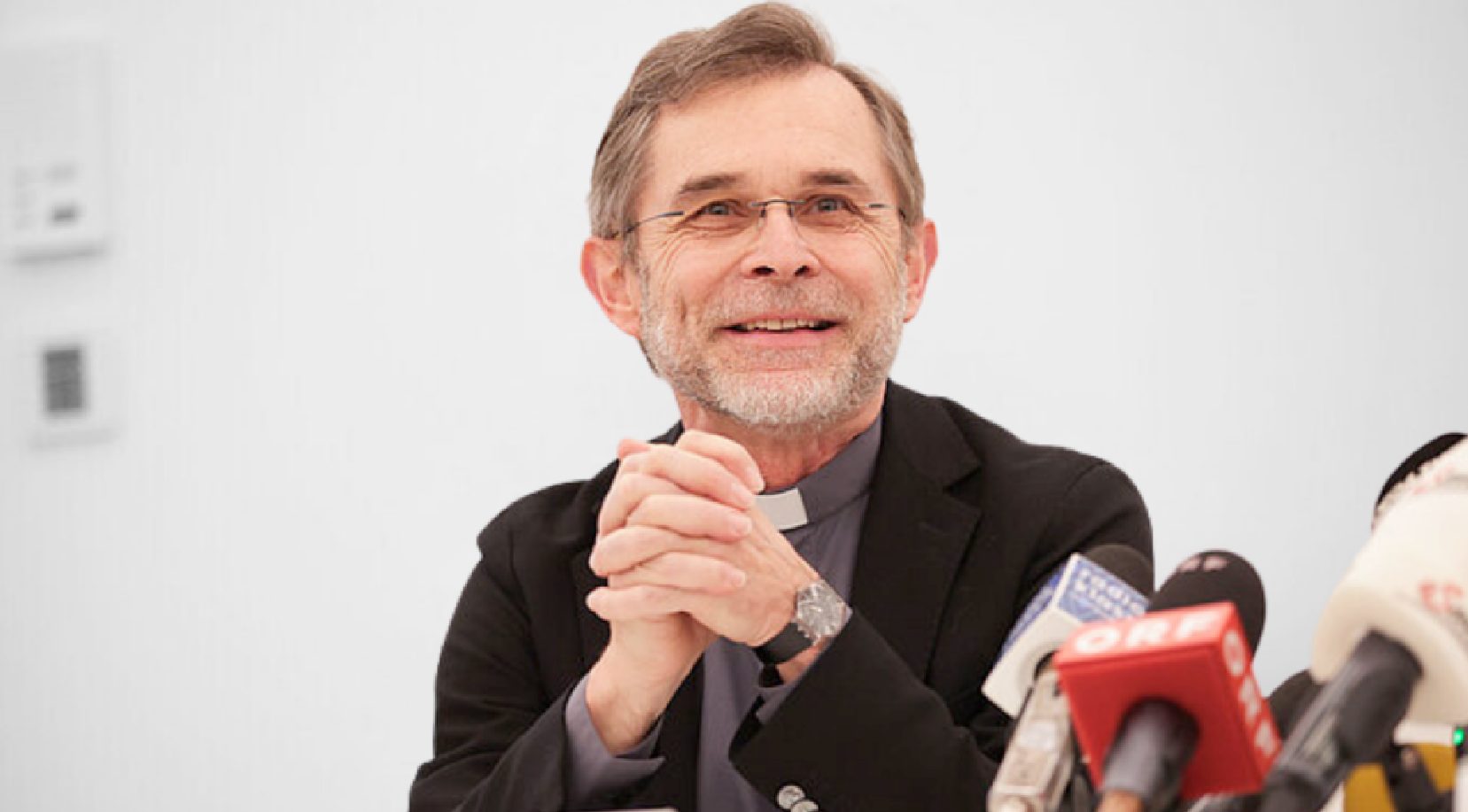
(ZENIT News / Vienna, 10.20.2025).- When Pope Leo XIV announced on October 17 the appointment of Josef Grünwidl as Archbishop of Vienna, Austria’s most influential Catholic see entered a new chapter—one that many believe could redefine the tone of the Church in the country and, perhaps, in parts of Europe.
Grünwidl, 63, steps into a role long identified with theological gravitas and moral authority. He succeeds Cardinal Christoph Schönborn, the Dominican intellectual who led Vienna for thirty years and helped shape the global Church through his work on the Catechism of the Catholic Church and his close ties to both John Paul II and Benedict XVI. Schönborn’s resignation, accepted by Pope Francis before his death earlier this year, ended an era marked by stability, scholarship, and pastoral caution. Grünwidl’s arrival, by contrast, signals a more experimental spirit—one open to dialogue, reform, and, some would argue, risk.
A former parish priest, organist, and episcopal vicar, Grünwidl is no outsider to the Viennese clergy. He has served the archdiocese in various capacities since his ordination in 1988, including a period as Schönborn’s personal secretary in the 1990s. His colleagues describe him as a man of warmth, intellect, and fierce independence. Yet that independence has often unsettled more traditional quarters of the Church.
For years, Grünwidl was associated with Austria’s “Pastoral Initiative,” a movement born in the mid-2000s that pushed for sweeping changes: the ordination of women, optional priestly celibacy, and Communion for the divorced and remarried. The group’s self-styled “call to disobedience” provoked Vatican concern and deep division within Austrian Catholicism. Though Grünwidl has since distanced himself from the movement, his past affiliation remains part of his reputation. In a recent interview, he explained that he left the group because, in his view, Pope Francis had already advanced many of its pastoral aims “without the need for confrontation.” He now speaks instead of “critical obedience,” emphasizing dialogue within the bounds of communion rather than defiance.
Still, Grünwidl’s theological instincts lean toward reform. He has repeatedly called for “urgent clarification” on women’s roles in ordained ministry, advocating for renewed debate on the female diaconate. He has even said he could “conceive” of women cardinals, noting that nothing in canon law explicitly prevents such a step. On clerical celibacy, he has been equally frank: it is, he insists, a spiritual choice rather than an article of faith and should not be mandatory.
These views have earned him admiration among progressive Catholics and unease among conservatives. The public broadcaster ORF described him as a “pastor of dialogue and inclusion,” while some Church commentators warn of “pastoral populism” that could dilute doctrinal clarity. Yet even critics concede that Grünwidl is deeply rooted in prayer and pastoral life, and few doubt his personal sincerity.
Pope Leo XIV’s decision to elevate him—one of the first major episcopal appointments of his pontificate—appears to reflect the new pope’s desire to balance fidelity with openness. A Vatican source noted that Leo “wanted a shepherd who knows Vienna not from above, but from within.”
Reactions across Austria were strikingly positive. Cardinal Schönborn called the appointment “a day of joy and relief,” saying he felt “a weight lifted” knowing the archdiocese was “in good hands.” Archbishop Franz Lackner of Salzburg, president of the Austrian bishops’ conference, praised Grünwidl as “a pastor with an open heart and a sharp mind,” someone capable of bringing people closer both to God and to one another. Even Austria’s president, Alexander Van der Bellen, offered congratulations, wishing the new archbishop strength “for a Church that listens and unites.”
The Archdiocese of Vienna, home to nearly 1.3 million Catholics, occupies a pivotal position in the cultural and political life of Austria and Europe. Its archbishop is not only a spiritual leader but also a public moral voice in national debates—from migration and secularization to bioethics and education. Grünwidl inherits this mantle at a time when Church affiliation is steadily declining and trust in institutions remains fragile.
Observers expect his episcopate to emphasize pastoral proximity over doctrinal polemics. In recent homilies, he has spoken about the Church’s need to “learn again how to listen,” urging priests to engage those who have drifted away from faith not through condemnation but through accompaniment.
Whether Grünwidl can maintain unity amid ideological polarization is another matter. Austria’s clergy is divided between those who see renewal in pastoral flexibility and those who fear doctrinal compromise. Yet the new archbishop’s approach—firmly rooted in personal faith, attentive to human experience, and cautious not to sever ties with Rome—suggests he may attempt to navigate that divide through relationships rather than decrees.
One of his first acts as administrator earlier this year was to appoint three women to senior positions in the diocesan leadership team, a move both symbolic and practical. It reflected his conviction that collaboration, not hierarchy, is the language the Church must learn to speak again.
At his upcoming installation Mass, expected in November at St. Stephen’s Cathedral, Josef Grünwidl will inherit not only Schönborn’s chair but also his unfinished question: how to make the Church credible in a secular world.
Thank you for reading our content. If you would like to receive ZENIT’s daily e-mail news, you can subscribe for free through this link.

Publicaciones relacionadas:
 Prefect of the Dicastery for Education visits Argentine neighborhood and meets founder of the Pope’s Scholas project
 Canada’s Bishops Choose New Leader as Church Faces Digital, Cultural, and Indigenous Challenges
 These are the 10 bishops who are candidates to lead the Catholic Church in the United States for the next three years
 This is how the inauguration of the new Catholic Archbishop of Westminster went
