

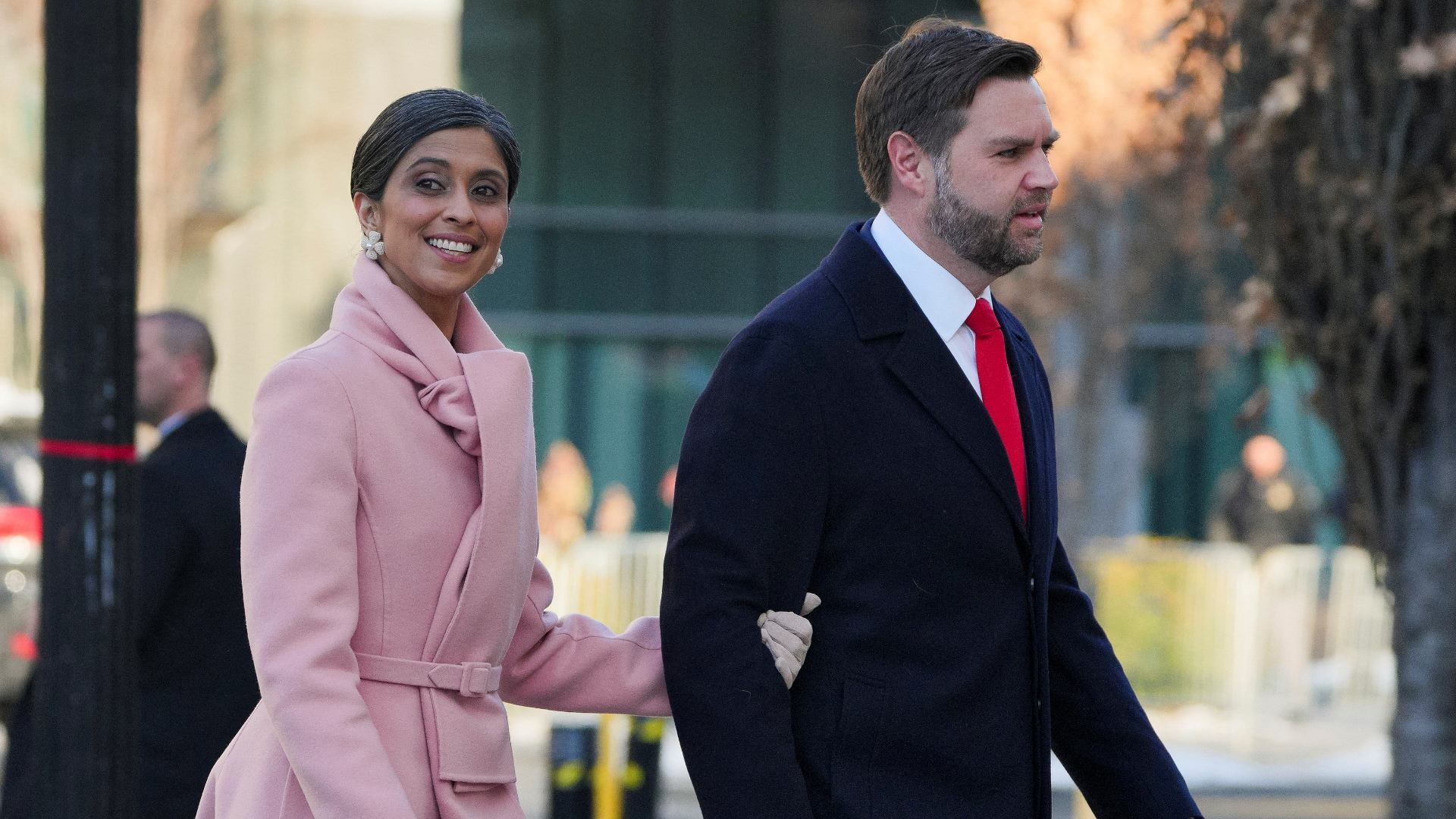
(ZENIT News / Washington, 11.03.2025).- When JD Vance took the stage before a crowd of ten thousand university students, he didn’t come to talk about politics. He came to talk about faith, marriage, and the delicate balance between conviction and love. What followed was a moment of raw honesty that has since sparked both admiration and criticism across the American cultural spectrum.
The Vice President, a Catholic convert since 2019, spoke openly about raising his children in the Catholic faith—and about his hope that his wife, Usha, who was raised in a Hindu family, might one day share his belief in the Gospel. “Most Sundays, Usha comes to church with me,” Vance said to the cheering students. “Do I hope that someday she’ll be moved by the Church the way I was? Yes, sincerely. Because I believe in the Christian Gospel. But if she doesn’t, God gives us free will, and that doesn’t trouble me.”
In an age when public figures often tread cautiously around religion, Vance’s candor stood out. It was the kind of statement that could only come from someone who has wrestled personally with belief and doubt. Before their marriage, both JD and Usha described themselves as agnostic. His conversion, which came years later, was not a political calculation but, as he tells it, the culmination of a personal journey—one that Usha supported even without sharing his faith.
The remarks, however, ignited criticism online. Some accused the Vice President of “publicly undermining” his wife’s religion for political applause. Vance’s response was swift and firm. “My Christian faith tells me the Gospel is true and good for humanity,” he wrote on X (formerly Twitter). “My wife is the greatest blessing of my life. She encouraged me to return to faith years ago. She’s not Christian, and doesn’t plan to convert—but I’ll love her, support her, and talk with her about faith and life because she’s my wife.”
🚨 JUST IN: JD Vance says he’s raising his children Christian, and he hopes his agnostic wife, Usha, comes around to the Christian faith
Vance’s 8-year-old did his first Communion «about a year ago,» and his two oldest kids go to a Christian school
«Most Sundays, Usha comes… pic.twitter.com/RuXAWOD58j
— Eric Daugherty (@EricLDaugh) October 30, 2025
For Vance, faith is not a weapon, but a language of love. He insists that wanting his wife to share his beliefs is not intolerance but care. “If I didn’t want my wife to believe in Christ,” he said, echoing the words of an online commentator who defended him, “that would make me a liar. I wish eternity with her.”
In Usha’s own retelling, the story is more practical than ideological. Speaking last summer on Meghan McCain’s podcast, she described the long, candid conversations that followed her husband’s conversion. “When JD became Catholic, we talked a lot about what that meant—especially for raising our kids,” she said. “I’m not Catholic, and I don’t plan to convert. But we decided to send our kids to a Catholic school and let them make their own choices about baptism and the sacraments.”
Their approach—marked by mutual respect and freedom—stands in quiet tension with centuries of Church teaching that once discouraged “mixed marriages.” The Catholic Church has long viewed unity of faith between spouses as ideal, not only for spiritual harmony but for the religious formation of children. Yet over time, pastoral practice has shifted. The Church now recognizes the spiritual richness that can emerge from difference—if approached with reverence, patience, and genuine dialogue.
Vance seems to embody that evolution. In his speech, he reflected not as a politician defending a position, but as a husband learning humility in the face of divine mystery. “We talk about these things,” he said. “We trust that God has a plan and try to follow it as best we can.”
Behind the headlines and online debates lies a story that many American families will recognize: a couple navigating faith, culture, and love in a pluralistic world. The Vances’ marriage mirrors the reality of countless interfaith families who find meaning not in erasing difference, but in facing it honestly.
Still, Vance’s testimony carries a distinctly Catholic undertone: the conviction that truth is not imposed but proposed, that grace works through patience, and that every act of love within marriage is itself a form of evangelization. Whether or not Usha ever embraces her husband’s faith, their partnership already embodies one of its most challenging truths—that love and conviction are not enemies, but companions on the same pilgrimage.
Thank you for reading our content. If you would like to receive ZENIT’s daily e-mail news, you can subscribe for free through this link.

Publicaciones relacionadas:
 They have quadruplets and name them after evangelists
 Resurrection: The Method of Accompaniment in Transcendent Mourning That Heals and Evangelizes
 She Was Lesbian, He Homosexual: The Inspiring Story of Tove and Bjørn Refstad” Marriage
 18 Years on Mission, in Marriage and with 10 Children (in Addition to 4 in Heaven) in An Island of the Pacific Ocean
