(ZENIT News / Madrid, 11.12.2025).- The Spanish government has unveiled the design chosen to transform one of the country’s most controversial monuments: the Valley of the Fallen, officially renamed the Valley of Cuelgamuros. The winning proposal, titled “The Base and the Cross”, envisions a dramatic reconfiguration of the vast esplanade and approach to the basilica carved into the Sierra de Guadarrama, while promising only “minimal” interventions inside the church itself.
The project, created by Pereda Pérez Arquitectos and Lignum S.L., was selected by an international jury convened by the Ministry of Housing and Urban Agenda, which praised it as the proposal that “most coherently responds to the criteria of the competition.” The design, officials say, seeks to shift the monument’s symbolic center: from stone to soil, from architecture to nature, from imposition to encounter.
“This project faces the monumental character of the existing ensemble with courage,” explained Iñaqui Carnicero, Secretary General for Urban Agenda and Architecture and president of the jury. “It proposes a new vision of the site, one that gives greater prominence to nature, breaks the rigid axiality of the original plan, and opens a fissure—a vast shadow that invites dialogue and a more plural, democratic reading of the space.”
That “fissure,” as described in the project’s documentation, will physically replace the monumental staircase that currently ascends toward the basilica’s entrance. Visitors will instead descend into a circular vestibule “open to the sky,” a threshold meant to suggest openness, humility, and reinterpretation. From there, pathways will diverge—one leading toward the basilica, another toward a new memorial zone dedicated to reflection and historical memory.
Yet beneath the architectural rhetoric lies a tension that is both aesthetic and spiritual. The Valley of the Fallen was conceived by order of General Francisco Franco as a national memorial “for all who fell in the Spanish Civil War.” Completed in 1959, it combines monumental architecture, a Benedictine monastery, and a pontifical basilica—granted that status by Pope John XXIII in 1960—where the remains of more than 33,000 combatants from both sides of the conflict rest.
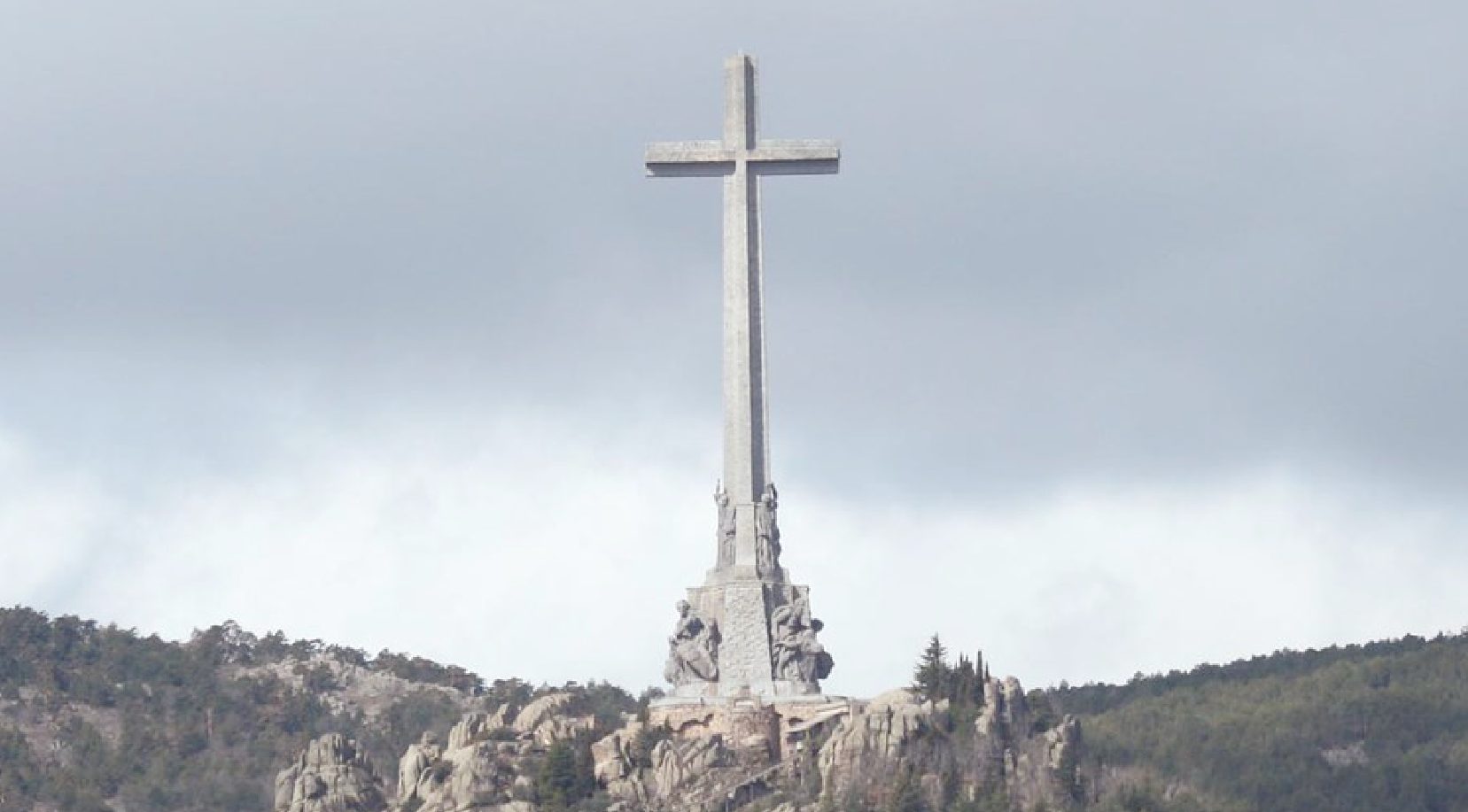
Its most visible feature, the 150-meter stone cross, dominates the landscape; at its base stand four colossal statues of the Evangelists and four of the cardinal virtues, all sculpted by Juan de Ávalos. Above the basilica entrance, his Pietà presides over the valley—a work that, like the monument itself, has been both venerated and vilified.
The government insists that these sculptures will remain untouched. “The Pietà does not appear in the model because it was not part of the scale representation,” sources close to the jury have clarified, “but there was never any discussion about its removal.” Still, their absence from the project’s official visualizations has fueled unease among many observers who suspect that “reinterpretation” may become erasure.
The debate over the future of Cuelgamuros is inseparable from Spain’s broader struggle with its past. Since the passage of the 2022 Democratic Memory Law—which ordered the exhumation of Franco’s remains and the renaming of the site—the valley has been a focal point of dispute between those who see it as a symbol of reconciliation and those who regard it as a relic of dictatorship.
For the anticlerical government of Pedro Sánchez, the “resignification” project is framed as an act of democratic renewal, a way of transforming a space long associated with Francoist triumphalism into one of inclusivity and plural memory. For critics, it represents a politically motivated desecration—a rewriting of history at the expense of faith, art, and cultural continuity.
The Archdiocese of Madrid, after months of negotiation with both the Spanish government and the Holy See, has accepted the project under strict conditions: the basilica will retain its sacred status, and the Benedictine community, which prays daily for the souls of the fallen, will remain in place. Even so, questions persist about how shared access between pilgrims and visitors will be managed once construction begins.
The timeline is ambitious. The design team has eight months to complete the technical plans, after which the works are expected to last around forty months. Bidding for construction contracts is anticipated in the latter half of 2026, with completion projected for 2030. The total cost is estimated at 31 million euros.
Thank you for reading our content. If you would like to receive ZENIT’s daily e-mail news, you can subscribe for free through this link.