

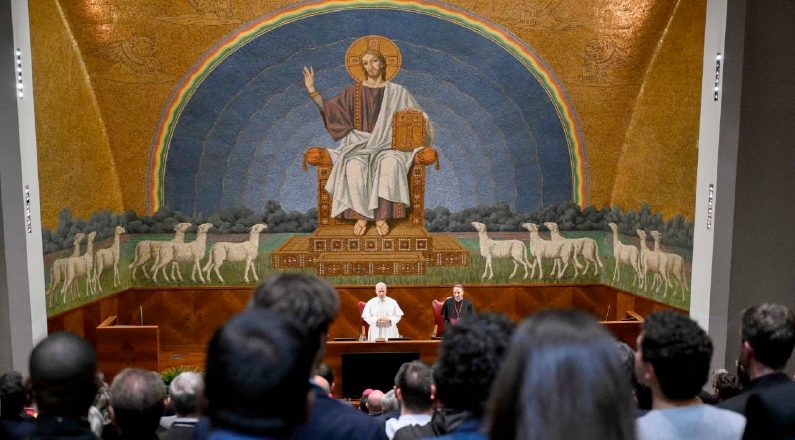
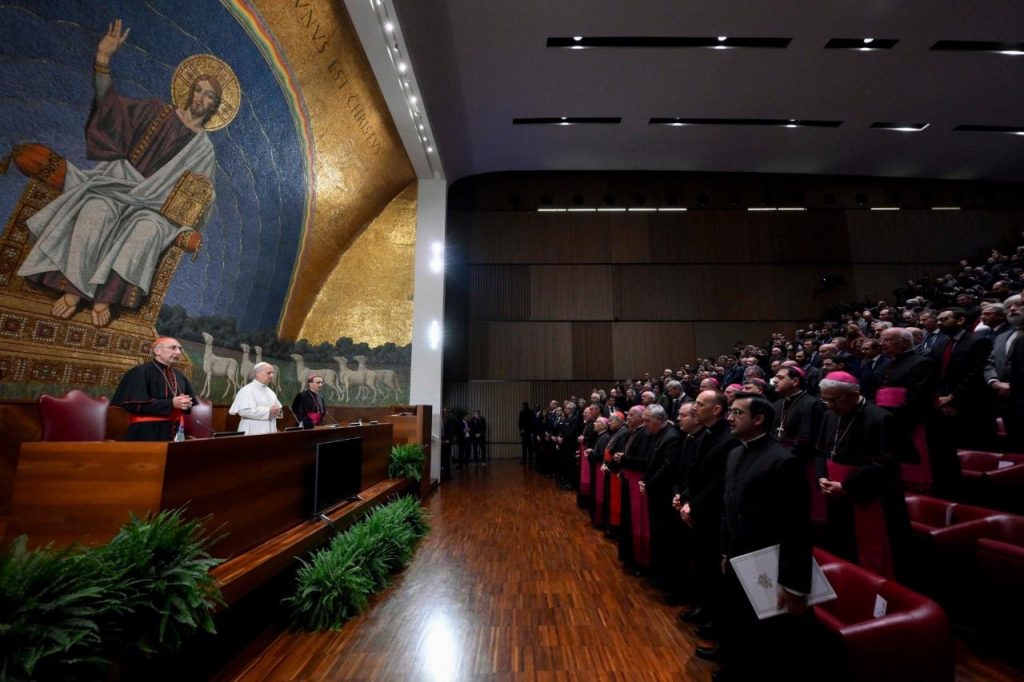
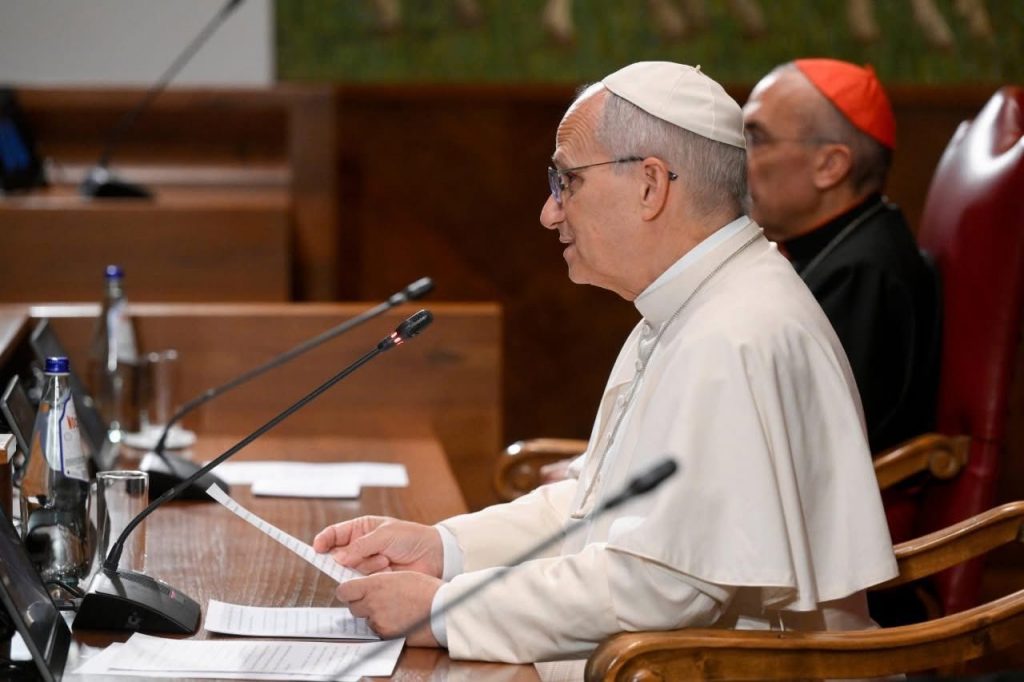
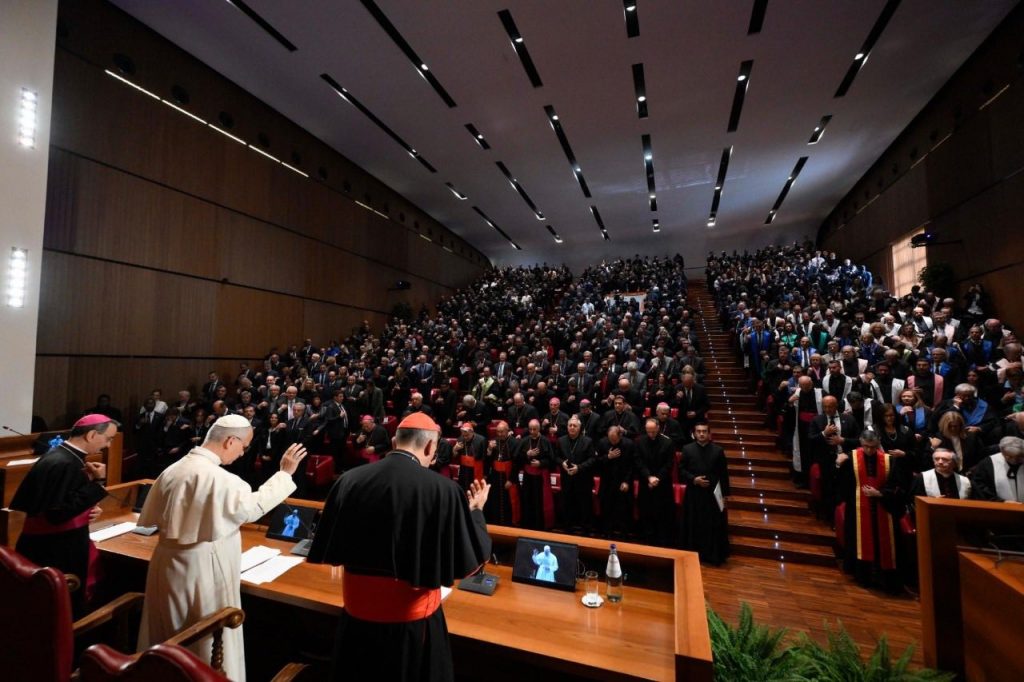
(ZENIT News / Vatican City, 11. 12. 2025) – On Friday, November 14, Pope Leo XIV visited the Pontifical Lateran University, the Pope’s University as Bishop of Rome, on the occasion of the opening session of the Academic Year. The general theme of the Pope’s lectio magistralis was «The Unique Mission of the Pontifical Lateran University in the Current Circumstances.
* * *
Dear Brothers and Sisters,
I greet the Grand Chancellor, Cardinal Reina, to whom I express my gratitude for his words; the Rector Magnificus, Monsignor Amarante; the members of the Higher Council of Coordination; the professors, the students, the support staff, and the Civil and Religious Authorities present.
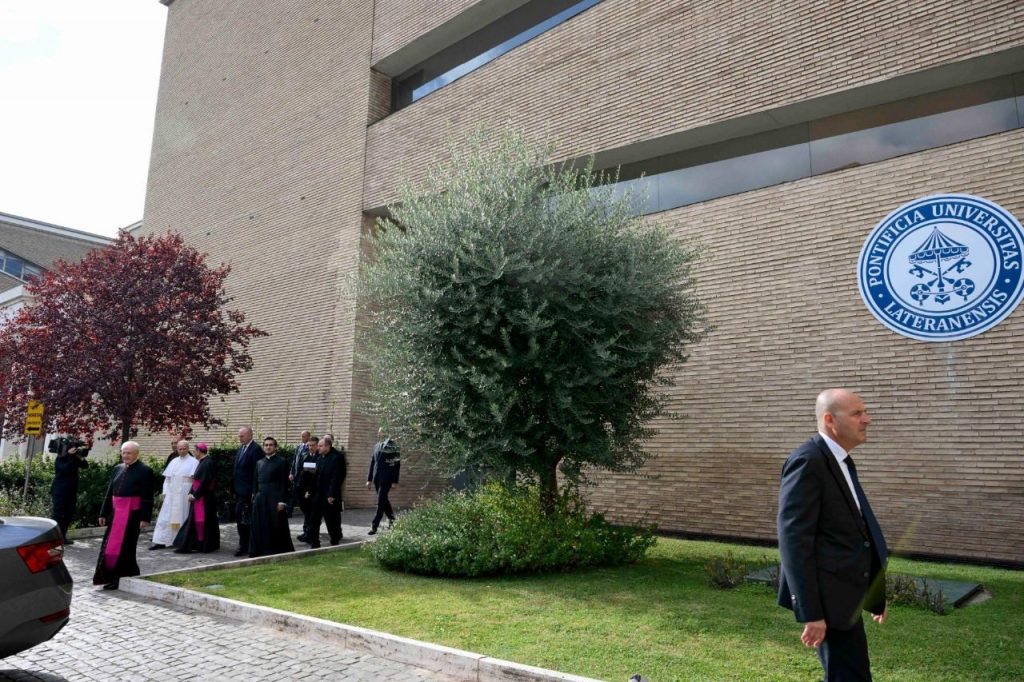
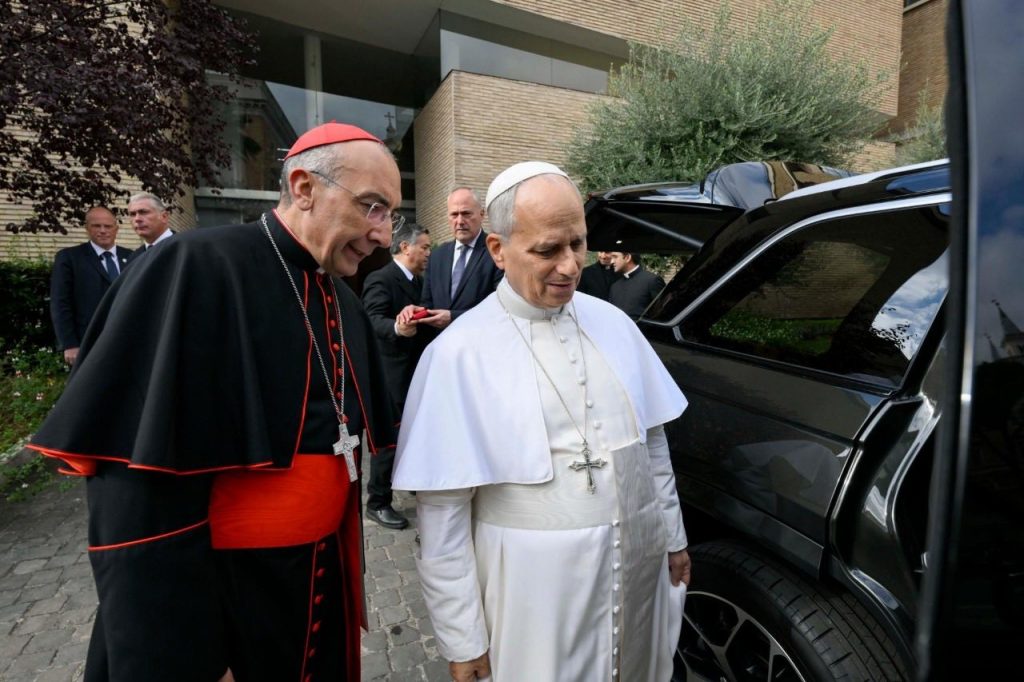
I am pleased to be here with you at the Pontifical Lateran University for the inauguration of the 253rd Academic Year since its foundation. This is a special occasion in which, while we look with gratitude at the long history that precedes us, we also look forward to the mission that awaits us, the paths to explore, and the service to offer the Church in the present reality and in the face of future challenges. A grateful look at the past, then, but also with our eyes and hearts fixed on the future, because the valuable service provided by the University is needed.
Each University, in fact, is a place of study, research, training, relationships, and links with the reality in which it is embedded. In particular, Ecclesiastical and Pontifical Universities, erected or approved by the Apostolic See, are communities in which the necessary cultural mediation of faith is developed, which, being articulated in a reflection open to dialogue with other forms of knowledge, finds its primary and perennial source in Jesus Christ.» [1]
Among academic institutions, the Lateran University has a very special bond with the Successor of Peter, and this has been a defining characteristic of its identity and mission since its origins, when in 1773 Clement XIV entrusted the Theological School of the Roman College to the secular clergy, requesting that this institution be under the Pope’s authority to train its priests. Since then, all successive Popes have maintained and strengthened a privileged relationship with what would become the present-day Lateran University. Among them, Blessed Pius IX, who established the structure, still in force, of the four Faculties: Theology, Philosophy, Canon Law and Civil Law, with the faculty to confer academic titles in both; Leo XIII, who founded the Institute of High Literature; Pius XII, who erected the Pontifical Institute of Pastoral Studies in the Athenaeum; Saint John XXIII, who conferred on the Athenaeum the title of University; and Saint Paul VI, who, already a Professor in these halls, upon visiting the University when newly elected, reaffirmed the close link between it and the Roman Curia.
This unique relationship was emphasized by Saint John Paul II: «You constitute, in a special way, the University of the Pope: a title undoubtedly honorary, but for that very reason, onerous,» he said. With equally affectionate words, this bond was reaffirmed by Pope Benedict and Pope Francis; the latter wished to establish two cycles of study: in Peace Studies and in Ecology and the Environment.
In reiterating and confirming all that was instituted and granted by my Venerable Predecessors, I am pleased to point out the unique mission of the Pontifical Lateran University in the present circumstances.
This University, unlike other illustrious academic institutions, including Roman ones, does not have a charism of its Founder to safeguard, deepen, and develop, but rather its distinctive orientation is the Magisterium of the Pope. By its nature and mission, it constitutes a privileged center in which the teaching of the universal Church is elaborated, received, developed, and contextualized. From this perspective, it is an institution to which the Roman Curia can also refer in its daily work.
At the same time, academic reflection, inspired by the Petrine charism, embraces interdisciplinary, international, and intercultural perspectives. This mission finds its differentiated application in the four Faculties and two Institutes located at this campus, and in the three Institutes ad instar facultatis, with external campuses: the Pontifical Parish Institute Augustinianum, of the Augustinians; the Pontifical Alphonsian Academy for Moral Theology Studies, of the Redemptorists; and the Pontifical Claretian Institute of Theology of Consecrated Life, of the Claretians.
To these must be added the 28 Institutes associated with various degrees on three Continents — Europe, Asia and America — both to the Faculty of Theology and to the Institutum Utriusque Iuris: a broad and differentiated reality, an expression of the richness of cultures and experiences and, at the same time, of the search for unity and fidelity to Petrine teaching.
Dear friends, today we have an urgent need to reflect on faith so that we can adapt it to current cultural contexts and challenges, but also to counteract the risk of a cultural void that, in our time, is becoming increasingly omnipresent. In particular, the Faculty of Theology is called to reflect on the deposit of faith and to bring forth its beauty and credibility in different contemporary contexts, so that it may appear as a fully human proposition, capable of transforming the lives of individuals and society, of triggering prophetic changes in relation to the tragedies and poverty of our time, and of encouraging the search for God. This mission requires that the Christian faith be communicated and transmitted in the different spheres of ecclesial life and action, and for this reason, I consider the service provided by the Pastoral Institute to be of vital importance.
At the Lateran University, the study of philosophy (cf. Veritatis Gaudium, art. 81, § 1) must be oriented toward the search for truth through the resources of human reason, open to dialogue with cultures and, above all, with Christian Revelation, for the integral development of the human person in all its dimensions. This is an important commitment, also in the face of a sometimes resigned attitude that characterizes contemporary thought, as well as in the face of emerging forms of rationality linked to transhumanism and posthumanism.
The Faculties of Canon and Civil Law, which have characterized our University for centuries, are called to study and teach Law through the broadest possible comparison between the legal systems of Civil Law and that of the Catholic Church. In particular, I encourage you to consider and study in depth administrative processes, an urgent challenge for the Church.
Finally, the cycles of studies in Peace Studies and Ecology and Environment deserve special mention, as they will gradually acquire a more defined institutional structure over the years. The topics they address are an essential part of the recent Magisterium of the Church, which, established as a sign of the covenant between God and humanity, is called to form agents of peace and justice who build and bear witness to the Kingdom of God. Peace is certainly a gift from God, but at the same time, it requires women and men capable of building it each day and of supporting, at the national and international levels, the processes toward integral ecology. Therefore, I ask my University to continue developing and strengthening these two cycles of studies at an inter- and transdisciplinary level and, if necessary, to integrate them with other pathways.
All this concerns the educational mission of the University in general, but I would also like to imagine together with you the Lateran University as a space that, as I said at the beginning, has its eyes and heart set on the future and throws itself into contemporary challenges through some particular dimensions that I will briefly underline.
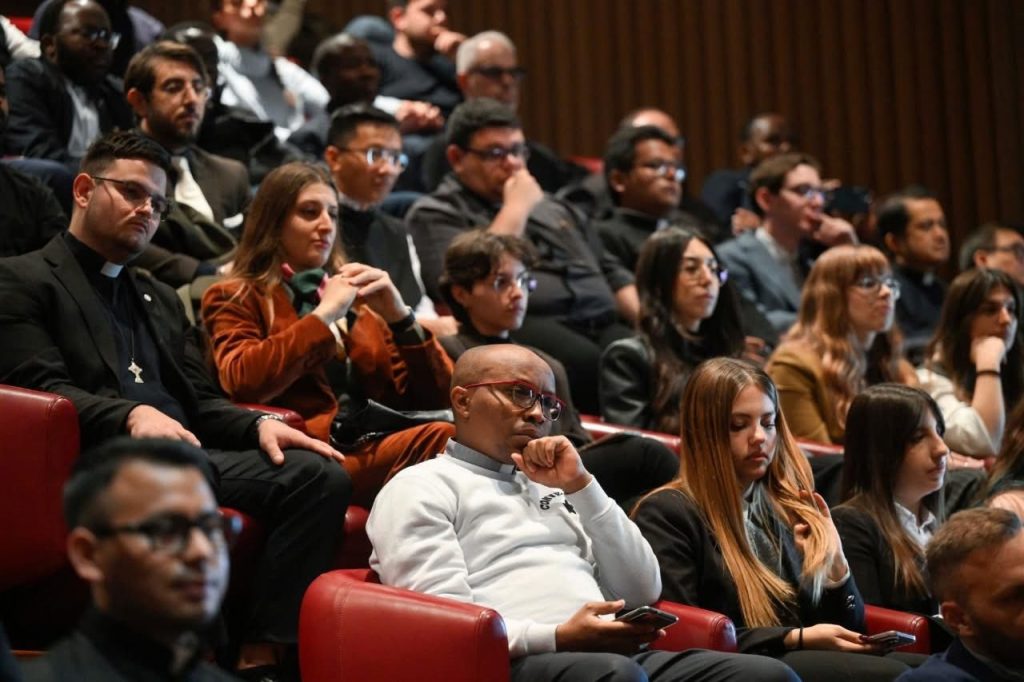
The first is this: reciprocity and fraternity must be at the heart of education. Today, unfortunately, the word «person» is often used as a synonym for «individual,» and the allure of individualism as the key to a successful life has troubling repercussions in all areas: it fosters self-promotion, cultivates the primacy of the self, and makes cooperation difficult; prejudices and walls grow toward others, particularly those who are different; responsible service is exchanged for solitary leadership; and ultimately, misunderstandings and conflicts multiply. Academic formation helps us move beyond self-referentiality and promotes a culture of reciprocity, of otherness, of dialogue. Against what the encyclical Fratelli Tutti defines as «the virus of radical individualism» (n. 105), I ask you to cultivate reciprocity, through relationships based on gratitude and experiences that foster fraternity and encounters between different cultures. The Pontifical Lateran University, notable for the presence of students, professors and staff from all five Continents, represents a microcosm of the universal Church: it is, therefore, a prophetic sign of communion and fraternity.
The second dimension I would like to mention is scientific rigor, which must be promoted, defended, and developed. Academic service often does not receive the recognition it deserves, partly due to deep-seated prejudices that, unfortunately, are also present within the eclesial community. Sometimes one encounters the idea that research and study are useless for real life, that what counts in the Church is pastoral practice rather than theological, biblical, or legal preparation. The risk is falling into the temptation of simplifying complex issues to avoid the effort of thought, with the danger that, even in pastoral action and its language, one may fall into banality, oversimplification, or rigidity.
Scientific research and the effort of inquiry are necessary. We need well-prepared and competent lay people and priests. Therefore, I urge you not to lower your guard regarding scientific rigor, carrying forward a passionate search for truth and a close dialogue with other sciences, with reality, and with the problems and difficulties of society.
This requires that the University have well-prepared faculty who are in a position — pastorally, legally, and economically — to dedicate themselves to academic life and research; that students be motivated and enthusiastic, willing to engage in rigorous study. It requires that the University engage in dialogue with other centers of study and teaching so that, from this inter- and transdisciplinary perspective, unexplored paths can be undertaken.
The third dimension I briefly mention is that of the common good. The goal of the educational and academic process should be to form individuals who, guided by gratitude and a passion for truth and justice, can build a new, compassionate, and fraternal world. The University can and should disseminate this culture, becoming a sign and expression of this new world and the pursuit of the common good.
Dearest friends, an illustrious theologian from this University, Professor Marcello Bordoni, in one of his reflections on the relationship between Christology and inculturation, affirms that it is necessary to take on the task of thinking about faith, and that «the dialogue with the world, with its changing history, which frequently provokes the faith of the Christian in the face of new problems and new situations in life, constitutes the gymnasium of this endeavour, which is the ‘effort of the concept'» (M. Bordoni, Riflessione Teologica sulla Verità della Rivelazione Cristiana, in Path 2002/2, 263).
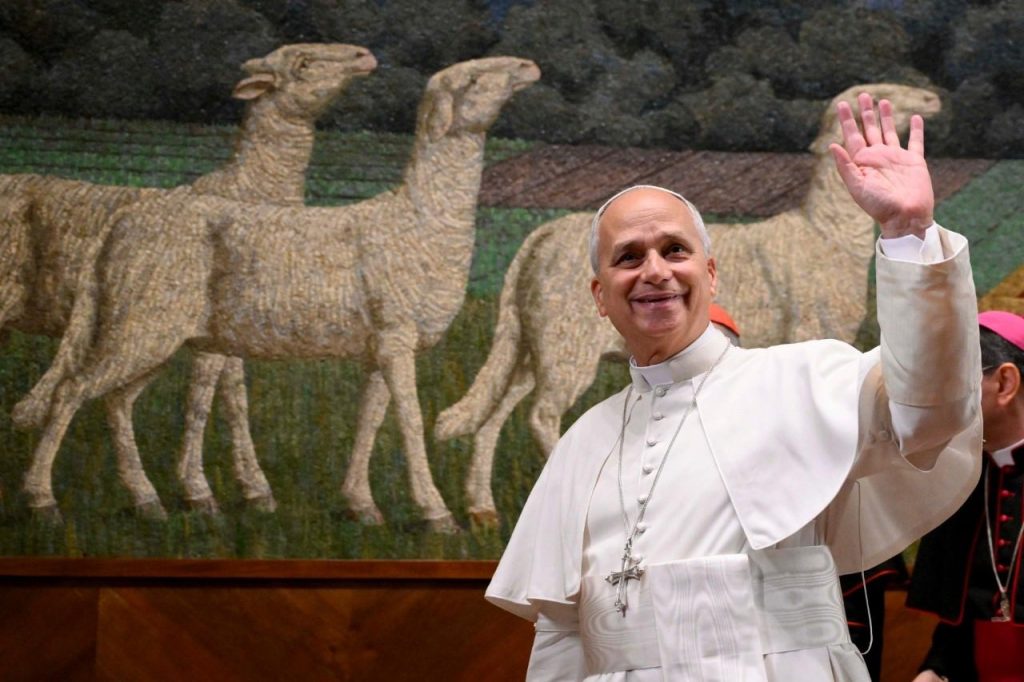
I wish you continued deepening of your understanding of the mystery of the Christian faith with this passion, and that you always exercise yourselves in the gym of dialogue with the world, with society, with the questions and challenges of today. The Lateran University holds a special place in the Pope’s heart, and he encourages you to dream big, to imagine possible spaces for the Christianity of the future, to work joyfully so that all may discover Christ and, in Him, find the fullness to which they aspire.
Thank you and happy Academic Year!
Note:
[1] Letter of the Holy Father Francis to the Bishops for the support to the Pontifical Lateran University, December 13, 2024.

Publicaciones relacionadas:
 Jubilee, Hope, and Family: Three Reflections by the Pope on the Future of the Family
 German president visits the Pope: invitation to the country, role of the Holy See in the current situation, and ecclesial life in Germany are the topics
 A New Phase in the Leonine Pontificate: Pope Reshapes His Inner Circle with a Surprising Appointment
 From the poor to artificial intelligence: this is what Leo XIV’s first encyclical and apostolic exhortation would be like
