

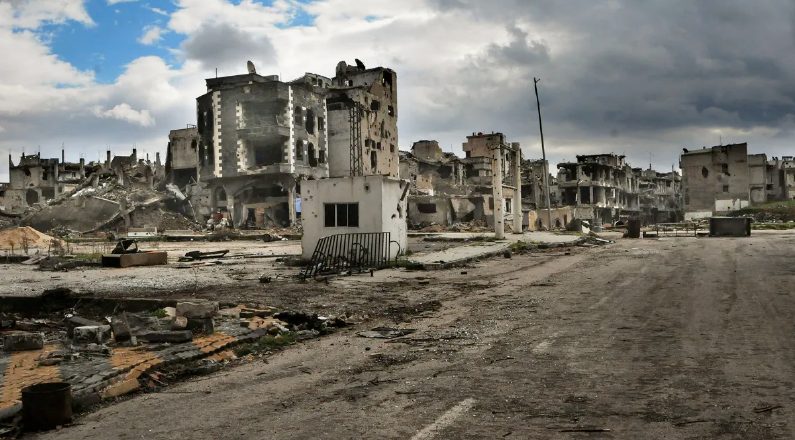
(ZENIT News / Damascus, 12.13.2025).- In the ruins left by more than a decade of war, Syria’s Christian communities are struggling not only to survive, but to be seen. A new report released on November 27 by L’Œuvre d’Orient offers a rare, ground-level portrait of their fears, resilience, and fragile hopes in a country emerging from dictatorship and conflict, yet still marked by deep uncertainty.
Compiled over months of research before and after the fall of Bashar al-Assad’s regime, the report gathers testimonies from across the country. Its message is unambiguous: Christianity in Syria remains alive, active, and socially indispensable, but it is also gravely diminished and increasingly vulnerable.
“We exist. We don’t want to die and be forgotten.” The words come from Elias, a young medical student in Damascus, speaking during a videoconference organized by L’Œuvre d’Orient with journalists. Elias is among the few Syrians expected to meet the Pope during his apostolic visit to Lebanon. His hope is simple yet profound: that Leo XIV will publicly call the world to prayer for Syria’s Christians, a community exhausted by war and unsettled by what comes next.
Others echo his unease. “We no longer feel at home in our own country,” said Firas, a parishioner from the same Damascus community. “We don’t understand why we are not accepted, especially when Christians have always tried to love everyone.” These voices, shared from within Syria itself, prompted the organization—normally focused on discreet humanitarian work—to speak out more forcefully.
Christianity has been rooted in Syria for nearly two millennia, and its institutional presence remains striking. Aleppo alone still counts nine Christian dioceses, a reminder of the country’s historic religious plurality. According to the report, Christians continue to play an outsized role in education, healthcare, disability support, and reconciliation efforts, largely through networks of associations that expanded during the war years.
Based on data gathered directly from local communities, L’Œuvre d’Orient estimates that around two million Syrians benefit from Christian-run social and humanitarian initiatives. In healthcare alone, four Christian hospitals in Damascus and Aleppo treat approximately 117,000 patients each year, regardless of religion. These facilities are widely regarded as among the country’s best, both for quality of care and for their openness to all.
Education remains another cornerstone of Christian engagement. Across Syria, churches manage 57 schools educating some 30,000 students from diverse religious backgrounds. Beyond academic instruction, these schools are often described as spaces where values of coexistence, peace, and mutual respect are still taught by example.
Yet even this work faces obstacles. Of the 67 Christian schools confiscated by the Baath Party, negotiations are underway to recover only 30. Some buildings were nationalized, others abandoned. Restoring them requires new teaching licenses and political goodwill that is not always forthcoming. In heavily damaged regions such as Deir Ezzor or Suwayda, reopening a single school could help reconnect tiny Christian minorities with the broader population and restore a minimal sense of communal life.
The demographic collapse described in the report is stark. Deir Ezzor, once home to 7,000 Christians, now counts only four. Nationwide, the war has killed more than 520,000 people, displaced millions internally, and forced around seven million into exile. While all Syrians have suffered, Christian neighborhoods—often located along front lines or targeted by Islamist groups—were hit particularly hard. In Aleppo, only about one-sixth of the pre-war Christian population remains.
Overall, an estimated 300,000 to 400,000 Christians are still in Syria. Of those who remain, more than half are over the age of 50. The community’s age structure is inverted, with far fewer young people able or willing to stay. Earthquake devastation in 2023, international sanctions, and compulsory military service accelerated an already massive exodus.
Violence has not ended with the war’s conclusion. The report documents alarming incidents under the country’s new authorities, including attacks along the coast against Alawites and, in June, an assault on the church of Mar Elias during a liturgy—an act described as unprecedented even during the height of the conflict. Comparable attacks in recent history are rare and include the 2010 massacre at Baghdad’s Our Lady of Perpetual Help church.
Christians are not alone in their fears. Druze communities have also been targeted, and insecurity has spread from Homs to Hama and Latakia. Abductions and localized violence persist, often with minimal intervention from state forces. Church leaders are now in dialogue with the transitional president in Damascus, raising concerns directly and assessing what reforms are, or are not, taking shape.
One issue causing deep anxiety is the perceived Islamization of public life. The report notes recent changes to school curricula that remove references to pre-Islamic deities and include language portraying Jews and Christians as being “in error.” Such developments, church representatives warn, undermine pluralism and risk reigniting sectarian tensions.
In response, L’Œuvre d’Orient calls for swift and concrete action. Among its recommendations are the creation of justice and reconciliation mechanisms accessible to all Syrians, a national platform for intercommunal dialogue inspired by initiatives like the Mar Moussa monastery, and international funding structures dedicated to protecting ethnic and religious diversity. A proposed fund, potentially supported by the European Union, would help sustain the public services largely provided today by Christian communities with church-based funding alone.
“These proposals are meant to send a positive signal to partners who feel abandoned,” said Vincent Gélot, the organization’s mission director for Syria and Lebanon. “We cannot control the country’s security forces, but something can still be done. The very existence of these communities is at stake.”
For Syria’s Christians, survival is no longer only a question of rebuilding churches or schools. It is about whether a plural, shared future remains possible—and whether the world is still willing to care before another ancient presence fades into silence.
Thank you for reading our content. If you would like to receive ZENIT’s daily e-mail news, you can subscribe for free through this link.

Publicaciones relacionadas:
 USA: 300th Catholic Church Attacked Since 2020
 After 112 vandalized churches, Canada ends funding for research on Catholic school tombs
 500 Attacks on U.S. Catholic Churches since May 2020 to 2025
 American missiles, persecuted Christians, and a country that cannot protect them: why did Trump bomb part of Nigeria?
