

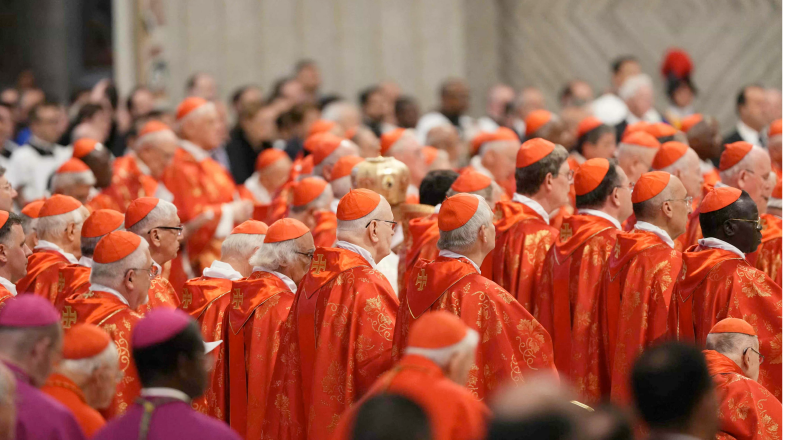
(ZENIT News / Rome, 12.22.2025).- Early January 2026 will bring decisive moment for the Catholic Church. Pope Leo XIV has summoned the entire College of Cardinals to Rome for two days of meetings on 7 and 8 January, a gesture that signals far more than a routine gathering. Coming immediately after the conclusion of the Holy Year on the Solemnity of the Epiphany, the consistory will mark the first structured effort by the new pope to shape his own way of governing the universal Church.
The announcement, confirmed on 20 December by the Holy See Press Office, puts an end to weeks of speculation in Vatican circles. Until now, Leo XIV’s first months have been largely absorbed by the demanding rhythm of the Jubilee: encounters with pilgrims, special liturgies, and audiences tied to the Holy Year’s calendar. Alongside this public schedule, he has also been working through unfinished business inherited from the long pontificate of Pope Francis. That combination left little space for articulating a personal vision of governance.
The January consistory changes the tone. For the first time since his election on 8 May 2025 as the first pope with American and Peruvian roots, Leo XIV is formally inviting the world’s cardinals to assist him in discernment. The decision is noteworthy not only for its timing, but also for its scope: all cardinals able to travel have been called, underlining the pope’s desire to hear voices from across continents and ecclesial cultures.
According to the Vatican’s statement, the gathering will be deliberately consultative. There will be no creation of new cardinals and no ceremonial agenda. Instead, the days will be structured around prayer, reflection and open exchange, with the explicit aim of supporting the pope in what the communiqué describes as his “high and demanding responsibility” in governing the Church. The emphasis on fraternity and shared discernment suggests a leadership style that seeks breadth rather than reliance on a small inner circle.
This represents a subtle but real shift from the previous pontificate. Pope Francis made limited use of consistories as instruments of governance, preferring instead to rely on a compact group of trusted advisers, notably the Council of Cardinals. Leo XIV’s choice to convene the full College at such an early stage indicates a willingness to reactivate a more traditional, collegial mechanism, without abandoning the pastoral priorities that have shaped the Church in recent decades.
While the Holy See has not officially confirmed the agenda, Italian media report that three broad areas are likely to frame the discussions: the governance of the Church, the future of synodality, and questions surrounding liturgy. If these themes are indeed addressed, the consistory could offer important clues about how Leo XIV intends to balance continuity with recalibration, particularly at a time when debates over authority, participation and worship remain sensitive across the global Church.
The context adds further symbolic weight. The consistory will follow immediately after the closing of the Holy Door at St Peter’s Basilica, bringing the Jubilee to an end. That sequence suggests a deliberate transition: from a year marked by pilgrimage and hope to a phase focused on internal discernment and strategic direction. A Mass expected on 8 January would underscore the spiritual framing of the encounter.
In Vatican terms, a consistory is more than a meeting. Its very name, drawn from the Latin consistere, evokes the act of standing together. By choosing this format at the threshold of a new year, Leo XIV appears to be defining the start of his pontificate not through decrees or grand speeches, but through listening. For a pope still being closely observed by bishops and faithful alike, the January gathering may well prove to be the moment when his leadership begins to take a clearer and more personal shape.
Thank you for reading our content. If you would like to receive ZENIT’s daily e-mail news, you can subscribe for free through this link.

Publicaciones relacionadas:
 Pope Leo to bishops on pilgrimage to Rome: “take special care of priests, your first collaborators”
 Abuse, Social Media, Synod, Seminaries, Mission… This Is What Pope Leo XIV Addressed During a Meeting with New Bishops
 Pope Leo XIV: yes to synodality, but without undermining the authority of the bishop
 Pope Leo XIV accepts resignation of bishop whom Pope Francis appointed cardinal, but who “did not want” to receive the appointment
