

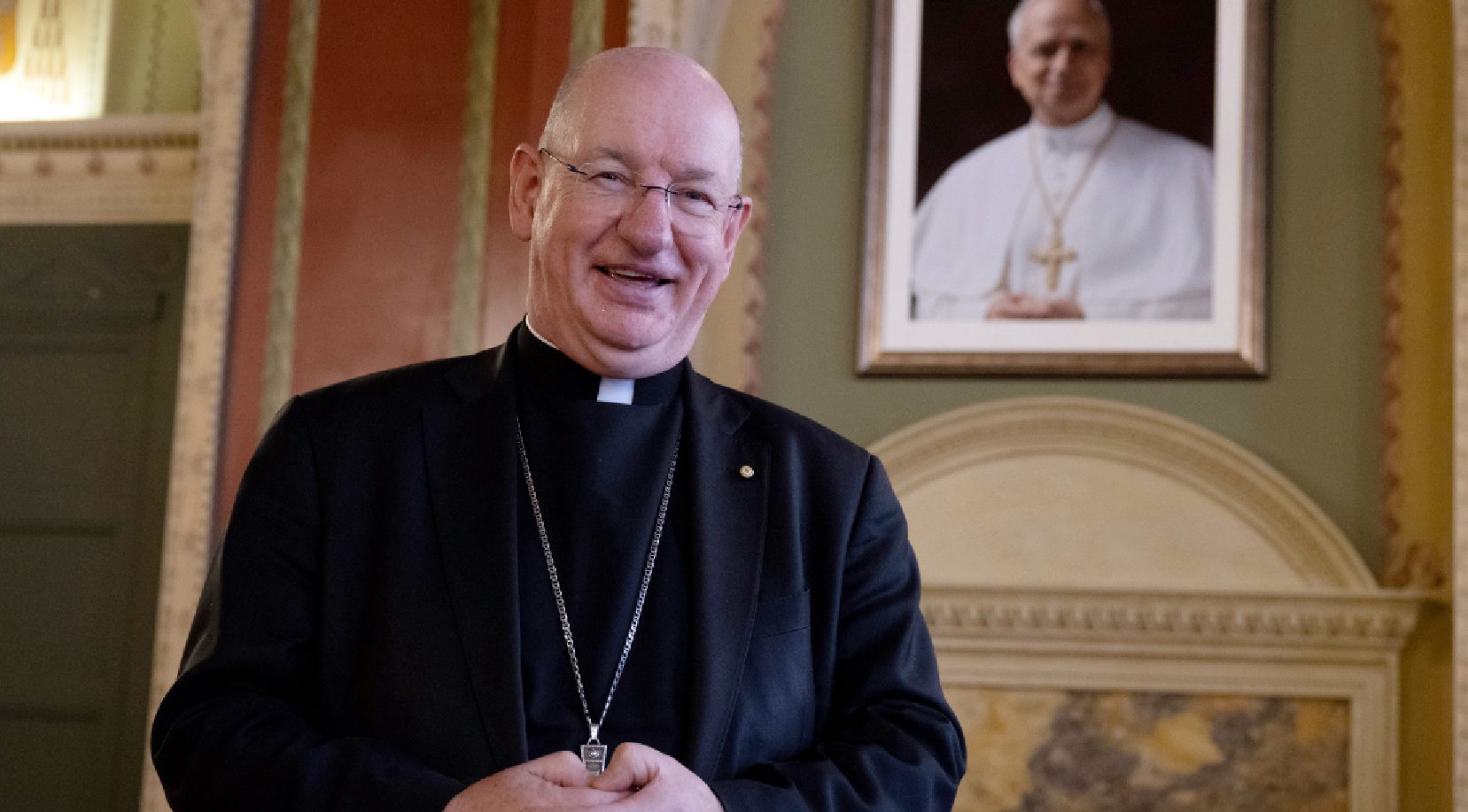
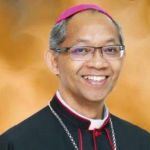
(ZENIT News / London, 12.22.2025).- The Catholic Church in England and Wales is preparing for a generational handover at its most visible see. Pope Leo XIV has appointed Bishop Richard Moth as the next Archbishop of Westminster, entrusting him with pastoral leadership of the country’s largest and most influential Catholic diocese. The announcement, made on 19 December, sets the stage for a transition that combines continuity with a distinctly pastoral and socially engaged profile.
At 67, Moth will become the twelfth Archbishop of Westminster, succeeding Cardinal Vincent Nichols, who has led the diocese since 2009 and now steps aside after reaching the customary age of retirement. Nichols will remain apostolic administrator until Moth’s installation at Westminster Cathedral on 14 February 2026, a date that also carries strong symbolic resonance in the Church’s calendar.
Moth arrives in Westminster after a decade as Bishop of Arundel and Brighton, a diocese marked by both historic Catholic presence and contemporary pastoral challenges. Before that, his ministry took him into one of the Church’s most demanding environments: from 2009 to 2015 he served as Bishop of the Armed Forces, accompanying military personnel and their families across the world, including deployments in active conflict zones. That experience shaped a bishop accustomed to moral complexity, institutional pressure and the need for quiet, steady leadership.
In his first public words following the appointment, Moth signalled a style rooted more in listening than in grand gestures. He spoke of his desire to meet the priests and people of Westminster personally, and to build patiently on the foundations laid by his predecessors. His language reflected a view of the Church as a shared pilgrimage rather than a centrally managed structure, a theme that has recurred throughout his ministry.
Born in 1958 in Chingola, in what was then Northern Rhodesia and is now Zambia, Richard Moth grew up in Kent after his family returned to England. His vocation emerged early, influenced by parish life and a priest whose personal holiness left a lasting impression. He entered St John’s Seminary in Wonersh as a teenager and was ordained a priest for the Archdiocese of Southwark in 1982. Alongside parish ministry, he pursued advanced studies in canon law in Ottawa, work that later led him into diocesan governance and tribunal service.
For nearly a decade, he served as private secretary to Archbishop Michael Bowen, gaining close insight into episcopal leadership and ecclesial administration. Subsequent roles as vicar general and chancellor of Southwark confirmed his reputation as a reliable administrator, able to combine legal precision with pastoral sensitivity. That balance would later recommend him for episcopal appointment.
Beyond formal governance, Moth has been a consistent voice on social questions within the bishops’ conference. As chair of its department for social justice and as liaison bishop for prisons, he has engaged directly with issues such as penal reform, migration, family policy and the dignity of work. He has argued repeatedly that Catholic social teaching must be more than a theoretical framework, insisting it should shape concrete responses to poverty, exclusion and injustice.
His new role places him at the heart of a Church facing both difficulty and cautious signs of renewal. Westminster serves around 450,000 Catholics across north London and Hertfordshire, a community marked by striking ethnic and cultural diversity. While declining vocations and pressure on clergy remain serious concerns, recent research has suggested a modest resurgence in church attendance among younger adults, a trend that many will watch closely during Moth’s tenure.
Observers note that Moth was not initially considered an obvious successor to Cardinal Nichols. Yet his broad experience, links with British civic institutions and reputation for steady leadership appear to have weighed heavily in his favour. He follows a familiar path from Arundel and Brighton to Westminster, one previously taken by Cardinal Cormac Murphy-O’Connor, and some suggest his mandate could similarly extend over the next decade.
Personally reserved, Moth is known to value endurance over visibility. He has spoken candidly about stamina as one of his few standout gifts, and those who have worked with him describe a man more inclined to persistence than to rhetoric. Outside his episcopal duties, he finds renewal in walking, riding and time spent as an oblate of Pluscarden Abbey, a Benedictine monastery in Scotland.
The appointment of Richard Moth signals a choice for continuity anchored in lived pastoral experience. His challenge will be to sustain a Catholic presence that is intellectually credible, socially engaged and spiritually rooted, in a city and a society where the Church’s voice must constantly learn how to be heard anew.
Thank you for reading our content. If you would like to receive ZENIT’s daily e-mail news, you can subscribe for free through this link.

Publicaciones relacionadas:
 Leader of Ukrainian Catholics visits the Pope and invites him to Ukraine: “his visit would contribute to stop the war”
 These are the first countries Pope Leo would visit according to Cardinal Sturla’s statements
 Pope Leo XIV avoids schism, ends mission of bishop in liturgical dispute in India
 Pope Leo XIV accepts resignation of bishop whom Pope Francis appointed cardinal, but who “did not want” to receive the appointment
