

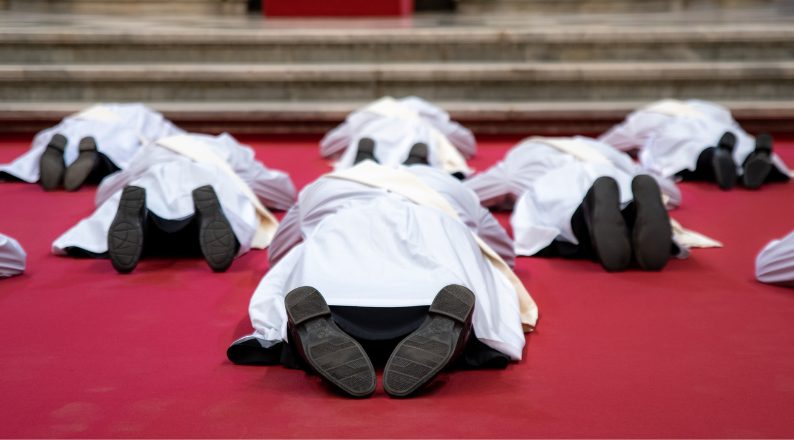
(ZENIT News / London, 12.24.2025).- The latest figures on priestly ordinations in England and Wales offer a picture that is neither one of collapse nor of renewal, but of a Church hovering on a narrow ridge between stabilization and further decline. After a modest uptick in 2024, new projections suggest that the brief improvement may prove temporary, reinforcing long-standing anxieties about the sustainability of clerical life across much of the region.
In 2024, the Catholic dioceses of England and Wales, together with the Personal Ordinariate of Our Lady of Walsingham, recorded 22 priestly ordinations, two more than the previous year. Spread across 22 dioceses and the Ordinariate, the number is modest, yet symbolically significant for a Church that saw vocations fall sharply from the late 1990s onward. Over the past quarter-century, annual ordinations have largely settled around the low twenties, with occasional spikes linked to former Anglican clergy entering Catholic ministry.
Projections published by the National Office for Vocation in late December, however, point to renewed contraction. The number of ordinations is expected to fall to 14 in 2025, rise slightly to 17 in 2026, and then drop again to 14 in 2027. Behind these national averages lie stark local contrasts and, in some cases, deep concern.
Few voices have captured that concern more vividly than Bishop Philip Egan of Portsmouth. In a recent pastoral letter, he noted that his diocese lost ten priests to death in a single year while ordaining only one. For the first time, he warned, Portsmouth may send no new candidates to seminary at all. The imbalance between loss and replacement, he suggested, is no longer a distant threat but a lived reality.
Portsmouth’s experience is not unique. Ten dioceses recorded no priestly ordinations in 2024, and five are projected to have none at all between 2025 and 2027: Hexham and Newcastle, Menevia, Middlesbrough, Nottingham, and Wrexham. These gaps are increasingly shaping decisions at the highest levels of Church governance.
In December, Pope Leo XIV accepted the resignation of Bishop Terence Drainey of Middlesbrough upon reaching retirement age. Rather than appointing a successor, the pope named Bishop Marcus Stock of neighboring Leeds as apostolic administrator. In a message to the faithful, Stock spoke openly about exploring closer cooperation between the two historic dioceses, language that many interpreted as a cautious step toward eventual structural union. Similar logic has already prevailed elsewhere: last year, the Diocese of Menevia was formally merged with the Archdiocese of Cardiff to form the new Archdiocese of Cardiff-Menevia.
Ironically, these institutional consolidations come at a time when interest in priestly formation shows tentative signs of life. In 2024, 25 men entered priestly formation in England and Wales, the highest number since 2020. The total number of seminarians rose to 117, up from 110 the previous year. Those entering are not, on average, young school-leavers: the mean age for entry into diocesan seminary stood at 33.4, with candidates for the preparatory year averaging just over 29. This older profile reflects a pattern seen across much of Western Europe, where vocations increasingly emerge from adult discernment rather than adolescence.
Alongside the priesthood, the permanent diaconate continues to expand quietly. In 2024, 24 new permanent deacons were ordained, and 110 men were in formation, a notable increase from the previous year. With an average entry age above 50, the diaconate has become a significant pastoral resource, particularly in dioceses struggling to staff parishes with priests. Forecasts suggest that new diaconal ordinations will peak at 38 in 2026 before declining again.
Leadership changes are also reshaping the ecclesial landscape. On December 19, Pope Leo XIV appointed Archbishop-elect Richard Moth as the new Archbishop of Westminster, succeeding Cardinal Vincent Nichols and effectively placing him at the helm of the Church in England and Wales. Moth arrives in Westminster after leading the Diocese of Arundel and Brighton, itself a diocese that enjoyed a brief run of ordinations in 2024 and 2025 but is projected to have none in the two years that follow.
Even Westminster, the country’s largest and most visible diocese, reflects the broader fragility. Serving roughly 450,000 Catholics, it ordained two priests in 2025 but expects only one per year in 2026 and 2027. Liverpool, with four ordinations in 2024, led the national tally, followed by Westminster and the Ordinariate, each with three—figures that underline how concentrated vocations have become.
Taken together, the data suggest that the Church in England and Wales may have reached a demographic plateau rather than a turning point. The flow of candidates into formation offers some reassurance, but the projected ordination numbers and the growing number of dioceses without new priests point to structural strain. Mergers, shared leadership, and expanded reliance on permanent deacons are no longer theoretical options but practical responses to a changing reality.
Whether this fragile equilibrium can be sustained will depend less on short-term fluctuations than on the Church’s ability to foster vocations in a secularized culture while reimagining pastoral life with fewer priests. For now, the figures tell a restrained but unmistakable story: stability, where it exists, remains vulnerable, and the future shape of Catholic ministry in England and Wales is still very much in flux.
Thank you for reading our content. If you would like to receive ZENIT’s daily e-mail news, you can subscribe for free through this link.

Publicaciones relacionadas:
 UK: Three new priests for the Diocese of Westminster
 African seminary with almost 800 students celebrates 100 years by ordaining 40 deacons
 1 in 20 new priests by 2025 in the U.S. come from the military. Research reveals surprising facts
 The Seminary with the Most Seminarians in the World (700) Dedicated to a French Laywoman
