

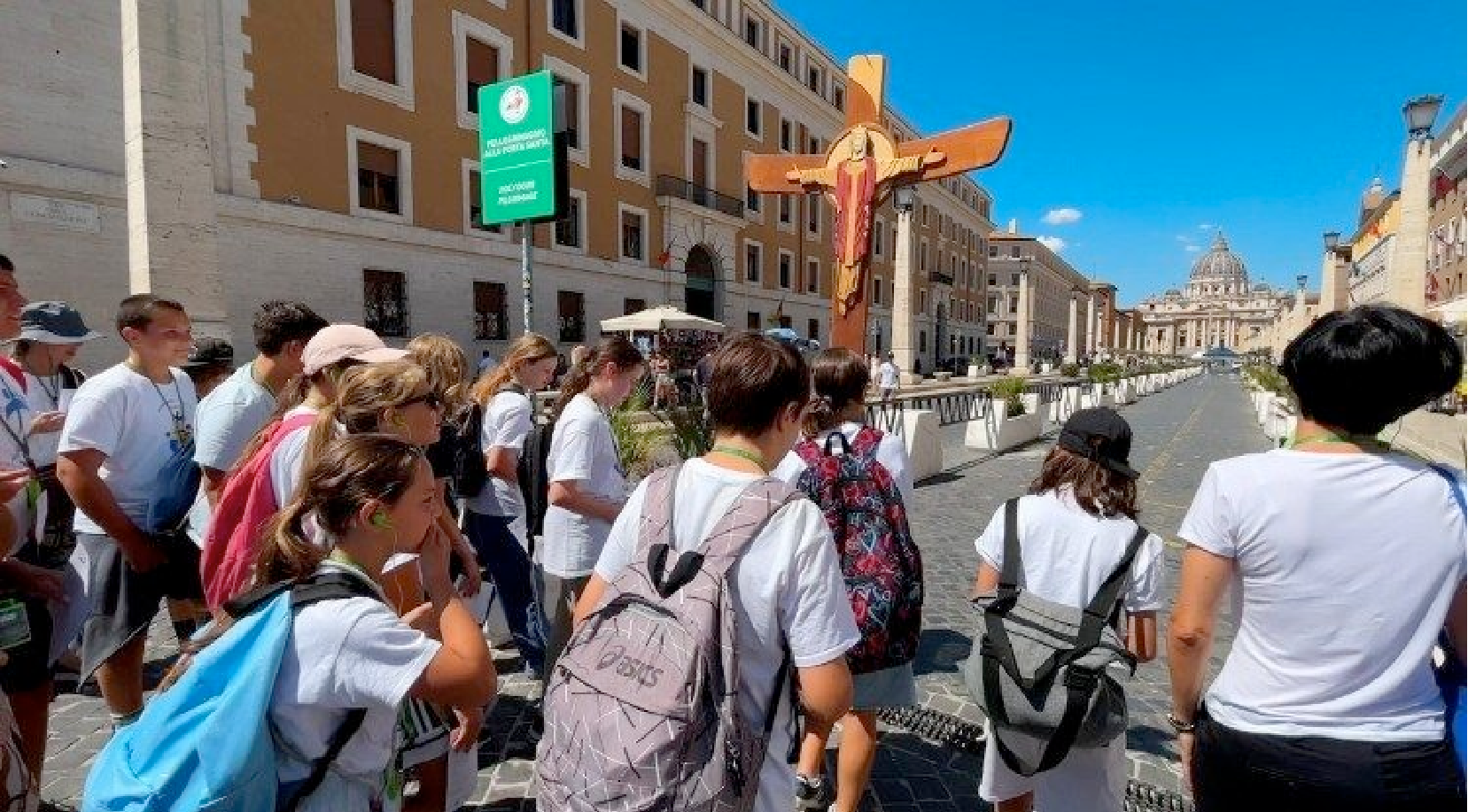
(ZENIT News / Vatican City, 01.05.2026).- Rome has rarely seen a year like this one. The Vatican has confirmed that 33,475,369 pilgrims from 185 countries took part in the Jubilee of Hope, making the Holy Year 2025 one of the largest religious gatherings in modern history. The figure does not merely surpass expectations; it decisively overtakes them. A study by Roma Tre University had forecast just over 31 million participants, later refined to 31.7 million. Reality went well beyond those projections.
The scale of the event was outlined on 5 January, on the eve of the Jubilee’s conclusion, during a press conference at the Holy See Press Office. Archbishop Rino Fisichella, pro-prefect of the Dicastery for Evangelization and chief organizer of the Holy Year, presented the final assessment alongside Italian civil authorities who repeatedly referred to what they now call the “Jubilee method” of cooperation.
Europe accounted for the majority of pilgrims, with 62 percent arriving from the continent. Italy ranked first by country of origin, followed by the United States and Spain. Yet the geographical reach was unmistakably global, reflecting what organizers described as “the whole world” coming to Rome.
Numbers, however, only tell part of the story. The Jubilee calendar featured 35 major events, but Fisichella insisted that neither attendance figures nor programming alone capture the deeper meaning of the year. According to him, the defining feature was spiritual renewal. He described a “people on the move” marked by a renewed desire for prayer and conversion. Papal basilicas and other key sites of devotion across Rome experienced unprecedented crowds. The Scala Santa, among other shrines, saw record attendance. Confessions increased significantly, and the Jubilee indulgence, the central spiritual sign of the Holy Year, was widely received.
Behind the scenes, the Jubilee relied on a vast human network. A total of 5,000 volunteers served throughout the year, complemented by 2,000 members of the Order of Malta who provided first aid services at the four papal basilicas. Their contribution, Fisichella noted, was particularly meaningful at a time marked by growing individualism.
Italian authorities highlighted the administrative framework that made the event possible. Alfredo Mantovano, undersecretary of state to the Italian prime minister’s office, explained that the “Jubilee method” meant coordination rather than control, problem-solving rather than bureaucracy, and shared responsibility rather than competition. He described it as a system where public institutions placed themselves at the service of a spiritual experience rather than overshadowing it.
Rome’s mayor, Roberto Gualtieri, who also served as the government’s extraordinary commissioner for the Jubilee, emphasized that the influx of pilgrims did not overwhelm the city. On the contrary, he said, it acted as an engine for renewal. Rome maintained its capacity to welcome tourists and serve residents, while hosting millions seeking the Jubilee indulgence. He singled out the event at Tor Vergata as a moment destined to remain etched in the city’s collective memory.
From a regional perspective, Lazio president Francesco Rocca pointed to the operational impact on public services. Emergency medical services handled 580,000 interventions during the Jubilee year, an increase of 40,000 compared to the previous year. Emergency room admissions reached 1,600,000, which is 100,000 more than in 2024. Rocca attributed the smooth functioning of services to a collaborative climate that favored calm over rivalry.
Security was another key concern. Rome prefect Lamberto Giannini explained that the guiding principle was to ensure both safety and serenity. Rather than heavy militarization, authorities focused on prevention. Giannini recalled the Jubilee of Young People as particularly striking, especially the confessional stations set up in the Circus Maximus, an image he said would remain unforgettable.
The Vatican acknowledged that the figure of 33,475,369 pilgrims is an estimate rather than an exact count. It was calculated by combining official registrations for Jubilee events, manual crowd counts at Rome’s major basilicas, and closed-circuit television data from St. Peter’s Basilica. Cameras recorded between 25,000 and 30,000 people per day crossing the threshold of the Holy Door.
Attendance also rose steadily after the death of Pope Francis in April and the election of Pope Leo XIV. This transition made the Jubilee of Hope only the second in Church history to be opened by one pope and closed by another. The first occurred in 1700, when Pope Innocent XII inaugurated the Holy Year and Pope Clement XI concluded it following Innocent’s death.
Beyond people, the Jubilee reshaped the city itself. Of the 117 public works projects initially linked to the Holy Year, 110 have been completed. The most ambitious was the creation of a pedestrian square at the end of Via della Conciliazione, directly facing St. Peter’s Basilica. The project required diverting traffic into an underground tunnel and resulted in the new Piazza Pia.
The square also revealed one of the few moments of open disagreement between organizers. Its design includes two contemporary stone fountains framing the view toward the basilica. Gualtieri favored them; Fisichella did not. The archbishop later recounted, with humor, that this was likely the only point where they openly differed, ultimately conceding because the square lies on Italian territory. Fisichella questioned whether modern fountains were appropriate in a space overlooking the baroque grandeur of St. Peter’s and the Fascist-era architecture of Via della Conciliazione, itself created by demolishing an entire neighborhood for the Jubilee of 1950.
As the Holy Door closes, organizers insist that the Jubilee’s true legacy is not confined to statistics or infrastructure. For Fisichella, the lasting outcome is hope itself, rekindled in millions of lives and projected toward a future marked, in his words, by peace and serenity.
Thank you for reading our content. If you would like to receive ZENIT’s daily e-mail news, you can subscribe for free through this link.

Publicaciones relacionadas:
 Pope and Priests From a Sector of Rome Talk About Prisoners, Women in the Formation of Priests and the Forthcoming Jubilee
 Will “Holy Doors” Be Opened Outside of Rome for the Jubilee 2025? The Vatican Answers
 What Days Will Masses with the Pope Be Held in June 2025? The Vatican Releases Its Official Calendar.
 “We cannot and do not want to forget”: Pope Leo XIV at ecumenical celebration for martyrs and witnesses of the faith
