

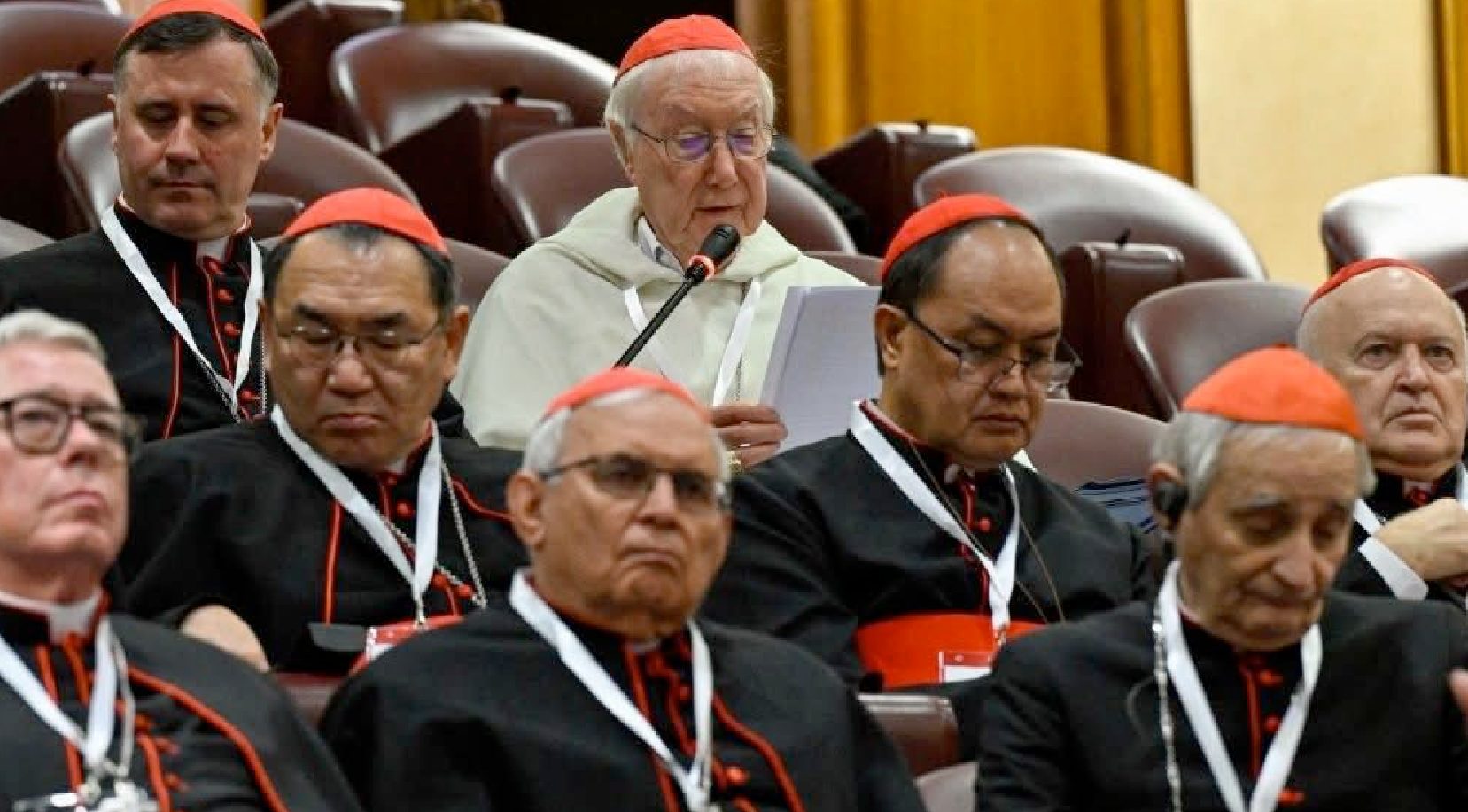
(ZENIT News / Vatican City, 01.07.2026).- Below is the English translation of the meditation given on the afternoon of Wednesday, January 7, to the cardinals participating in the Consistory by Cardinal Timothy Radcliffe, O.P.
***
A reading from the Holy Gospel according to Saint Mark
(6:45–52)
After the five thousand had eaten and were satisfied, Jesus made his disciples get into the boat and precede him to the other side toward Bethsaida, while he dismissed the crowd. And when he had taken leave of them, he went off to the mountain to pray. When it was evening, the boat was far out on the sea and he was alone on shore. Then he saw that they were tossed about while rowing, for the wind was against them. About the fourth watch of the night, he came toward them walking on the sea. He meant to pass by them. But when they saw him walking on the sea, they thought it was a ghost and cried out. They had all seen him and were terrified. But at once he spoke with them, “Take courage, it is I, do not be afraid!” He got into the boat with them and the wind died down. They were completely astounded. They had not understood the incident of the loaves. On the contrary, their hearts were hardened.
***
We are gathered in this Consistory to be of help to the Holy Father in the exercise of his ministry to the Universal Church. How are we to do that? Tomorrow Pope Leo will preach on the gospel of the day, the feeding of the five thousand in St. Mark. It was suggested that the text which follows, Jesus walking on the water, gives us some clues as to our task.
Jesus commanded the disciples to get into the boat and go before him. Peter must not go into the storm alone. This is our first obedience, to be in the barque of Peter, with his successor, as he faces the storms of our times. We cannot remain on the beach saying ‘Myself, I would not go sailing today.’ Or ‘I would choose a different boat’. Jesus is alone on the mountain but Peter must not be unaccompanied.
John writes that: ‘if we love one another, God abides in us and his love is perfected in us.’ If the boat of Peter is filled with disciples who quarrel, we shall be of no use to the Holy Father. If we are peace with each other in love, even when we disagree, God will indeed be present even when he seems to be absent.
In the storm, Jesus is a long way off on the mountain but, the gospel says, ‘he saw that they were making headway painfully.’ His eye is always on them. It is as if Jesus wishes them to experience his apparent absence. He takes his time. He waits until they are almost exhausted. This experience of absence prepares them for an intimacy they could never have imagined. He gets into the boat with them.
Sometimes we too shall feel alone, burnt out exhausted. But Jesus is watching and will come closer to us than ever before. So we need not be afraid. We live in a time of terrible storms too, of growing violence, from knife crime to war. The chasm between the rich and the poor is every wider. The world order which came into being after the last world war is breaking down. We have no idea of what Artificial Intelligence will yield. If we are not nervous, we ought to be.
The Church herself is shaken by her own storms, of sexual abuse and ideological division. The Lord commands us to sail out into these storms, and face them truthfully, not timidly waiting on the beach. If we do so in this Consistory, we shall see him coming to us. If we hide on the beach we shall not encounter him.
Mark gives us a strange detail: ‘he meant to pass by them.’ The Greek word for ‘passing by’ is connected with dying, as it is in English when we talk of someone ‘passing away’. We see the pattern of Holy Week. A shared meal, the feeding of the 5000; the absence of Jesus, and his sudden appearance. Already on the Sea of Galilee the disciples are living in anticipation the death and resurrection of the Lord. It will be repeated after the feeding of the four thousand.
In Mark, the Resurrection is both utterly new and to be relived again and again, as we do so in the Liturgical Year. In Evangelli Gaudium we read of how the Christian life is sustained by memory and by God’s inexhaustible newness. Augustine says that God is always younger than we are!
In the Consistory some of us will be champions of memory, cherishing the tradition. Others will delight more in God’s surprising newness, but memory and newness are inseparable in the dynamic of Christian life. So our discussions will come alive if we are both rooted in our memory of the great things the Lord has done and open to his ever fresh newness. There is no competition.
The disciples were ‘utterly astounded for they did not understand about the loaves for their hearts were hardened.’ In the Bible, the heart is the seat of thinking rather than emotions which were in the bowels. As one of my brethren said, everything happens 50 centimetres lower in the Bible.
The disciples had fed the five thousand but they were stuck in the old logic of calculation. All that they had been able to produce was five loaves and a few fish. They had to discover that in the logic of the Kingdom. Their small offerings were more than enough for thousands. The Lord of the harvest works miracles with what they offer.
We may feel that, faced with the vast challenges of our world and Church, we have so little offer. What can we say and do that will make a difference? But with God’s grace, our little will be more than enough. So let us not harden our hearts but be open to the incalculable gifts of God, who bestows upon us grace without measure if we open our hands and our ears to Him and to each other.
Thank you for reading our content. If you would like to receive ZENIT’s daily e-mail news, you can subscribe for free through this link.

Publicaciones relacionadas:
 Woman Wins Lawsuit Against Two Bishops in Belgium for Refusing to Accept Her for Diaconal Formation
 Second in Hierarchy of the Vatican Secretariat of State Appears in Court in London
 Andorra will approve abortion despite the fact that its head of state is a Catholic bishop
 A Silent Genocide? Church Leaders Welcome U.S. Investigator’s Report Exposing Systematic Erasure of Christianity in Nigeria
