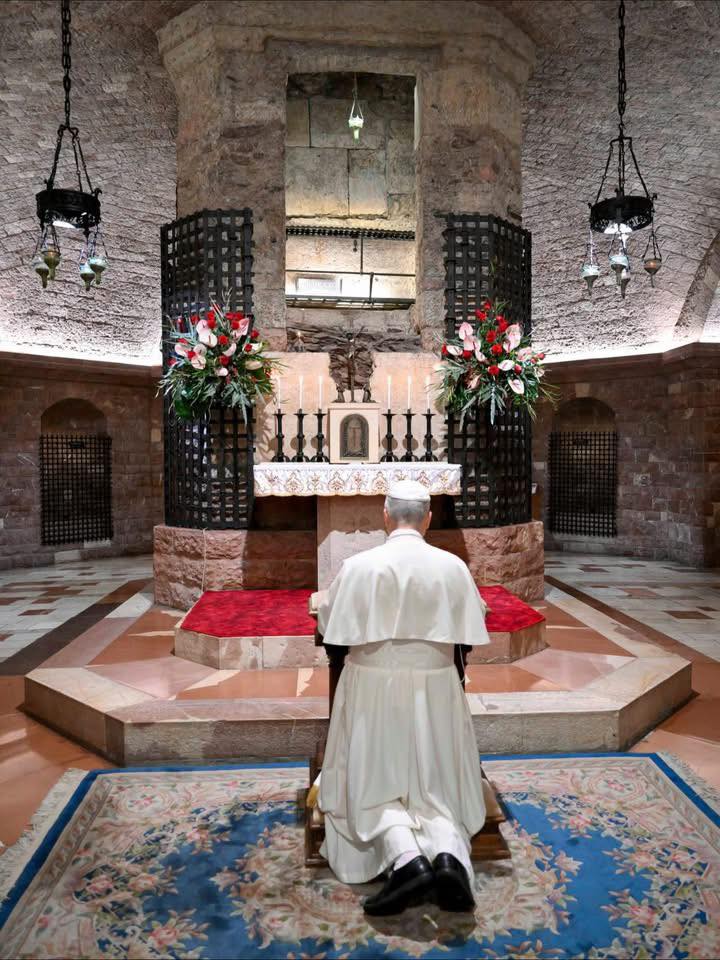
(ZENIT News / Rome, 01.17.2026).- Pope Leo XIV has proclaimed a special Jubilee Year dedicated to Saint Francis of Assisi, marking the 800th anniversary of the saint’s death. The initiative, which runs from 10 January 2026 to 10 January 2027, is conceived not as a mere commemoration, but as a global spiritual journey aimed at renewing holiness, reconciliation, and peace in a fractured world.
The decision was formalized in a decree of the Apostolic Penitentiary published on 16 January and signed by Cardinal Angelo De Donatis, Major Penitentiary, together with Monsignor Krzysztof Józef Nykiel, Regent of the dicastery. The document establishes the conditions under which the faithful may obtain a plenary indulgence throughout the Franciscan Year, extending a practice deeply rooted in the spiritual legacy of the “Poor Man of Assisi.”
According to the decree, the indulgence is granted under the usual canonical conditions: sacramental confession, Eucharistic communion, and prayer for the intentions of the Roman Pontiff. As is customary in such jubilees, the indulgence may also be applied as a suffrage for the souls in Purgatory. What distinguishes this initiative is its broad scope: it is open not only to members of the Franciscan families—across the First, Second, and Third Orders, both regular and secular—but to all the faithful, without distinction, who participate with a sincere detachment from sin.
To receive the indulgence, pilgrims are invited to visit any Franciscan conventual church or any place of worship dedicated to Saint Francis, anywhere in the world. There, they are asked to take part in jubilee rites or to devote an appropriate amount of time to prayer and meditation, concluding with the Lord’s Prayer, the Creed, and invocations to the Virgin Mary, Saint Francis, Saint Clare, and the saints of the Franciscan family. The decree explicitly links these acts of devotion to concrete intentions: that hearts may be stirred toward Christian charity and authentic desires for concord and peace among peoples.
In a sign of pastoral sensitivity, the Holy See has made special provision for those unable to undertake a pilgrimage. Elderly persons, the sick, caregivers, and all who are prevented by serious reasons from leaving their homes may also obtain the plenary indulgence. They are invited to unite themselves spiritually to the jubilee celebrations, offering their prayers, sufferings, and daily trials to God, with the intention of fulfilling the usual conditions as soon as circumstances allow.
The Apostolic Penitentiary situates this Franciscan Jubilee as an “ideal continuation” of the Ordinary Jubilee of 2025, whose spiritual fruits, it notes, remain “current and effective.” The Year of Saint Francis is thus presented as a prolongation rather than a rupture: a passage from hope rediscovered to charity lived, from pilgrimage to concrete evangelical witness. The timing is deliberate. The year 2026 stands as the culmination of a broader Franciscan cycle that has already marked several eighth centenaries: the first Christmas crib at Greccio, the composition of the Canticle of the Creatures, and the reception of the stigmata on Mount La Verna, two years before Francis’ death in October 1226.
Beyond canonical norms and devotional practices, the Jubilee is framed as a response to contemporary crises. In the decree’s reflection on the figure of Francis—once the son of a wealthy merchant, later a radical witness to poverty and humility—the saint is described as an alter Christus, whose life offers tangible and enduring models of evangelical authenticity. The text insists that the present age is not unlike Francis’ own: a time when charity grows cold, social conflict becomes habitual, and peace appears increasingly fragile. In such a context, the Franciscan message, far from being anachronistic, acquires renewed urgency.
This emphasis was echoed in a letter Pope Leo XIV addressed on 7 January 2026 to the ministers general of the Franciscan family. In it, the Pope underscored that peace is not the product of technical agreements or human calculation alone, but a gift of God that must be humbly received. He pointed to the traditional Franciscan greeting, “The Lord give you peace,” as the heart of an evangelical experience that speaks directly to a world scarred by what he called “apparently endless wars” and deep social fractures. True peace, the Pope wrote, is inseparable from reconciliation with God, harmony among people, and respect for creation.
The jubilee celebrations began solemnly at the Basilica of Saint Mary of the Angels in Assisi, at the Porziuncola, the place most intimately associated with Francis’ final years. The opening ceremony was presided over by Friar Francesco Piloni, Minister Provincial of the Friars Minor of Umbria and Sardinia, alongside the six ministers general representing the various branches of the Franciscan family, including the Friars Minor, Conventuals, Capuchins, the Secular Franciscan Order, the Third Order Regular, and the International Franciscan Conference of women religious.
One of the most evocative moments of the inauguration came when the outgoing Archbishop of Assisi, Domenico Sorrentino, and the city’s mayor, Valter Stoppini, together lit a candle from the Paschal flame and carried its light through the basilica. The gesture recalled the historic reconciliation between civil and ecclesial authorities in Francis’ own time, a symbolic reminder that peace must be built across institutional as well as personal divides.
As part of the centenary observances, the Holy See has also announced an exceptional opportunity for veneration: from 22 February to 22 March 2026, the body of Saint Francis will be brought out of its crypt to allow the faithful closer access during this pivotal period of the jubilee year.
The celebrations concluded with a prayer proposed by Pope Leo XIV, invoking Saint Francis as an intercessor so that Christians may become “artisans of peace” and “unarmed witnesses” of the Gospel. The prayer asks for the courage to build bridges where the world erects barriers and insists that genuine reconciliation is measured by the walls it brings down.
In proclaiming this Jubilee Year, the Church signals that the eighth centenary of Saint Francis’ death is not intended as a retrospective exercise in nostalgia. Rather, it is presented as a forward-looking call: to translate one of Christianity’s most compelling spiritual legacies into concrete gestures of peace, mercy, and respect for human dignity in the complexities of the contemporary world.
Thank you for reading our content. If you would like to receive ZENIT’s daily e-mail news, you can subscribe for free through this link.