

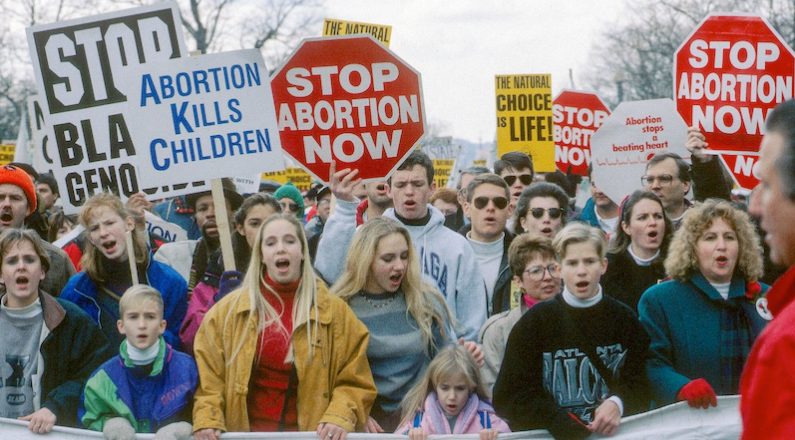
(ZENIT News / Washington, 02.01.2026).- For years, conventional wisdom in the United States held that younger generations were moving steadily toward more permissive views on abortion. New data suggest something far more complex—and potentially transformative—is underway.
The Daily Signal suggests points to an unexpected shift among Americans aged 18 to 29: a growing share now identifies as pro-life, while support for unrestricted abortion access has declined noticeably over the past three years.
According to Gallup and related surveys, about 37 percent of young adults described themselves as pro-life in 2025. That represents an increase of roughly 8 to 11 percentage points compared with results from 2022 and 2023. At the same time, Gallup data show that the proportion of young Americans who believe abortion should be legal in all circumstances has dropped sharply—by an estimated 10 to 14 points.
These figures do not mean that young adults have suddenly become a solidly pro-life bloc. A separate Pew Research Center survey conducted in 2024 found that Americans under 30 remain more likely than older age groups to support legal abortion in “all or most cases.” Yet even Pew recorded a decline in that support compared with previous years. The direction of travel, analysts note, matters.
Moral unease meets legal reality
The picture becomes more complicated when opinions are tested at the ballot box.
In recent statewide referendums on abortion, pro-abortion campaigns have prevailed almost everywhere, with notable exceptions in Nebraska, South Dakota, and Florida. This reveals a persistent gap: many Americans may feel growing moral discomfort about abortion, but that does not automatically translate into support for legal protections for unborn children.
Pro-life leaders have long argued that persuasion operates on two levels. Convincing people that abortion ends a human life is one challenge; persuading them that unborn children deserve legal protection is another—and often harder—task.
Even so, advocates see signs of momentum, particularly among younger adults.
What’s driving the change?
Observers point to several converging factors.
Campus-based pro-life initiatives have expanded their reach in recent years, engaging students through debates, pregnancy resource outreach, and personal testimony. At the same time, some young adults are reconnecting with religious communities, where abortion is framed not only as a political issue but as a moral and anthropological one—about what it means to be human.
There is also the lasting impact of Dobbs v. Jackson Women’s Health Organization, the 2022 Supreme Court decision that overturned Roe v. Wade. Far from ending the national conversation, Dobbs intensified it, pushing abortion policy into state legislatures and onto front pages. For many young Americans, abortion is no longer an abstract legal right but a visible, contested public question.
Setbacks and structural challenges
The broader landscape, however, remains difficult for the pro-life movement.
Since Roe was overturned, one of the most significant developments has been the Biden administration’s decision to eliminate the in-person medical visit requirement for obtaining abortion pills—a policy initially justified during the COVID-19 pandemic. The result has been a nationwide distribution network allowing chemical abortion drugs to be mailed across state lines, often from pro-abortion states such as California and New York into states with pro-life laws like Texas and Louisiana.
Critics argue that this effectively undermines state-level abortion restrictions, since pills ordered online are nearly impossible to regulate. Despite sustained pressure from pro-life groups, the Trump administration has so far declined to reverse the Biden-era policy.
Meanwhile, pro-abortion organizations continue to outspend their opponents by wide margins, benefiting from what pro-life advocates describe as tens of millions of dollars’ worth of sympathetic media coverage each year. Major outlets routinely amplify abortion-rights messaging, while pro-life claims—particularly about the risks associated with chemical abortion—are frequently challenged or dismissed.
Durable sentiment in a hostile media climate
Against that backdrop, even modest gains stand out.
Gallup’s 2025 national survey found that Americans overall became slightly more pro-life compared with the previous year. Dr. Michael New, a political scientist and statistician who tracks abortion attitudes, called the trend striking.
Despite what he described as an “avalanche” of negative media coverage surrounding newly enacted pro-life laws, New noted that pro-life sentiment has proven “remarkably durable.”
That resilience is notable given the intensity of post-Dobbs messaging, much of it warning that abortion restrictions endanger women’s lives. For supporters of the movement, the fact that public opinion has not collapsed under that pressure suggests a deeper stability in Americans’ moral instincts.
A generational inflection point?
No one is claiming a sudden cultural conversion. Young adults, as a group, still lean more pro-abortion than their parents or grandparents. But the emerging data hint at a generational inflection point: a cohort more open to questioning abortion orthodoxy than many expected.
Whether this trend continues—and whether it reshapes laws as well as attitudes—remains uncertain. What is clear is that, after years of assuming youth would drive ever-expanding abortion access, the United States is witnessing a quieter, more nuanced reality.
In a media environment largely hostile to pro-life arguments, a growing number of young Americans appear willing to reconsider fundamental questions about life, responsibility, and the role of law. For a movement long accustomed to playing defense, that shift may prove more consequential than any single election result.
Thank you for reading our content. If you would like to receive ZENIT’s daily e-mail news, you can subscribe for free through this link.

