

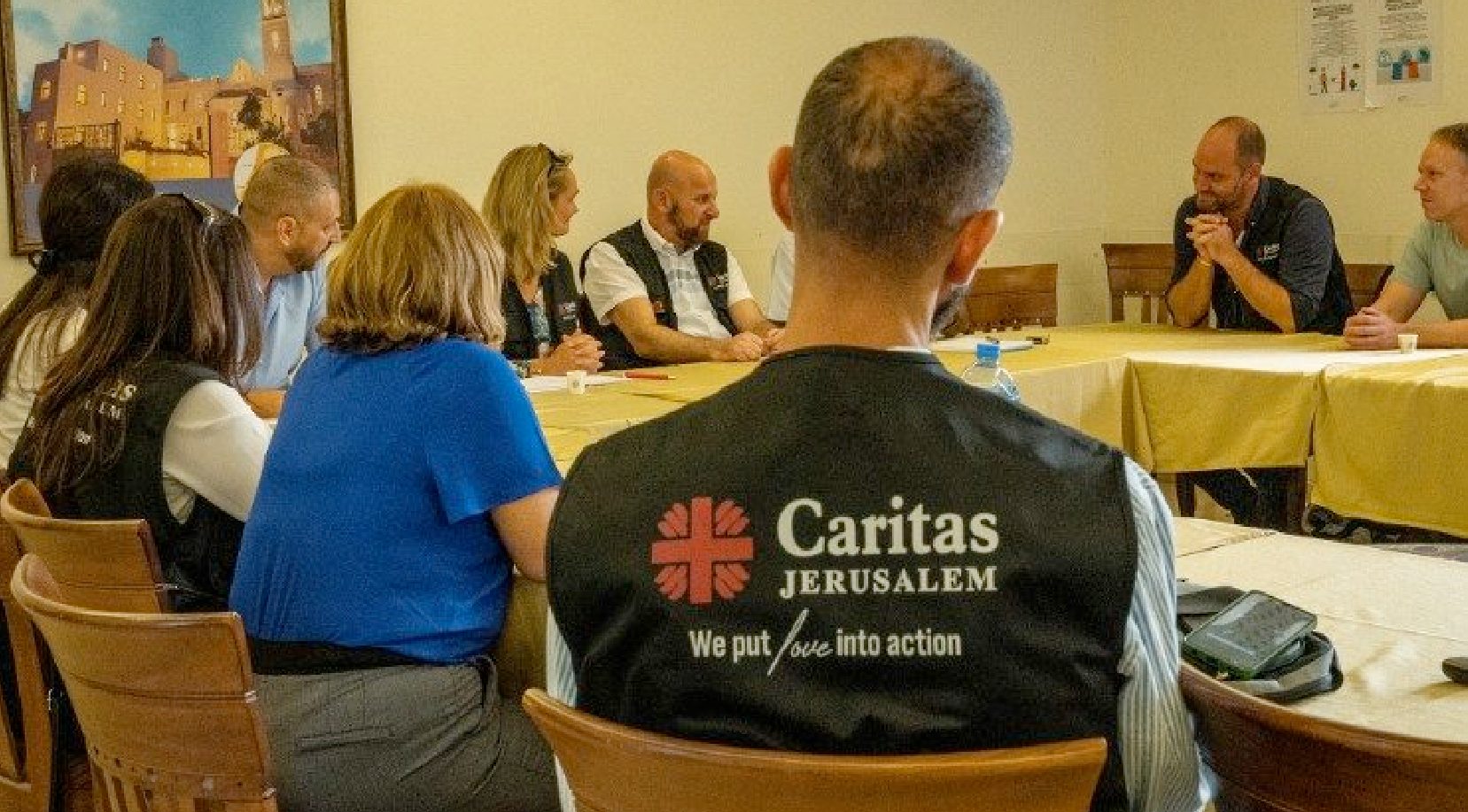
(ZENIT News / Jerusalem, 02.12.2026).- Israel’s interministerial team has formally clarified that Caritas Jerusalem is not subject to the transitional guidelines governing the registration of organizations and the authorization of foreign personnel. The notification effectively voids previous correspondence on the matter and confirms that no re-registration procedures are pending.
For Caritas Jerusalem, the announcement closes a chapter of administrative ambiguity that began in December 2025, when Israeli authorities published a list of 37 non-governmental organizations that were reportedly required to cease operations in the Gaza Strip. Among the names that appeared were Caritas Internationalis and Caritas Jerusalem—an inclusion that, according to the latter’s Secretary General Anton Asfar, came as a profound shock.
The regulatory shift that triggered the uncertainty was not merely technical. Responsibility for the registration of international organizations had moved from the Ministry of Social Affairs to the Ministry for Diaspora Affairs and Combating Antisemitism. In a region where legal status can determine access to territory, staff mobility and the importation of humanitarian supplies, such bureaucratic adjustments carry substantial practical implications.
Following a reassessment, however, the interministerial committee concluded that the provisions outlined in the “Guidelines for the Registration of Organizations and the Issuance of Recommendations for their Foreign Personnel” during the transitional phase do not apply to Caritas Jerusalem. The communication states that earlier exchanges are to be considered null and that no additional procedures are required. For a humanitarian body operating in one of the world’s most tightly controlled environments, this is more than a formal clarification: it is a green light to continue.
Caritas Jerusalem, the Catholic Church’s social and development agency in the Holy Land, has been present in Gaza since 1967. Its work there did not cease after 7 October 2023, when the latest escalation of violence began. “We have never stopped our operations,” Asfar has said publicly, while underscoring that the organization’s staff are themselves part of the local population and therefore subject to the same displacement, trauma and insecurity as those they serve.
The numbers illustrate both scale and strain. In the Gaza Strip, Caritas employs 127 staff members; another 28 work in the West Bank. The organization runs eight medical units in Gaza, including one fixed clinic in Gaza City, alongside two psychosocial support units. Before May 2024, teams operated in Rafah, at times in improvised tents. Following the Israeli military incursion into Rafah in May 2024, activities were relocated northward to Khan Yunis, Deir al-Balah and Nuseirat. When a military operation hit Deir al-Balah in July, one medical point had to be evacuated—later reopening when conditions allowed.
September brought further upheaval with the evacuation of Gaza City. Of 125 staff then in service, 102 were compelled to move south once more. The cumulative psychological burden has been immense. Personnel have had to care for their own families—often displaced multiple times—while continuing to provide primary health care and life-saving assistance to the wider community.
Caritas has also paid a devastating human price. Asfar has recounted the death of a laboratory technician, Viola, who was killed along with her husband, their two-month-old daughter and extended family members while seeking refuge; twelve people in the same family died in the strike. In another case, a pharmacist was killed after relocating with relatives to a building sheltering thirty people; only a three-year-old daughter survived. Such losses have left deep scars within an organization whose identity is rooted in proximity to the communities it serves.
Financially, the response has required sustained international backing. In 2024 and 2025, Caritas Jerusalem launched two emergency appeals totaling €7.5 million. For 2026, it has issued a further appeal for €8 million. Caritas Ambrosiana alone has developed bilateral projects worth €1 million in support. These figures reflect not reconstruction—still largely aspirational—but survival: medical supplies, food assistance, psychosocial care.
Even after a ceasefire announcement on 10 October 2025, the humanitarian landscape remains bleak. Staff returning to Gaza City found entire neighborhoods flattened, homes damaged and infrastructure destroyed. Potable water supply is a critical concern. Current capacity stands at 6,000 cubic meters, compared to a pre-war level of 14,000. Aid entry continues intermittently. On 12 October, Caritas succeeded in bringing in 10,000 cans of infant formula, distributed across Gaza amid fears of famine. At the same time, newly assembled mobile clinics remain unauthorized to enter.
The human dimension of this crisis is embodied by staff such as Fatena Mohanna, a computer engineer from Gaza City who has documented Caritas’ activities—work later cited by international media due to restrictions on foreign journalists entering the Strip. Recently relocated to Siena to study Italian before enrolling in a master’s program, she describes the psychological dissonance of safety: clean water for the first time in two years, quiet nights after prolonged bombardment, and the guilt of eating and sleeping while her family remains in Gaza.
Her reflections underscore a paradox central to Caritas’ mission. The organization is composed of people drawn from the very communities it assists. “Who helps those who provide the help?” is a question she has posed publicly. In her view, many of her colleagues are “heroes”—not in rhetoric, but in endurance.
Beyond emergency response, Caritas is planning to expand a maternal and child health center in Gaza, focusing on mothers—many widowed by war—and minors. At the same time, it continues initiatives aimed at dialogue and reconciliation, modest efforts in a context that Asfar describes as fractured by extremism on multiple sides. Small groups working for coexistence, he suggests, resemble salmon swimming against the current.
The recent Israeli decision to clarify Caritas Jerusalem’s legal standing does not alter the political horizon of the Israeli–Palestinian conflict. It does, however, remove a potentially crippling administrative obstacle at a moment when humanitarian needs remain acute. For the Catholic Church in the Holy Land, whose presence is numerically small but symbolically significant, the ability of its principal charitable agency to operate without regulatory uncertainty is essential.
In Jerusalem and Gaza alike, Christian communities often speak of carrying a “small cross” by remaining in a land marked by sacred history and contemporary violence. The lifting of the registration cloud does not lighten that cross. It ensures, at least for now, that the Church’s social arm can continue to shoulder it alongside the most vulnerable.
Thank you for reading our content. If you would like to receive ZENIT’s daily e-mail news, you can subscribe for free through this link.

