

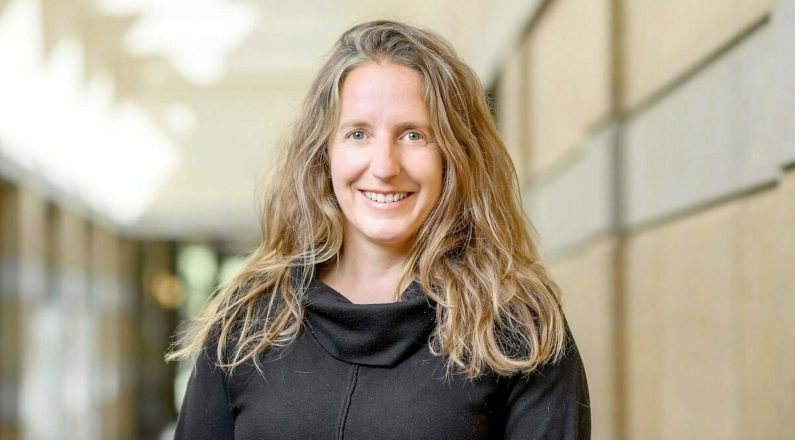
(ZENIT News / Fort Wayne, 02.17.2026).- A prominent Catholic university long regarded as a flagship of intellectual life in American Catholicism now finds itself at the center of a national ecclesial dispute. The University of Notre Dame’s decision to appoint Associate Professor Susan Ostermann as director of its Liu Institute for Asia and Asian Studies has prompted an unusually broad and coordinated response from U.S. bishops, including the president of the United States Conference of Catholic Bishops.
The controversy began on February 11, when Bishop Kevin C. Rhoades of the Diocese of Fort Wayne–South Bend — the local ordinary in whose jurisdiction Notre Dame is located — publicly expressed “consternation” and “strong opposition” to Ostermann’s appointment, which is set to take effect on July 1. Rhoades argued that the decision undermines a foundational principle of justice central to Notre Dame’s Catholic identity, particularly given Ostermann’s well-documented public advocacy for legal abortion and her sharp criticism of the pro-life movement.
Within days, at least nine bishops had aligned themselves with Rhoades’ call to reverse the appointment. Among them was Archbishop Paul S. Coakley of Oklahoma City, president of the USCCB, who stated on February 13 that he fully supports Rhoades’ challenge to what he characterized as flawed judgment in elevating a faculty member who openly opposes Catholic teaching on the sanctity of life, specifically the protection of the unborn.
Other episcopal voices joined in. Bishop Robert E. Barron of Winona–Rochester described Ostermann not as merely “pro-choice,” but as a forceful critic of the pro-life position and its defenders. Archbishop Salvatore J. Cordileone of San Francisco, Bishop James D. Conley of Lincoln, Bishop Michael F. Olson of Fort Worth, Bishop David L. Ricken of Green Bay, Bishop James S. Wall of Gallup, and the recently retired Archbishop Samuel J. Aquila of Denver also publicly supported Rhoades’ intervention. Bishop Donald J. Hying of Madison expressed solidarity as well, framing the matter as a question of fidelity to Catholic teaching on human dignity. Notably, some bishops typically associated with more progressive currents in the U.S. Church have remained silent (for example, those in Chicago and Washington).
The Liu Institute, which operates within Notre Dame’s Keough School of Global Affairs, focuses on Asia and Asian Studies. Ostermann, a political scientist and legal scholar specializing in regulatory compliance, comparative politics and environmental regulation — with particular attention to South Asia — has been a member of the university’s faculty since 2017. Beyond her academic portfolio, critics point to her public record: opinion pieces strongly defending abortion rights and consultancy work for the Population Council, an international research organization promoting sexual and reproductive health and rights.
Rhoades indicated that he had reviewed numerous articles co-authored by Ostermann and concluded that her public positions not only diverge from Catholic moral teaching but risk causing scandal among the faithful. In Catholic theological vocabulary, “scandal” refers not to mere controversy but to actions that may lead others into moral confusion or error.
The internal repercussions at Notre Dame were swift. Two faculty members affiliated with the Liu Institute severed formal ties with it after the announcement. Diane Desierto, professor of law and global affairs, resigned from her role with the institute, citing in a public statement her commitment to taking seriously the words of Pope Leo XIV on the dignity of life at every stage. Emeritus theology professor Robert Gimello likewise withdrew, stating that continued formal association with a unit led by someone so publicly opposed to the Church’s pro-life teaching was, for him, inadmissible — irrespective of the appointee’s academic credentials.
The debate has also drawn commentary from Catholic intellectuals beyond Indiana. In an essay published on February 13 in First Things, retired sociologist Christian Smith, former director of Notre Dame’s Center for the Study of Religion and Society, criticized what he described as a broader institutional ambiguity about Catholic mission. While not naming Ostermann directly, he lamented what he sees as a “check-the-box” approach to Catholic identity among faculty, arguing that being baptized but dissenting from core teachings does not exhaust the meaning of Catholic affiliation in a university whose charter explicitly claims a Catholic mission.
Mary Rice Hasson of the Ethics and Public Policy Center in Washington called the appointment irreconcilable with the university’s commitment to human dignity. David A. Armstrong, president of St. Thomas University in Miami, emphasized that Catholic universities possess a constitutional right to maintain their confessional identity and that respecting Catholic teaching is a minimal expectation for those serving in leadership roles.
Notre Dame, for its part, has signaled no intention of reversing course. In statements to the press, university officials described Ostermann as a highly respected scholar well prepared to lead the institute. They reiterated the institution’s “unwavering” commitment to upholding the inherent dignity of the human person and the sanctity of life at every stage. Ostermann herself has said she respects Notre Dame’s institutional stance on life issues and is committed to fostering an environment of academic freedom where a plurality of voices can flourish.
That last phrase — academic freedom — sits at the center of the dispute. Catholic universities in the United States operate within a delicate framework shaped by both civil law and canon law. The 1990 apostolic constitution Ex Corde Ecclesiae, issued by St. John Paul II, affirms the autonomy of Catholic universities while also insisting that they maintain a clear and public fidelity to Catholic doctrine, particularly in matters touching on faith and morals. Tensions arise when faculty members in leadership roles publicly advocate positions that the Church defines as intrinsically immoral, such as abortion.
The current controversy therefore raises a question that extends well beyond a single appointment: how should a Catholic university balance scholarly freedom, institutional prestige, and confessional coherence? For many of the bishops who have intervened, the issue is not whether diverse views may exist within a university community, but whether those who openly oppose definitive moral teachings should be entrusted with shaping academic units that form future leaders.
The episode also underscores the unique symbolic weight of Notre Dame. As the most prominent Catholic university in the United States, its decisions reverberate nationally and internationally. When bishops speak in unusually unified tones — at least nine within days — the signal is unmistakable: they perceive not a routine hiring matter, but a test of identity.
Thank you for reading our content. If you would like to receive ZENIT’s daily e-mail news, you can subscribe for free through this link.

Publicaciones relacionadas:
 USA: “9 Days for Life” Unites Hundreds of Thousands in Prayer for the Protection of Life
 USA: Bishops Reduce Investments in Campaigns Against Abortion Before the 2024 Elections
 USA: Bishops Thomas and Barron Applaud Move to Defund Abortion and “Gender Transition” Industries, Call for Authentic Health Care
 Costa Rica Chooses Laura Fernández: A Pro-Life Presidency Begins as Bishops Call for Unity, Dialogue, and Moral Leadership
