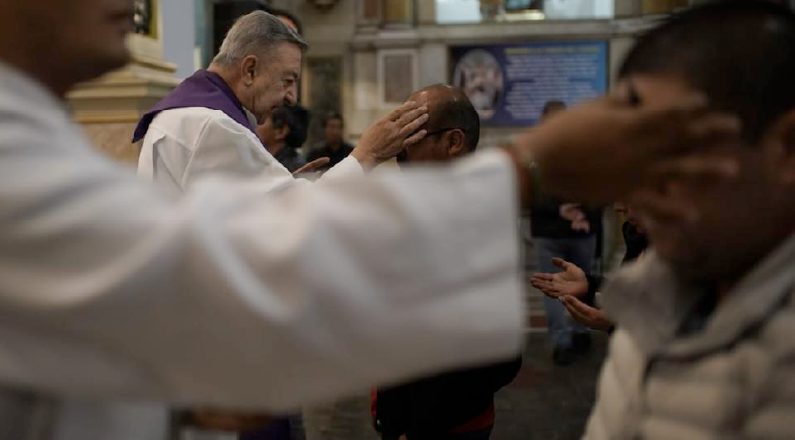
(ZENIT News / Chicago, 02.17.2026).- On the eve of Lent, a federal courtroom in Chicago became the stage for a dispute that reaches far beyond one suburban immigration facility. In a preliminary ruling issued on February 12, U.S. District Judge Robert W. Gettleman ordered the Department of Homeland Security to allow Catholic clergy to enter the ICE field office in Broadview, Illinois, to distribute ashes and Holy Communion on Ash Wednesday, February 18.
The decision represents a significant legal victory for the Coalition for Spiritual and Public Leadership (CSPL), a nonprofit Catholic and Christian organization rooted in liberation theology and community organizing. For months, the group had been denied access to the Broadview site, despite a history of providing pastoral care there. The ruling now compels federal authorities not only to permit sacramental ministry on Ash Wednesday but also to coordinate with the coalition on security arrangements and to meet about the future of religious services at the facility.
At the heart of the case lies a specific legal question: whether the government substantially burdened the religious exercise of clergy seeking to minister to detainees. Judge Gettleman concluded that it had. Citing the Religious Freedom Restoration Act of 1993, he found no compelling governmental interest that would justify blocking priests and religious sisters from offering pastoral care. Notably, the Department of Homeland Security did not argue that its policy met the strict standards required under that law — namely, that restricting religious exercise served a compelling interest and did so through the least restrictive means.
CSPL’s lawsuit did not primarily claim that detainees’ religious rights were violated. Instead, it argued that the government had infringed upon the ministers’ own First Amendment rights and protections under federal religious liberty statutes, including the Religious Land Use and Institutionalized Persons Act of 2000. According to court filings, federal authorities had erected a fence around the Broadview facility last autumn, preventing members of the coalition from praying on-site, and had issued directives barring prayer within federal property at the location. These claims went unchallenged in court.
Broadview functions as an ICE field office used to process detainees before transfer to longer-term detention centers. Officially, individuals are supposed to remain there only for several hours, with a maximum stay of 72 hours. Yet complaints surfaced last year alleging that some detainees were held for several days and, in certain cases, up to a week. For CSPL and its supporters, the short-term designation of the facility does not diminish what they see as a moral and spiritual obligation to accompany migrants during moments of acute vulnerability.
Father Dan Hartnett, SJ, a member of the coalition’s clergy council and one of the plaintiffs in the lawsuit, described the ruling as a hopeful sign at the beginning of Lent. He framed the decision as a step toward restoring religious liberty and affirming the dignity of migrants in federal custody. Another clergy leader associated with the coalition, Father Leandro Fossá, CS, has previously criticized what he characterizes as systemic injustices in federal immigration enforcement, expressing anticipation over how the government would respond to the court’s directive.
The ruling arrives amid heightened tensions surrounding immigration enforcement in the Chicago area. Last autumn, federal agencies launched an enforcement surge known as “Operation Midway Blitz.” Around the same time, a local resident, Silverio Villegas González, was fatally shot by ICE agents, an incident that galvanized activists and intensified scrutiny of federal practices. Since then, CSPL’s public liturgies and processions have drawn thousands, including a Day of the Dead Mass celebrated outside the Broadview facility last year by Auxiliary Bishop José María García-Maldonado of Chicago, himself an immigrant from Jalisco, Mexico.
This year’s Ash Wednesday observances will extend beyond the detention center’s perimeter. Cardinal Blase J. Cupich of the Archdiocese of Chicago is scheduled to preside at a large outdoor Mass at Our Lady of Mount Carmel Catholic Church in Melrose Park, organized in collaboration with the Scalabrinian missionaries, a congregation historically dedicated to serving migrants. The liturgy will be followed by a peaceful procession through the community, with participants praying the rosary and singing as a public sign of solidarity with immigrant families.
Whether Cardinal Cupich will personally enter the Broadview facility remains unconfirmed. In recent weeks, he has spoken publicly about incidents in which priests were reportedly stopped by federal agents and asked to prove their immigration status “because of their color.” Cupich, widely regarded as one of the most influential American cardinals due to his close ties to the Vatican, has consistently advocated for migrants and for comprehensive immigration reform.
The dispute in Illinois has also drawn attention from bishops across the theological spectrum. Archbishop Alexander Sample of Portland, Oregon — who chairs the U.S. Conference of Catholic Bishops’ committee on religious liberty and is often described as doctrinally conservative — recently identified restricted access to detention centers as the most troubling religious freedom issue in the immigration debate. He emphasized the importance of ensuring that detainees can receive pastoral care and especially the sacraments. Other bishops, including Bishop Kevin Rhoades of Fort Wayne–South Bend and Bishop Robert Barron of Winona–Rochester, have expressed similar concerns in recent months.
The issue resonates at the universal Church level as well. In November 2025, Pope Leo XIV underscored the need to consider the spiritual rights of detained migrants, reinforcing a long-standing Catholic teaching that pastoral care is not a privilege granted at convenience but an integral aspect of human dignity.
Ash Wednesday, which marks the beginning of Lent in the Christian calendar, is a day of fasting and repentance. The imposition of ashes — traced in the sign of the cross on the forehead — is a visible reminder of mortality and conversion. For detainees who choose to participate, receiving ashes or Holy Communion in a federal processing center would carry symbolic weight: a sign that, even within the bureaucratic machinery of immigration enforcement, the Church insists on accompanying its faithful.
As of late Friday February 13, CSPL said it was awaiting final logistical confirmation from the Department of Homeland Security regarding compliance with the court’s order. Federal agencies had not publicly responded to requests for comment.
The longer-term implications of Judge Gettleman’s ruling remain uncertain. He has ordered both sides to confer not only about Ash Wednesday but also about ongoing ministry at Broadview, including whether clergy may pray inside and outside the facility and interact directly with detainees. For advocates, the case tests whether religious liberty statutes — often invoked in other political contexts — will be robustly applied when the beneficiaries are migrants and those who minister to them.
Thank you for reading our content. If you would like to receive ZENIT’s daily e-mail news, you can subscribe for free through this link.