

(ZENIT News / Jerusalem, 02.28.2026).- The stretch of the Jordan River traditionally identified with the baptism of Jesus has once again opened its gates to pilgrims. Qasr el Yahud, revered by Christians as the place where John the Baptist baptized Christ, has been formally reopened following coordinated efforts by Israel’s Ministry of Tourism, Ministry of Environmental Protection, the Civil Administration, and the Israel Nature and Parks Authority. The reopening marks a new chapter for one of the most symbolically charged landscapes in the Christian world.
Known in Arabic as Al-Maghtas, meaning “the immersion,” Qasr el Yahud occupies a liminal geography both spiritually and historically. It stands at the threshold between desert and river, promise and fulfillment, and has long been embedded in Christian memory as a site of epiphany and renewal. Alongside the Church of the Holy Sepulchre in Jerusalem and the Church of the Nativity in Bethlehem, it ranks among the most visited Christian pilgrimage destinations in the Holy Land. Before the pandemic and regional disruptions, the site reached its modern peak in 2019, welcoming close to one million visitors in a single year.
The reopening is not merely symbolic. Since 2009, when basic visitor access was first established using temporary structures, Israeli authorities have pursued a gradual but comprehensive modernization of the area. According to the Ministry of Tourism, recent upgrades have focused on both accessibility and dignity, an important balance for a place where prayer and ritual immersion coexist with mass tourism.
Today, pilgrims arrive via improved access roads and parking areas, landscaped to minimize environmental impact. On site, a large air-conditioned service building provides showers with hot water and changing rooms, a practical necessity for those reenacting baptismal rites in the river. A new visitor center offers orientation and historical context, while a broad wooden deck allows safe, controlled access to the Jordan itself. Nearby, a pergola reserved for prayer gives groups and individuals a sheltered space for liturgy and reflection.
Haim Katz, Israel’s Minister of Tourism, framed the investment in explicitly strategic terms. He described Qasr el Yahud as one of Christianity’s most important pilgrimage destinations and argued that upgrading its infrastructure is part of a wider national effort to modernize religious and heritage tourism. The objective, he said, is to improve the visitor experience while ensuring that access is inclusive and of high quality.
For the Israel Nature and Parks Authority, however, the emphasis extends beyond logistics. Raya Shurki, the authority’s director general, stressed that the baptism site is among the most spiritually and historically significant locations in global Christianity. Each year, hundreds of thousands of pilgrims and tourists pass through the area, placing a heavy responsibility on those tasked with its care. Preservation of sanctity, she insisted, must go hand in hand with development and accessibility, all according to the highest standards.
Ver esta publicación en Instagram
This dual mandate—protection and hospitality—is especially delicate along the Jordan River, a fragile ecosystem already under strain from climate pressures and regional water use. Israeli officials underline that safeguarding the river’s natural, scenic, and heritage values is not a concession to tourism but a condition for its sustainability. The promise of the renewed Qasr el Yahud, they argue, is an experience that is respectful, safe, and comfortable without compromising the unique character of the river or the wider valley.
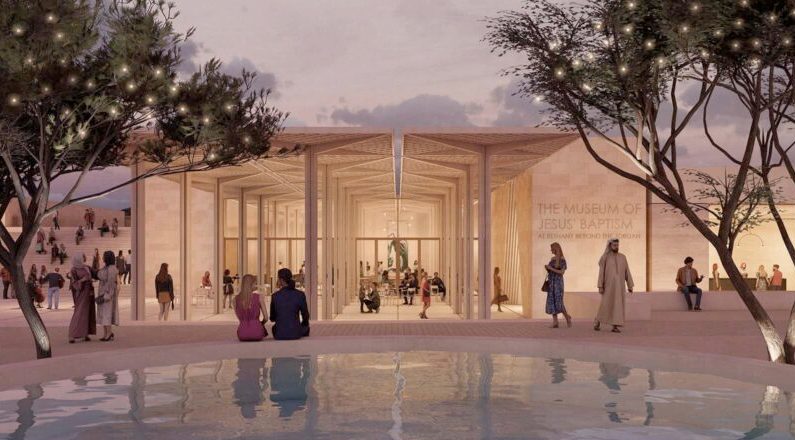
Just across the river, on the Jordanian side near Bethany beyond the Jordan, the future is also taking shape in architectural form. Plans are underway for a new Museum of the Baptism of Jesus, intended to deepen visitors’ understanding of the site’s theological and historical significance. An international design competition, organized by the Foundation for the Development of the Lands Adjacent to the Baptism Site, recently announced its winning team: a group led by the London-based Níall McLaughlin Architects.
The brief challenged architects to create a museum that would evoke both awe and humility while integrating sensitively with the surrounding landscape. According to a statement released by Malcolm Reading, who organized the competition, the winning design envisions a carefully choreographed journey. Visitors will descend from an arid wild garden into the earth, encounter a water-filled fissure symbolizing the Jordan River, and then emerge into light and a fertile, paradisiacal garden.
Architecturally, the project is structured around an east entrance and west exit facing one another across a public plaza. Between them, a terraced open landscape rises toward a roofscape from which visitors will be able to look out over the Jordan Valley and the historic pilgrimage route leading to the baptism site itself. The museum thus becomes not only an exhibition space but also a contemplative path, echoing the biblical movement from wilderness to promise.
The joint winners—Níall McLaughlin, landscape architect Kim Wilkie, and Pippa Nissen of Nissen Richards Studio—spoke of their sense of honor at being selected. They described Bethany as an extraordinary place marked by profound history and praised both the clarity of the competition brief and the strength of the shortlisted proposals.
Taken together, the reopening of Qasr el Yahud and the development of the Bethany museum point to a renewed confidence in pilgrimage as a living reality rather than a relic of the past. For Christian pilgrims, the Jordan River remains a place where geography and Gospel intersect. For the authorities on both sides of the river, the challenge is to steward that inheritance so that future generations can still descend to the water, step into history, and emerge renewed.
Thank you for reading our content. If you would like to receive ZENIT’s daily e-mail news, you can subscribe for free through this link.

Publicaciones relacionadas:
 12,000 Masses in 10 Years: The Magdala Center’s Chapel Celebrates a Decade with 1.3 Million Pilgrims
 Stairs and pathway that Jesus would have walked on discovered in Jerusalem
 American Jewish association to fund repairs to Gaza’s only Catholic church
 Archaeologists Identify the Site Where Jesus Exorcised the Legion of Demons and the Herd of Pigs
