


(ZENIT News / Washington, 03.16.2026).- The United States is undergoing a slow but unmistakable transformation in its religious landscape, according to newly compiled data from Gallup. While faith continues to shape the lives of millions, fewer Americans today describe religion as central to their existence, and an increasing number now stand outside any formal religious affiliation.
The latest figures, based on surveys conducted in May and December 2025, show that 47% of Americans consider religion “very important” in their lives. That number, though still representing a substantial portion of the population, confirms a long-term downward trajectory. In 2012, the figure stood at 58%, and in the mid-20th century—during the 1950s and 1960s—it routinely reached between 70% and 75%.
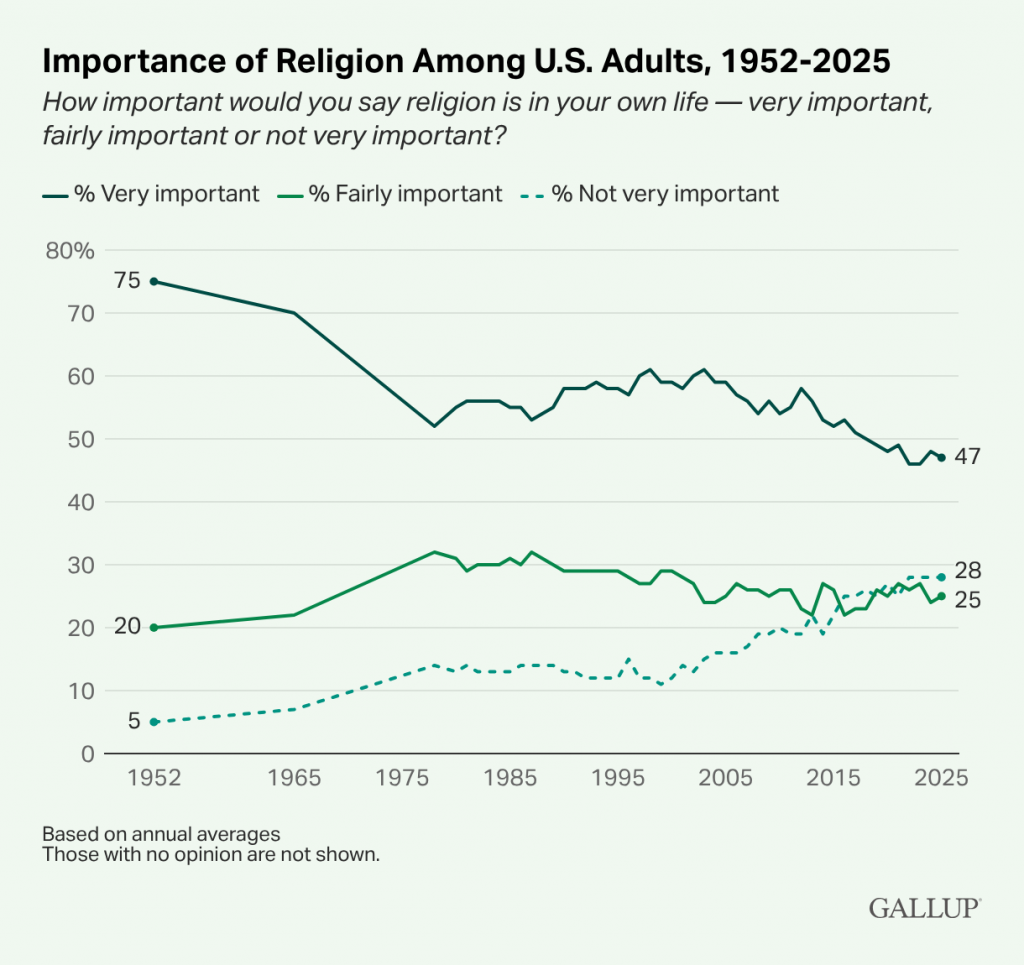
At the same time, the share of Americans who say religion is “not very important” has stabilized at 28% since 2022, marking the highest level ever recorded by Gallup and more than double the levels observed in the early 2000s. Another 25% describe religion as “fairly important,” a category that has shown a slight decline over time.
These figures point not to a sudden rupture but to a gradual rebalancing of belief, one that becomes clearer when examined across generational, cultural and political lines.
A generational turning point
One of the most decisive factors behind this shift is generational replacement. Younger Americans are significantly less likely to identify with religion or to consider it central to their lives, and as older generations diminish, their successors are reshaping the country’s spiritual profile.
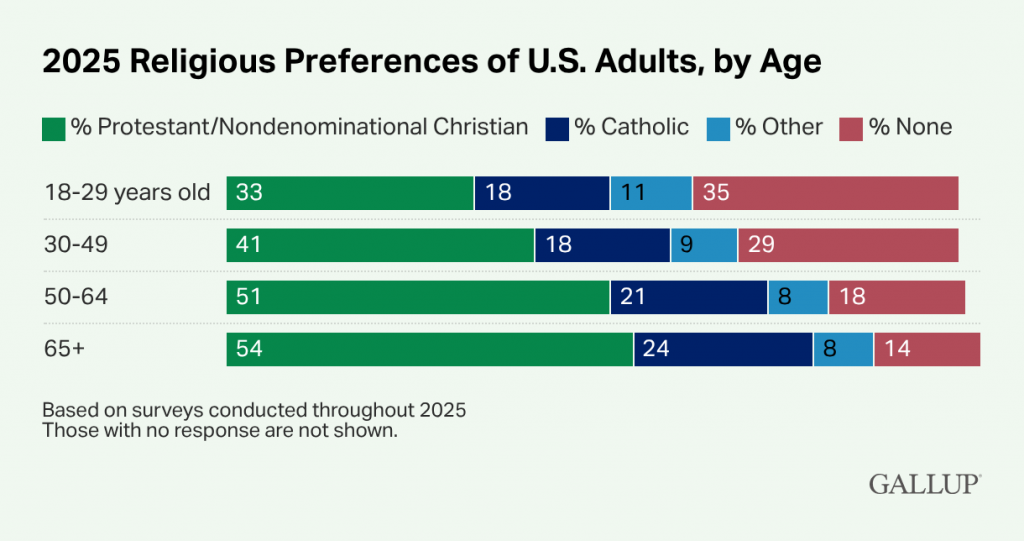
Among adults aged 18 to 29, only 33% say religion is very important to them—the lowest figure among all age groups. This cohort is also the most religiously unaffiliated: 35% report having no religious identity. By contrast, only 14% of Americans aged 65 and older fall into the non-affiliated category.
The pattern is consistent across intermediate age groups. Among those aged 30 to 49, 29% report no religious affiliation, compared to 18% among those aged 50 to 64. The data suggest that the rise of the religiously unaffiliated—often referred to as the “nones”—is not a temporary phenomenon but a structural shift linked to generational change.
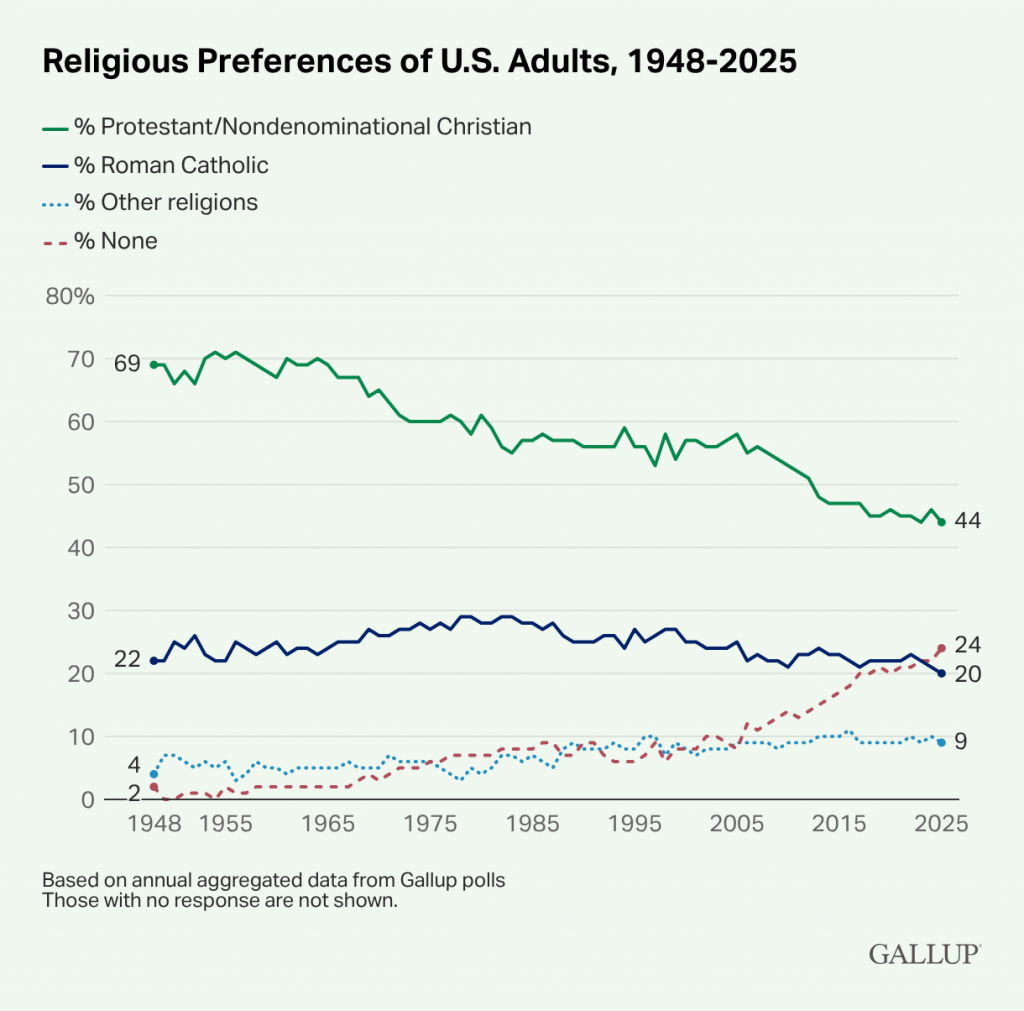
Indeed, the proportion of Americans without religious affiliation has reached a new high of 24% in 2025, up from just 2% in 1948. This latest figure is based on interviews with more than 13,000 adults conducted through Gallup’s monthly surveys over the past year.
A changing but resilient religious map
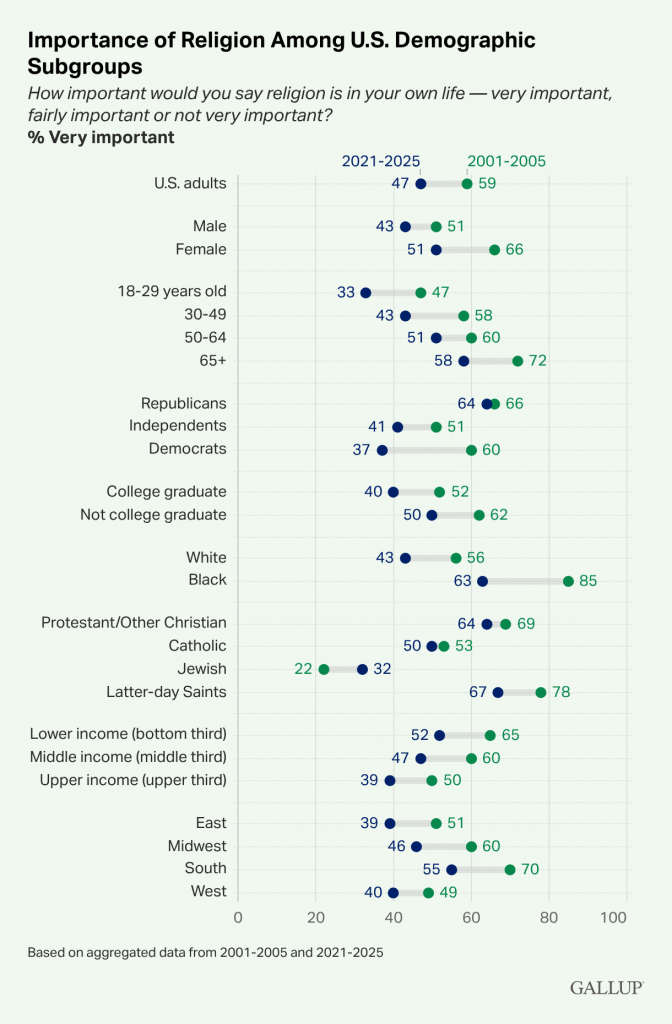
Despite the overall decline, religion remains deeply rooted in certain segments of American society. Between 2021 and 2025, several groups continue to report high levels of religious importance, with between 55% and 67% saying it plays a central role in their lives. These include Mormons, Republicans, Protestants or non-denominational Christians, African American adults, those aged 65 and older, and residents of the southern United States.
Other groups—such as lower-income Americans, women and individuals aged 50 to 64—also maintain a slight majority affirming the importance of religion.
At the opposite end of the spectrum are Jewish Americans, among whom 32% say religion is very important, and young adults, at 33%. Notably, Jewish Americans are the only group to have registered an increase over the past two decades in the share who consider religion very important, rising by 10 percentage points.
Political identity has also emerged as a significant dividing line. Among Democrats, the proportion who consider religion very important has dropped sharply by 23 percentage points, reaching 37%. African American adults, historically among the most religious groups in the country, have also seen a notable decline of 22 points, though a clear majority—63%—still affirm religion’s importance.
Affiliation and practice diverge
Religious identity in the United States continues to be dominated by Christianity, though its internal composition reflects broader changes. In 2025, 44% of Americans identified as Protestant or non-denominational Christians, while 20% identified as Catholic. Another 9% belong to other religious traditions.
Yet affiliation does not necessarily translate into practice. Data on religious attendance reveal a parallel trend of declining participation in communal worship.
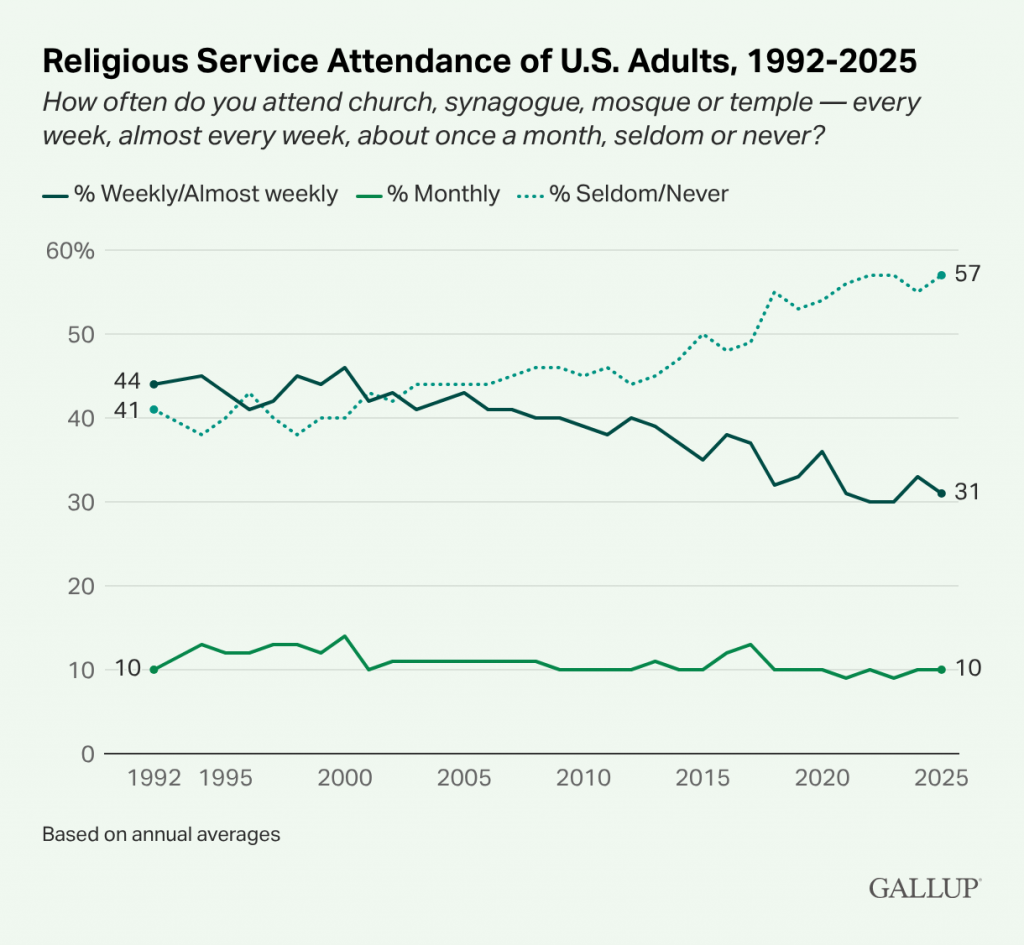
In 2025, 57% of Americans reported that they rarely or never attend religious services, while only 31% said they attend weekly or nearly weekly. Attendance roughly once a month has remained relatively stable, at around 10%.
This marks a significant departure from patterns observed between the early 1990s and 2008, when a majority of Americans reported attending religious services at least once a month. Since 2018, however, the balance has shifted decisively toward non-attendance.
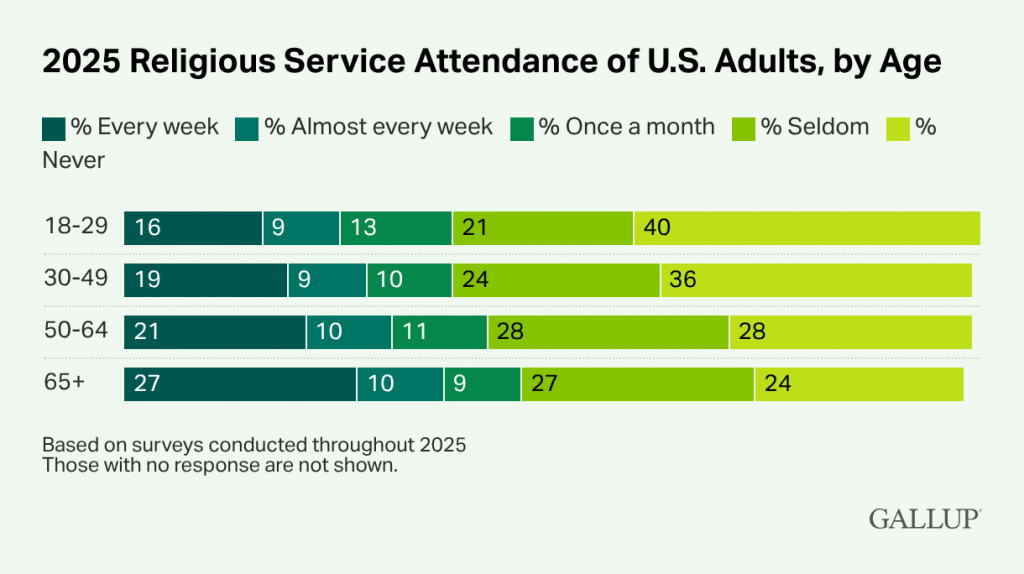
Once again, age plays a decisive role. Among younger adults, only 25% attend services weekly or nearly weekly, while 61% say they rarely or never participate. Among those aged 65 and older, the figures are notably different: 37% attend weekly or nearly weekly, and 51% report infrequent or no attendance.
Beyond decline: a reconfiguration
Taken together, the data suggest not simply a decline of religion in the United States, but a reconfiguration of how it is lived and understood. For large segments of the population, faith continues to provide meaning, identity and community. Yet for an increasing number of Americans—especially the young—it no longer occupies a central place in daily life.
This transformation has implications that extend beyond the religious sphere. Historically, religious institutions in the United States have played a significant role in shaping social cohesion, civic engagement and moral discourse. As patterns of belief and practice evolve, so too may the ways in which Americans organize community life and articulate shared values.
For now, the picture that emerges is one of contrast rather than uniform secularization: a country where vibrant pockets of religious commitment coexist with a growing culture of distance from organized faith. The direction of that trajectory appears clear, even if its final destination remains uncertain.
Thank you for reading our content. If you would like to receive ZENIT’s daily e-mail news, you can subscribe for free through this link.

Publicaciones relacionadas:
 Poland: Experts express serious concerns about Overbeek’s book about John Paul II
 USA: Catholics At The Top of Religions That Inspire Positive Sentiments Among the People in General
 What is the religion of the people who migrate the most? Research answers and Mexico is part of the answer
 The health (physical, mental, and spiritual) of Australian clergy in 2025: What interesting research reveals
