

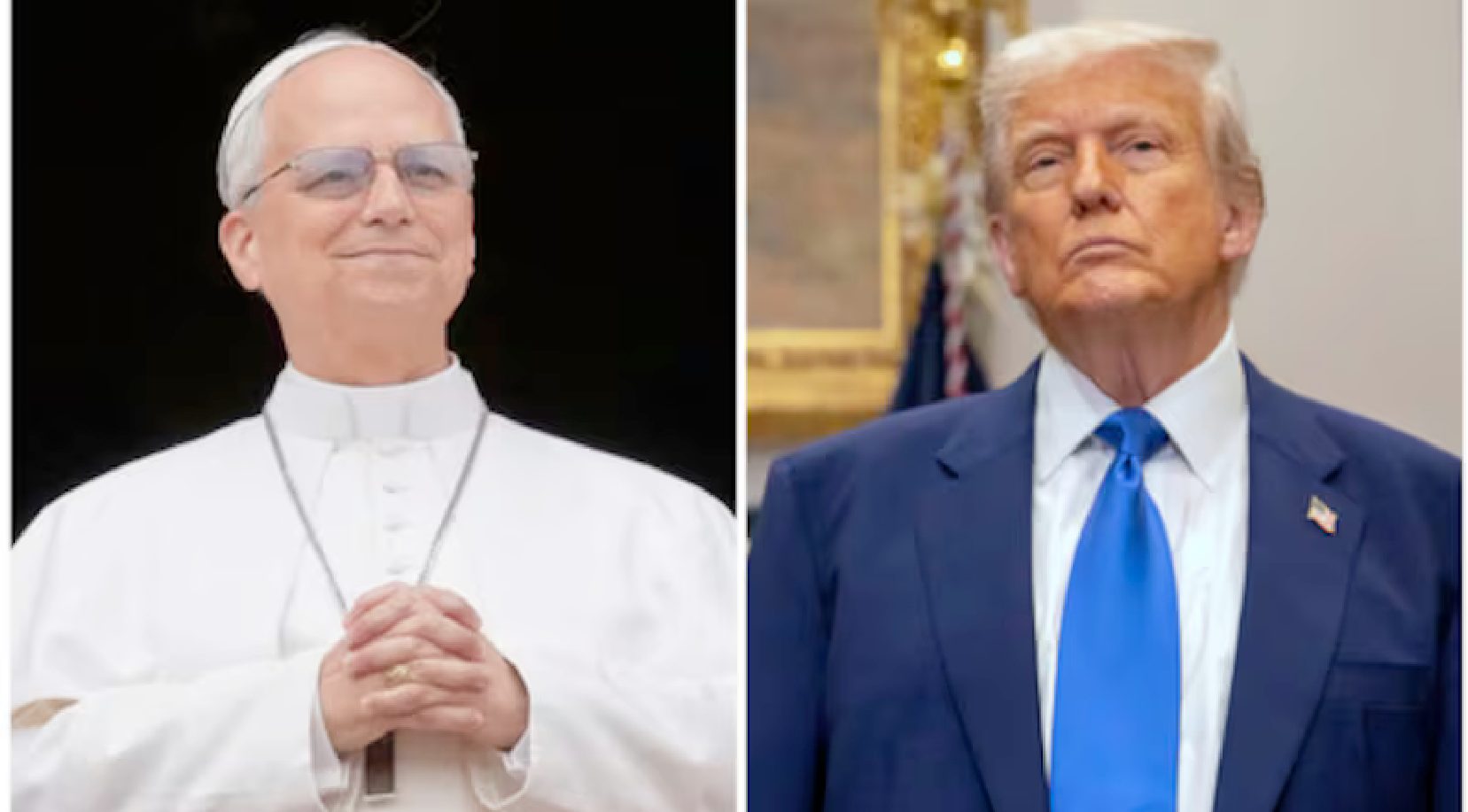
(ZENIT News / Rome, 04.14.2026).- Relations between the Holy See and the US presidency have entered a phase of open tension following a series of public statements that, in just a few days, have escalated from political criticism to a global verbal confrontation. At the center of this controversy are Pope Leo XIV, the first American Pontiff in history, and President Donald Trump, whose words have triggered a chain reactions both within and outside the ecclesial realm.
The episode began on April 12, when Trump posted a message on social media calling the Pope «weak» on crime and «terrible» on foreign policy. The intervention appeared to be a response to the Pontiff’s repeated calls for peace, particularly regarding the situation in Iran and other international conflicts. Just hours later, the Pope, during a meeting with journalists aboard the plane taking him to Africa, avoided direct confrontation but reaffirmed the core of his teachings: the condemnation of war and the promotion of dialogue between nations
Far from toning down, the US President reiterated his criticism the following day, April 13, before the media, ruling out any apology. He argued his disagreement with the Pope’s positions on the Iranian nuclear program and defended his own course of international policy. When the press asked Trump if he would apologize to the Pope, Trump responded emphatically: «No, no, because Pope Leo XIV said things that are wrong. He was against what I’m doing regarding Iran, and you can’t have a nuclear Iran. Pope Leo XIV wouldn’t be happy with the final result.»
Ver esta publicación en Instagram
Meanwhile, Vice-President JD Vance, a Catholic, publicly suggested in a Fox News interview that the Vatican should limit itself to religious matters and leave the definition of public policy to the Government: «I certainly believe that in some cases it would be better for the Vatican to stick to matters of morality, to stick to matters of what is happening in the Catholic Church and let the President dictate American public policy.»
🇺🇸🇻🇦The Catholic vice president of the United States has come out in support of Trump in his dispute with the Pope and the Vatican. Vance’s remarks on Fox News pic.twitter.com/a4MvFD8uOO
— ZenitEnglish (@zenitenglish) April 14, 2026
The statements have provoked a wide range of responses. In Mexico, for example, the country’s agnostic President spoke clearly in favour of the Pope.
Ver esta publicación en Instagram
From the European political sphere, Italian Prime Minister Giorgia Meloni expressed her support for the Pope and called the attacks unacceptable. She also emphasized the autonomy of religious authority from political power, at a time when her own Government is going through a delicate phase, marked by diplomatic tensions and strategic decisions, such as the suspension of the military cooperation agreement with Israel signed in 2005 and automatically renewed every five years until now. These were Meloni’s words: «I have expressed and continue to express my solidarity with Pope Leo. And I’ll go even further: I wouldn’t feel comfortable in a society where religious leaders do what political leaders say. Not in this part of the world.» And she added: «The Pope is the Head of the Catholic Church, and it is right and normal for him to call for peace and condemn any form of war.»
Ver esta publicación en Instagram
Trump also responded to Meloni with harsh criticism, opening an additional front in an already complex international situation. In an interview with Il Corriere della Sera, Trump declared: «Do Italians like that their President isn’t doing anything to get oil? Do people like it? I can’t imagine it. I’m very surprised. I thought [Meloni] had courage, but I was wrong.» The US President criticized Meloni for not wanting to lead Italy into war: «She simply says that Italy doesn’t want to get involved. Even though Italy gets its oil from there, even though the United States is very important to Italy… She doesn’t think Italy should get involved. She thinks the United States should do the work for her.»
Referring to the word «unacceptable» that Meloni used to describe Trump’s statements against the Pope, he said: «She’s the one who’s unacceptable, because she doesn’t care that Iran has a nuclear weapon and could blow Italy up in two minutes if it has the opportunity.» Finally, Trump revealed that he hasn’t spoken to Meloni in a long time and said why: «Because she doesn’t want to help us with NATO, she doesn’t want to help us get rid of nuclear weapons.» He added: «She’s very different from what I thought. She’s not the same person anymore.»
Relations between Rome and Tel Aviv have also deteriorated in recent weeks following statements by the Italian Foreign Minister regarding military operations in Lebanon, where thousands of casualties have been recorded since March 2, and after incidents involving Italian personnel deployed in the United Nations mission.
Within the ecclesial realm, the reaction has been equally significant. Several Bishops in the United States, the United Kingdom, Mexico, Chile, and other countries have expressed their concern about the tone used against the Pope, insisting on the spiritual nature of his mission. The President of the United States Conference of Catholic Bishops reiterated that the Pope does not act as a political actor, but as a religious leader whose authority is based on the Gospel. Other prelates have appealed to the need to preserve institutional respect and to promote dialogue instead of confrontation.
The interventions of religious leaders and Catholic thinkers have added nuance to the discussion. Some have emphasized the continuity of the main message with that of previous Popes, such as Saint John Paul II, who spoke out against the Iraq War in terms that resonate again today. Others have insisted that the Social Doctrine of the Church does not align itself with specific political categories, but rather articulates moral principles that can be interpreted in diverse ways in their practical application.
On the international stage, even actors outside the Catholic world have reacted. The Iranian President expressed his rejection of the criticism directed at the Pope, while political figures in the United States and Europe have intervened in the debate, reflecting the breadth of a controversy that transcends strictly religious matters.
All of this is taking place in a symbolically significant context: the start of a ten-day papal journey through Africa, from April 13 to 23, during which the Pope has emphasized his message of reconciliation. On this trip, accompanied by some 70 journalists, he reiterated that his role is not that of a political leader, but that of a shepherd who proposes paths to peace in a world marked by conflict.
The outcome of this episode highlights a recurring issue in contemporary history: the relationship between moral authority and political power. While the Pope insists on the language of the Gospel and the need to end wars, the scope of his intervention is questioned from the political sphere. Far from being resolved in the short term, this tension appears to have opened a new chapter in the complex relationship between Washington and the Vatican.

Publicaciones relacionadas:
 A Church Against the Logic of War: Vatican Voices, Middle East Realities, and the Risk of a Vanishing Christianity
 The Middle East, the spread of war, and the position of the Pope and the Catholic Church
 Vatican questions “preventive” war in Iran as Leo XIV intensifies diplomatic calls for peace
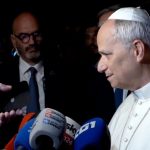 Pope Leo XIV Speaks Again About Trump and the War (and It Is Announced That the Pope Will Carry the Cross Throughout the Stations of the Cross on Good Friday)
