

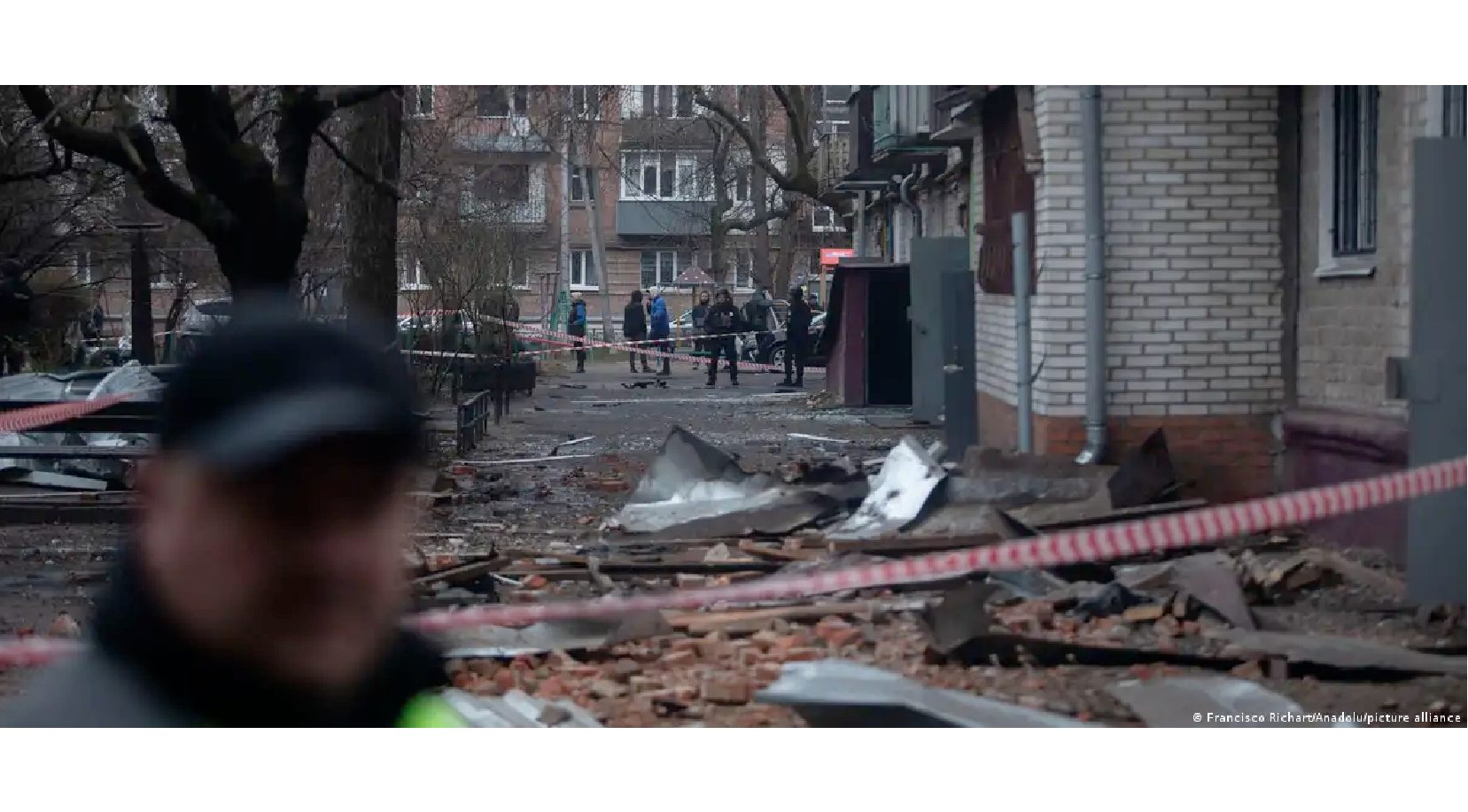
(ZENIT News / Colgne, 04.14.2026).- For a brief moment, the rhythm of war appeared to yield to the rhythm of faith. As Orthodox Christians marked Easter across a region scarred by conflict, a 32-hour ceasefire declared by Vladimir Putin offered the possibility—however fragile—of silence on the battlefield. By the time the liturgical celebrations reached their peak, that silence had already fractured.
Both Moscow and Kyiv emerged from the Easter weekend accusing each other of systematically violating the truce. Ukrainian military authorities reported 2,299 breaches within hours, ranging from artillery strikes to short-range drone attacks. Russia’s Ministry of Defense, for its part, claimed 1,971 violations by Ukrainian forces, including cross-border drone operations. Even within the limited scope of the ceasefire, the absence of long-range missile strikes or guided bombings suggested not peace, but a recalibration of hostilities.
The symbolism of the moment was difficult to ignore. Easter, the central feast of the Christian calendar, commemorates resurrection and renewal. Yet along the front lines of a war now entering its fourth year, it instead exposed the limits of religious gestures in the absence of political convergence. The ceasefire, announced unilaterally by the Kremlin, lacked the mutual guarantees that might have sustained it beyond a symbolic pause.
Volodymyr Zelenskyy had signaled conditional adherence, warning that any violation would trigger an immediate response. That warning proved prophetic. Ukrainian officials reported continued Russian assaults even before the truce formally ended, while Russian regional authorities, including those in Belgorod, pointed to civilian casualties attributed to Ukrainian strikes.
Within hours of the ceasefire’s expiration at midnight, hostilities resumed at scale. According to Ukrainian sources, Russia launched 98 drones overnight, of which 87 were intercepted by Kyiv’s air defenses. Moscow countered with its own figures, stating that 33 Ukrainian drones had been destroyed over Russian territory. The rapid return to full operational tempo underscored a reality that has become increasingly evident: pauses in this war are tactical, not transformative.
Yet beyond the military exchanges, the Easter weekend revealed a parallel narrative unfolding among civilians. On the outskirts of Kyiv, thousands gathered in open-air settings to observe traditional rituals. Families carried baskets filled with dyed eggs and paska bread to be blessed beside wooden churches, maintaining customs that predate the modern Ukrainian state. The coexistence of liturgy and latent violence defined the atmosphere: celebration tempered by skepticism.
For many, the ceasefire inspired little confidence. Previous attempts tied to religious or humanitarian occasions have consistently failed to hold. “Every time a holiday truce is announced, the shelling continues,” one participant observed, reflecting a widespread distrust shaped by experience rather than rhetoric.
And yet, the persistence of ritual itself carries meaning. A military chaplain presiding over the ceremonies framed Easter not only as a religious observance but as an affirmation of national identity. In his words, faith, tradition and territory form an indivisible whole—an understanding that helps explain why religious language has become intertwined with the narrative of resistance.
This intersection of faith and conflict was also visible at the highest political level. Zelenskyy and his wife chose to spend Easter visiting children orphaned, emphasizing a different dimension of the conflict: its generational cost. The gesture, quiet but deliberate, contrasted with the escalation unfolding on the battlefield.
Diplomatically, the days following the failed truce point to continued movement, albeit with uncertain prospects. Zelenskyy is expected to meet Giorgia Meloni, while Russian Foreign Minister Sergey Lavrov prepares for talks in China with Wang Yi. These parallel tracks—military escalation and diplomatic engagement—illustrate the dual nature of the conflict: entrenched on the ground, fluid in negotiation rooms.
The Easter ceasefire, though brief and ultimately ineffective, serves as a revealing episode. It highlights both the enduring power of religious symbolism and its limitations in the face of strategic imperatives. In a war where neither side shows readiness to concede core demands, even the most sacred moments struggle to impose a pause.
What remains is the image of a population that continues to celebrate resurrection under the shadow of drones, holding together fragments of normality while the broader horizon remains uncertain.
Thank you for reading our content. If you would like to receive ZENIT’s daily e-mail news, you can subscribe for free through this link.

Publicaciones relacionadas:
 Pope Francis Says That as a Child He Served A Ukrainian Priest Before Religious Leaders of That Country
 Pope to Lebanese after 4 years of explosion: “with you I ask for truth and justice, which have not yet arrived”
 Capuchin Priest Passed Himself Off as a Doctor and Nobleman to Swindle: His Order Makes Him Face Justice
 The World Health Organization Admits Chinese Laboratory Origin of COVID “Cannot Be Ruled Out”
