(ZENIT News / Rome, 04.14.2026).- At first glance, the contemporary world appears increasingly pluralistic. Migration, globalization and secularization have brought different beliefs into closer proximity than ever before. Yet a comprehensive study released by the Pew Research Center suggests a more nuanced reality: genuine religious diversity, understood as a relatively balanced coexistence of multiple faiths, remains the exception rather than the rule.
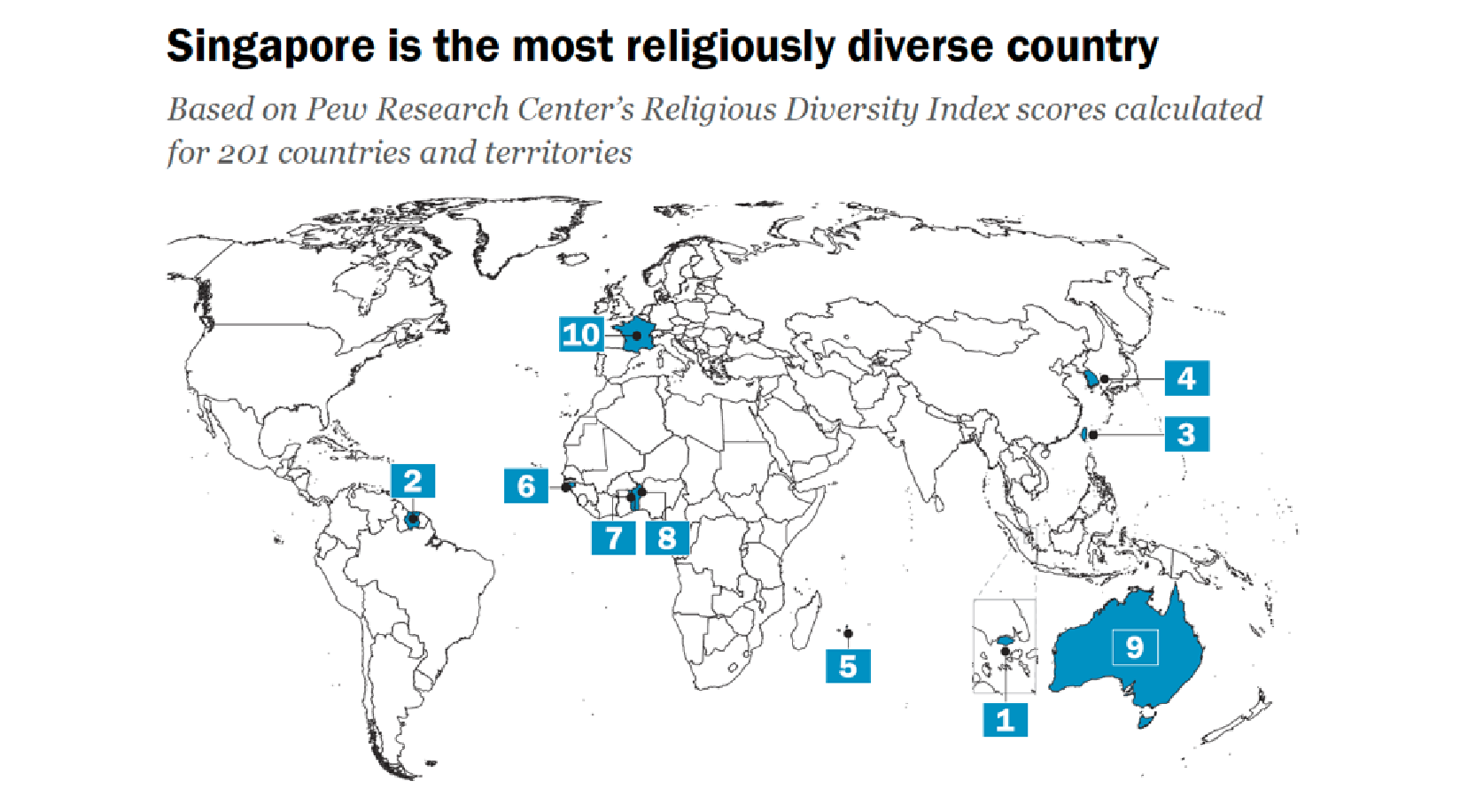
At the center of this global map stands Singapore, identified as the most religiously diverse country in the world as of 2020. Its composition illustrates what the researchers define as a near-equilibrium: Buddhists make up 31 percent of the population, followed by the religiously unaffiliated at 20 percent, Christians at 19 percent, Muslims at 16 percent, Hindus at 5 percent and other religious traditions at 9 percent. With a score of 9.3 on a scale from 0 to 10, the country comes closer than any other to an even distribution among the world’s principal religious groups.
This index, known as the Religious Diversity Index, does not measure the intensity of belief but the balance between groups. A score of zero would indicate total uniformity, while a perfect 10 would reflect an almost equal presence of all seven major categories used in the study: Christians, Muslims, Hindus, Buddhists, Jews, adherents of other religions and those with no religious affiliation. No country reaches that theoretical maximum.
Singapore’s position is far from typical. In fact, in 194 of the 201 countries and territories analyzed, a single religious group constitutes at least half of the population. Even more striking, in 43 places that dominance exceeds 95 percent. Religious homogeneity, not diversity, remains the global norm.
The contrast becomes even sharper when examining the least diverse countries. Yemen, Afghanistan and Somalia rank at the bottom of the index, each with Muslim populations exceeding 99.8 percent. In total, eight of the ten least diverse countries are overwhelmingly Muslim-majority, while the remaining two—Timor-Leste and Moldova—are almost entirely Christian.
Between these extremes lies a relatively small group of countries where diversity is both visible and structurally significant. Suriname, the only Latin American nation in the global top ten, offers a rare example of multi-religious balance: 53 percent of its მოსახლation is Christian, alongside 22 percent Hindus, 13 percent Muslims and 8 percent unaffiliated. Other highly diverse societies are concentrated in Asia-Pacific—such as Taiwan, South Korea and Australia—or in sub-Saharan Africa, including Mauritius, Togo and Benin. France stands alone as the only European country in the top tier, with a near parity between Christians (46 percent) and the religiously unaffiliated (43 percent), complemented by a 9 percent Muslim minority.
The United States presents a distinctive case. It does not rank among the ten most diverse countries overall, occupying 32nd place with a score of 5.8. Yet among the world’s most populous nations—those exceeding 120 million inhabitants—it emerges as the most religiously diverse. Around 64 percent of Americans identified as Christian in 2020, while nearly 30 percent reported no religious affiliation. The remaining 6 percent is distributed among smaller groups, each representing between 1 and 2 percent of the population.
This internal plurality places the United States ahead of other large nations such as Nigeria, Russia, India and Brazil. Nigeria, in particular, stands out for a different kind of balance: a near-even division between Christians and Muslims, each accounting for more than 40 percent of the population. Such “dual equilibria” represent another form of diversity, though more polarized than the multi-religious mosaic seen in Singapore.
Globally, however, only a minority of people live in highly diverse environments. Just 1 percent of the world’s population resides in countries classified as having very high religious diversity, while 19 percent live in highly diverse contexts. The majority inhabit societies with moderate (59 percent), low (9 percent) or very low (12 percent) diversity.
Geography plays a decisive role. The Asia-Pacific region is the most diverse overall, with an index score of 8.7, reflecting the coexistence of large populations of Buddhists, Hindus, Muslims, Christians and the unaffiliated. Notably, no single group forms a majority across the region. By contrast, the Middle East and North Africa register the lowest diversity score, at 1.3, with Muslims accounting for 94 percent of the population.
Europe and North America occupy an intermediate position, both characterized by Christian majorities and significant secular minorities. In these regions, the growth of the religiously unaffiliated has been a key driver of increasing diversity over the past decade. In the United States, for example, the proportion of Christians declined by 14 percentage points between 2010 and 2020, contributing to a shift from moderate to high diversity.
This trend points to an important dynamic often overlooked in discussions of pluralism: diversity does not necessarily arise from the expansion of multiple religious traditions, but can also result from the erosion of a dominant one. In several Western countries, rising secularization has diversified the religious landscape without increasing the number of active faith communities.
The methodological choices behind the index also shape its conclusions. By grouping the world’s religions into seven broad categories, the study allows for global comparability but inevitably simplifies internal complexities. Christianity alone, for instance, encompasses a vast array of denominations, while Islam, Hinduism and Buddhism each contain significant internal diversity. A more granular approach might yield different results, potentially increasing the apparent diversity of countries such as the United States or Pakistan.
Even so, the broader pattern remains clear. While modern societies often perceive themselves as increasingly plural, true religious balance is rare and geographically concentrated. Most nations continue to be defined by a dominant religious identity, even as minority groups and secular populations grow.
The global religious landscape, then, is not converging toward uniform diversity but evolving along multiple trajectories. In some regions, pluralism is deepening; in others, homogeneity persists; and in many, secularization is quietly redrawing the boundaries of belief.
Thank you for reading our content. If you would like to receive ZENIT’s daily e-mail news, you can subscribe for free through this link.