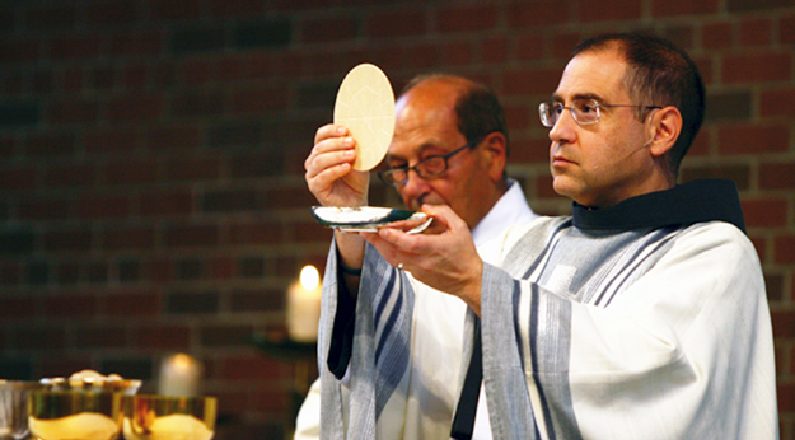
(ZENIT News / Rome, 07.05.2026).- Answered by Legionary of Christ Father Edward McNamara, professor of liturgy and sacramental theology at the Pontifical Regina Apostolorum university.
Q: Before the Prayer over the Gifts, the priest celebrant extends his hands, saying, “Pray, brethren, that my sacrifice and yours may be acceptable to God, the almighty Father.” Is the word «sacrifice» preferred to the Body and Blood of the Lord into which bread and wine will be transformed, or it simply means the gifts (bread and wine) on the altar at the moment? — A.P.H., Washington, D.C.
A: I would say that the word «sacrifice» in this context certainly includes the bread and wine on the altar and the Body and Blood of Christ into which they will be transformed.
However, the concept of sacrifice in the context of the Mass, while it embraces the Eucharistic transformation of the species, is much deeper because it makes present to us the one and only paschal mystery of Jesus.
Christ’s sacrifice is made present again, and we, as ministerial priest and baptized faithful, are able to participate, each one in his or her proper manner; and through this participation, preferably culminating in communion, the New Covenant is continually being ratified, and Christ’s Church more fully established.
In other words, while the real presence is a dogma of faith, and is of enormous importance in the Church’s life, we do not celebrate Mass in order to have hosts for adoration. It is the Mass itself which is the central act of our faith even if it were to happen that there were no hosts left over at the end. This is the context of the adage «The Church makes the Eucharist, and the Eucharist makes the Church.»
This is beautifully expressed in the Roman Canon. In concluding the consecration, the priest repeats the words of Christ: «Do this in memory of me.»
First, there is the people’s acclamation of the Mystery of Faith, then the priest continues:
«Therefore, O Lord,
as we celebrate the memorial of the blessed Passion,
the Resurrection from the dead,
and the glorious Ascension into heaven
of Christ, your Son, our Lord,
we, your servants and your holy people,
offer to your glorious majesty
from the gifts that you have given us,
this pure victim,
this holy victim,
this spotless victim,
the holy Bread of eternal life
and the Chalice of everlasting salvation.
«Be pleased to look upon these offerings
with a serene and kindly countenance,
and to accept them,
as once you were pleased to accept
the gifts of your servant Abel the just,
the sacrifice of Abraham, our father in faith,
and the offering of your high priest Melchizedek,
a holy sacrifice, a spotless victim.»
The «therefore» in this prayer, in a certain manner takes its cue from Christ’s command to do this as a memorial of him.
In Sacred Scripture, a memorial (anamnesis) is much more than a simple recalling of a historical event; in a mystical but real way, it makes that event present. In the Old Testament, the principal memorial was the annual paschal celebration in which the covenant of Sinai was renewed and ratified through the sacrifice of the paschal lamb. During the last supper, Christ took this symbolism on himself in establishing the new and eternal covenant with the Eucharist.
Thus, in the above prayer of the Roman Canon, coming immediately after the consecration, we can say that the Mass explains itself. It is not limited to the passion, but encapsulates Christ’s resurrection, ascension, and (in Eucharistic Prayer III and IV) the waiting for the second coming. The Church celebrates all of this in every holy Mass, and it is this to which the priest refers when he invites the whole assembly to pray that «my sacrifice and yours may be acceptable ….»
Certainly, Christ’s sacrifice will always be acceptable to the Father, but we, as imperfect human beings, whether sacred minister or baptized Catholic, must pray that our participation in this sacrifice may be made worthy to be joined to that of Christ.
Historically, we find many versions of this formula and its response. In its earliest form it would appear to have been a petition by the priest that the people pray for him as he enters into the canon. Already in the eighth century we find the people included in a form very similar to our current version.
The present form of the people’s response can be found, above all in Italy, from the 12th century onward. Sometimes this response was said aloud by the ministers, but on other occasions it was an invitation for the whole assembly to recite it inaudibly.
The current manner in which both the invitation to pray and the response by the entire assembly is said in an audible way comes from the reforms following the Second Vatican Council which assume the theology of celebration that is already implicit in the prayer.
In 1980, Pope St. John Paul II elucidated the meaning of this sacrifice in the letter “Dominicae Cenae,” on Eucharistic worship, addressed to all the bishops of the Church. In section No. 9 he writes:
“It is important that this first moment of the Liturgy of the Eucharist in the strict sense should find expression in the attitude of the participants. There is a link between this and the offertory ‘procession’ provided for in the recent liturgical reform and accompanied, in keeping with ancient tradition, by a psalm or song. A certain length of time must be allowed, so that all can become aware of this act, which is given expression at the same time by the words of the celebrant.
“Awareness of the act of presenting the offerings should be maintained throughout the Mass. Indeed, it should be brought to fullness at the moment of the consecration and of the anamnesis offering, as is demanded by the fundamental value of the moment of the sacrifice. This is shown by the words of the Eucharistic Prayer said aloud by the priest. It seems worthwhile repeating here some expressions in the third Eucharistic Prayer that show in particular the sacrificial character of the Eucharist and link the offering of our persons with Christ’s offering: ‘Look with favor on your Church’s offering, and see the Victim whose death has reconciled us to yourself. Grant that we, who are nourished by his body and blood, may be filled with his Holy Spirit, and become one body, one spirit in Christ. May he make us an everlasting gift to you.’
“This sacrificial value is expressed earlier in every celebration by the words with which the priest concludes the presentation of the gifts, asking the faithful to pray ‘that my sacrifice and yours may be acceptable to God, the almighty Father.’ These words are binding, since they express the character of the entire Eucharistic Liturgy and the fullness of its divine and ecclesial content.
“All who participate with faith in the Eucharist become aware that it is a ‘sacrifice,’ that is to say, a ‘consecrated Offering.’ For the bread and wine presented at the altar and accompanied by the devotion and the spiritual sacrifices of the participants are finally consecrated, so as to become truly, really and substantially Christ’s own body that is given up and His blood that is shed. Thus, by virtue of the consecration, the species of bread and wine re-present in a sacramental, unbloody manner the bloody propitiatory sacrifice offered by Him on the cross to His Father for the salvation of the world. Indeed, He alone, giving Himself as a propitiatory Victim in an act of supreme surrender and immolation, has reconciled humanity with the Father, solely through His sacrifice, ‘having canceled the bond which stood against us.’
“To this sacrifice, which is renewed in a sacramental form on the altar, the offerings of bread and wine, united with the devotion of the faithful, nevertheless bring their unique contribution, since by means of the consecration by the priest they become sacred species. This is made clear by the way in which the priest acts during the Eucharistic Prayer, especially at the consecration, and when the celebration of the holy Sacrifice and participation in it are accompanied by awareness that ‘the Teacher is here and is calling for you.’ This call of the Lord to us through His Sacrifice opens our hearts, so that, purified in the mystery of our Redemption, they may be united to Him in Eucharistic Communion, which confers upon participation at Mass a value that is mature, complete and binding on human life: ‘The Church’s intention is that the faithful not only offer the spotless victim but also learn to offer themselves and daily to be drawn into ever more perfect union, through Christ the Mediator, with the Father and with each other, so that at last God may be all in all.’
“It is therefore very opportune and necessary to continue to actuate a new and intense education, in order to discover all the richness contained in the new liturgy. Indeed, the liturgical renewal that has taken place since the Second Vatican Council has given, so to speak, greater visibility to the Eucharistic Sacrifice. One factor contributing to this is that the words of the Eucharistic Prayer are said aloud by the celebrant, particularly the words of consecration, with the acclamation by the assembly immediately after the elevation.
“All this should fill us with joy, but we should also remember that these changes demand new spiritual awareness and maturity, both on the part of the celebrant-especially now that he celebrates ‘facing the people’ and by the faithful. Eucharistic worship matures and grows when the words of the Eucharistic Prayer, especially the words of consecration, are spoken with great humility and simplicity, in a worthy and fitting way, which is understandable and in keeping with their holiness; when this essential act of the Eucharistic Liturgy is performed unhurriedly; and when it brings about in us such recollection and devotion that the participants become aware of the greatness of the mystery being accomplished and show it by their attitude.”
* * *
Readers may send questions to zenit.liturgy@gmail.com. Please put the word «Liturgy» in the subject field. The text should include your initials, your city and your state, province or country. Father McNamara can only answer a small selection of the great number of questions that arrive.
Thank you for reading our content. If you would like to receive ZENIT’s daily e-mail news, you can subscribe for free through this link.