

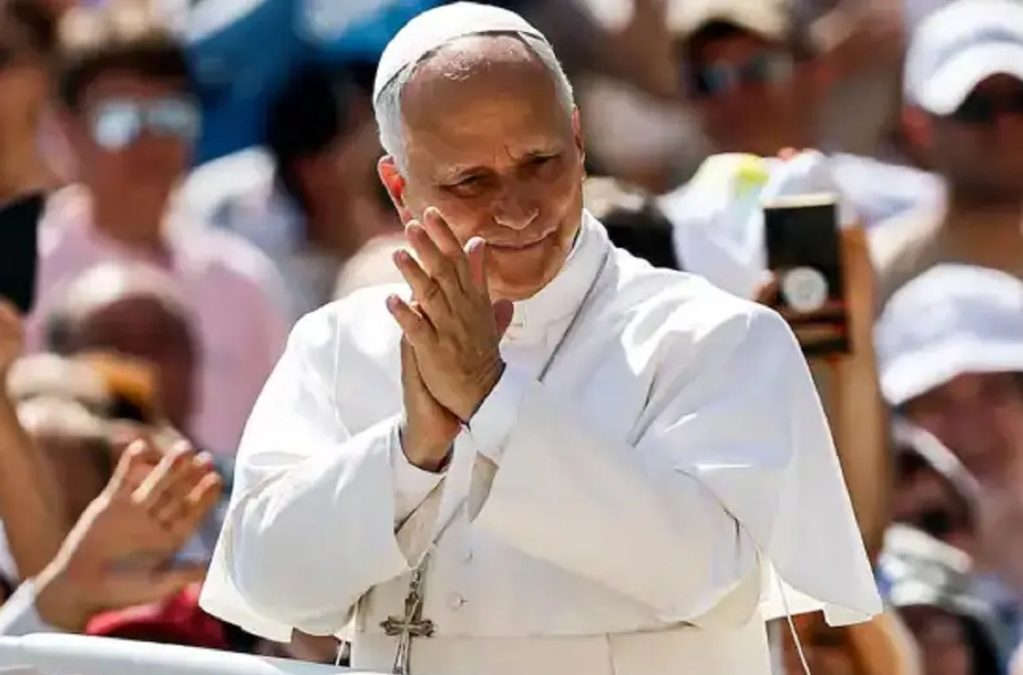
(ZENIT News / Buenos Aires, 08.12.2026).- As Argentina prepares to welcome Pope Leo XIV this November, the country’s Church is doing something unusual: inviting the faithful not only to attend a papal visit, but to help compose its soundtrack and build its success from the ground up.
With less than three months remaining before the Pope’s arrival, the Argentine Episcopal Conference (CEA) has launched two nationwide initiatives that reveal how seriously the local Church views this moment. One seeks financial support to organize the visit. The other seeks an official hymn capable of capturing the spiritual meaning of an event many bishops describe as a gift for the entire nation.
The apostolic journey, scheduled for November 8-11, will be part of Leo XIV’s South American tour, which also includes Uruguay and Peru. For Argentina, however, the significance extends beyond the normal expectations surrounding a papal trip. According to the bishops, it will mark the first visit of a Pope to the country in 39 years, making it one of the most anticipated ecclesial events in a generation.
Rather than limiting preparations to logistical planning, the Church has chosen to involve ordinary Catholics directly in the process. One of the most innovative elements is a national competition to select the official song of the papal visit.
Open to Argentine citizens over the age of 18, the contest invites composers, musicians, and creative teams to submit original works inspired by the Pope’s forthcoming journey and by a passage from Leo XIV’s encyclical Magnifica Humanitas. In that text, the Pontiff encourages Christians not to fear “getting their hands dirty” in the challenges of the contemporary world while keeping both God and the human person at the center of social life.
Organizers have deliberately avoided imposing a specific musical style. Participants may submit entries from any genre, provided the songs are original, written primarily in Spanish, and between two and four minutes in length. Indigenous languages may also be incorporated, reflecting the cultural diversity that has long shaped Argentine identity.
The rules reveal another feature of the Church’s effort to engage modern culture without surrendering artistic authenticity: the careful regulation of artificial intelligence.
Competitors are permitted to use AI tools for technical assistance, such as editing, mixing, mastering, or creating instrumental reference tracks. However, the composition itself must remain fundamentally human. The use of artificial intelligence to generate substantial portions of the lyrics or music, or to clone performers’ voices, is explicitly prohibited. Participants must disclose any use of AI, and organizers reserve the right to request evidence of the creative process.
In an age when artificial intelligence is rapidly transforming artistic production, the decision reflects a growing concern within both cultural and ecclesial circles about preserving genuine human creativity while taking advantage of technological advances.
Submissions will be accepted from August 10 through September 10. A jury drawn from both the musical and ecclesial worlds will evaluate the entries according to their artistic quality, originality, interpretation, and fidelity to the themes proposed by the organizers. The winning song will be announced on September 24 and will accompany official materials connected with the papal visit.
Music, however, is only one aspect of the preparations.
Argentina’s bishops have also announced a nationwide special collection to be taken during Masses on August 22 and 23. The initiative aims to help finance the extensive organizational effort required for a papal journey, including infrastructure, communications, security coordination, liturgical venues, and logistical services.
In a letter addressed to priests, deacons, religious communities, and pastoral councils, the bishops described Leo XIV’s arrival as far more than a ceremonial event. They portrayed the Pope as a pastor and visible sign of unity whose presence can strengthen faith, encourage evangelization, and foster a renewed spirit of fraternity.
Notably, the bishops emphasized that the visit is not intended only for practicing Catholics. They expressed hope that it might also serve the broader national community, encouraging dialogue, social friendship, and what the Church frequently calls a “culture of encounter,” a concept that has become increasingly important in Catholic social thought.
The appeal for financial support is therefore being framed as more than a fundraising effort. Church leaders have presented each contribution as a tangible expression of communion with the Successor of Peter and a way for every parish and local community to participate actively in the event.
Their message echoes a characteristic feature of Catholicism often overlooked by outside observers: major papal visits are not organized solely by ecclesiastical authorities. They are typically made possible through the combined efforts of volunteers, parish communities, benefactors, musicians, families, and countless ordinary believers working behind the scenes.
If the bishops’ plans succeed, Argentina’s welcome to Leo XIV will be expressed not only through crowds lining the streets or attending Masses, but also through a song created by its people and a collective effort to prepare for a visit they hope will leave lasting spiritual and civic fruits.
For a country marked by strong religious traditions but also by social and political challenges, the preparations suggest that the Church hopes the Pope’s arrival will become more than a historic memory. It seeks to turn the visit into a shared national experience, one capable of inspiring faith, participation, and unity long after the papal plane has departed.
Thank you for reading our content. If you would like to receive ZENIT’s daily e-mail news, you can subscribe for free through this link.

Publicaciones relacionadas:
 It’s for Real: Church in Spain Launches Website About Pope’s Visit and Announces Working Teams for Barcelona.
 Did Pope Leo XIV speak out against the Spanish party Vox, which is aligned with the Trump administration?
 An Italian: this is the Pope’s new ambassador “to” Donald Trump
 German bishops push their progressive agenda in Rome: an audience with Pope Leo XIV and the presentation of a synodal project to the Curia
