

(ZENIT News / Rome, 08.13.2026).- For much of the twentieth century, churches stood among the most trusted institutions in American life. They were places where citizens sought not only religious guidance but also moral leadership, social stability, and community belonging. Today, however, they are increasingly caught in a broader crisis of confidence that extends across nearly every major institution in the United States.
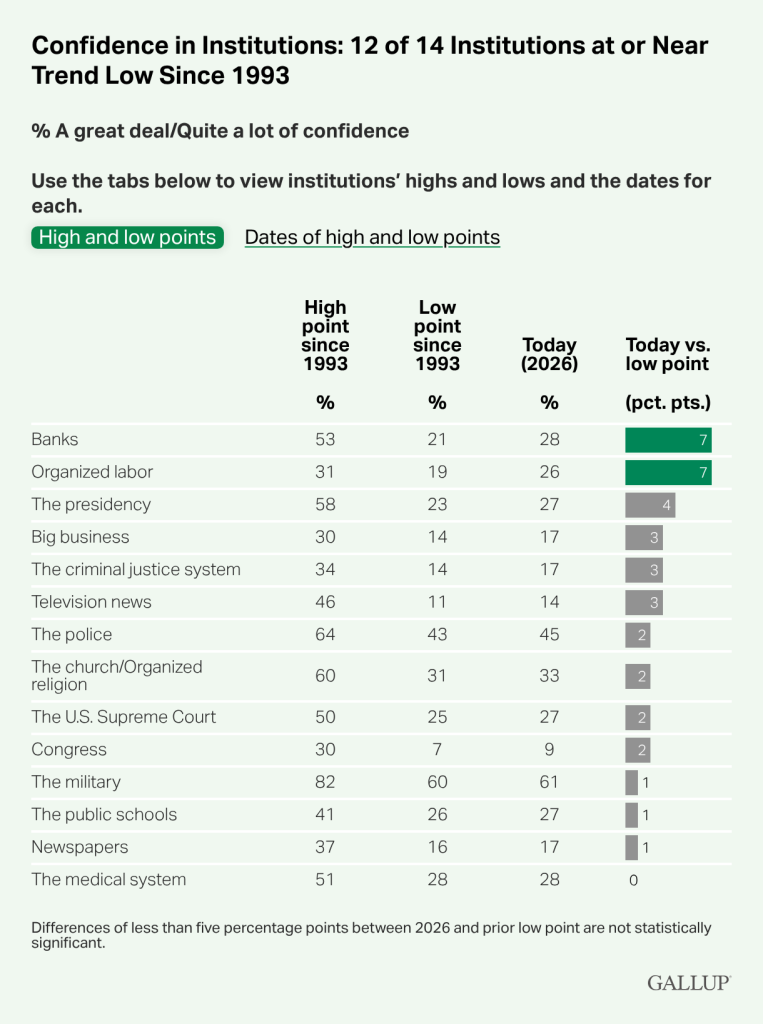
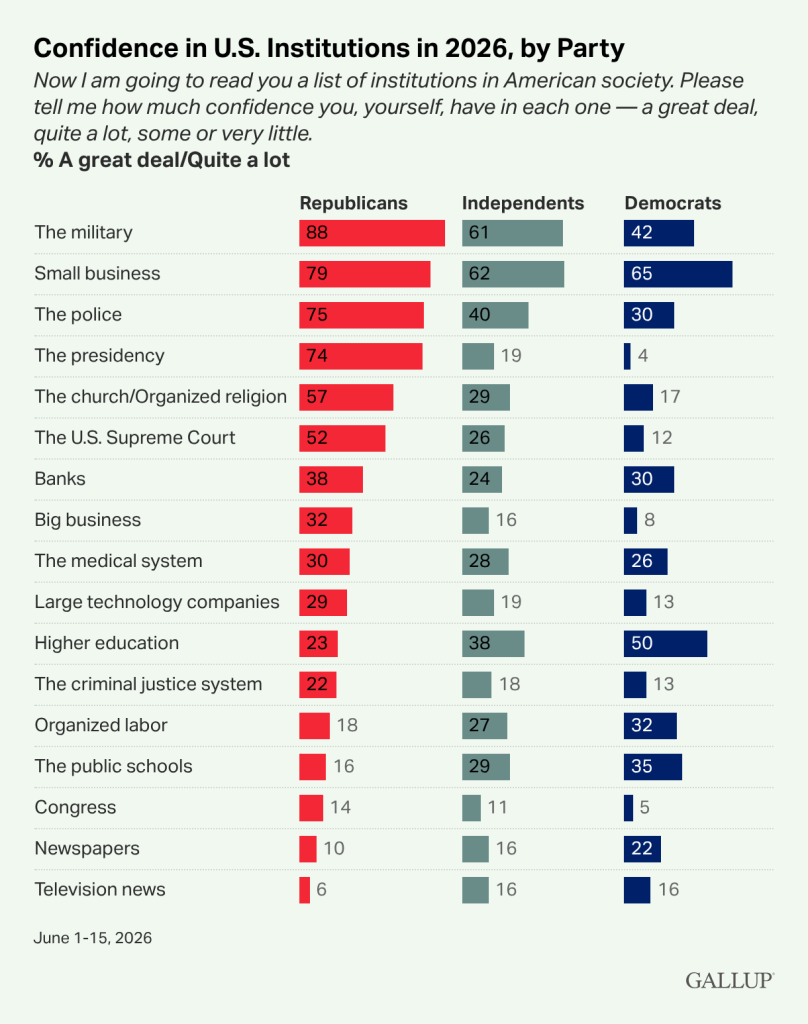
New findings from Gallup’s 2026 annual survey reveal that only 33% of Americans express either “a great deal” or “quite a lot” of confidence in organized religion or the Church. While that figure remains higher than many institutions, it places religious organizations far below the levels of trust they once enjoyed and only slightly above their historic low.
The result follows a brief rebound in 2025, when confidence rose from 32% to 36%. That recovery proved temporary. The latest figures suggest that mistrust, rather than confidence, remains the dominant mood among Americans.
The decline is particularly striking when viewed over the long term. When Gallup began measuring public trust in churches in the early 1970s, religious institutions occupied a position of extraordinary prestige. In 1975, 68% of Americans said they had substantial confidence in the Church. Even after periods of fluctuation, trust remained relatively strong for decades.
A notable exception came after the terrorist attacks of September 11, 2001. Like several other national institutions, churches experienced a surge in public confidence as Americans sought sources of meaning and unity during a period of national trauma. Trust reached 60% that year, the last time such a large proportion of Americans expressed confidence in organized religion.
By 2009, a narrow majority of Americans, 52%, still reported high levels of trust. Yet the downward trend accelerated in the following decade. In 2018, confidence fell below 40% for the first time. Although there were modest fluctuations afterward, the overall trajectory has remained unmistakably negative.
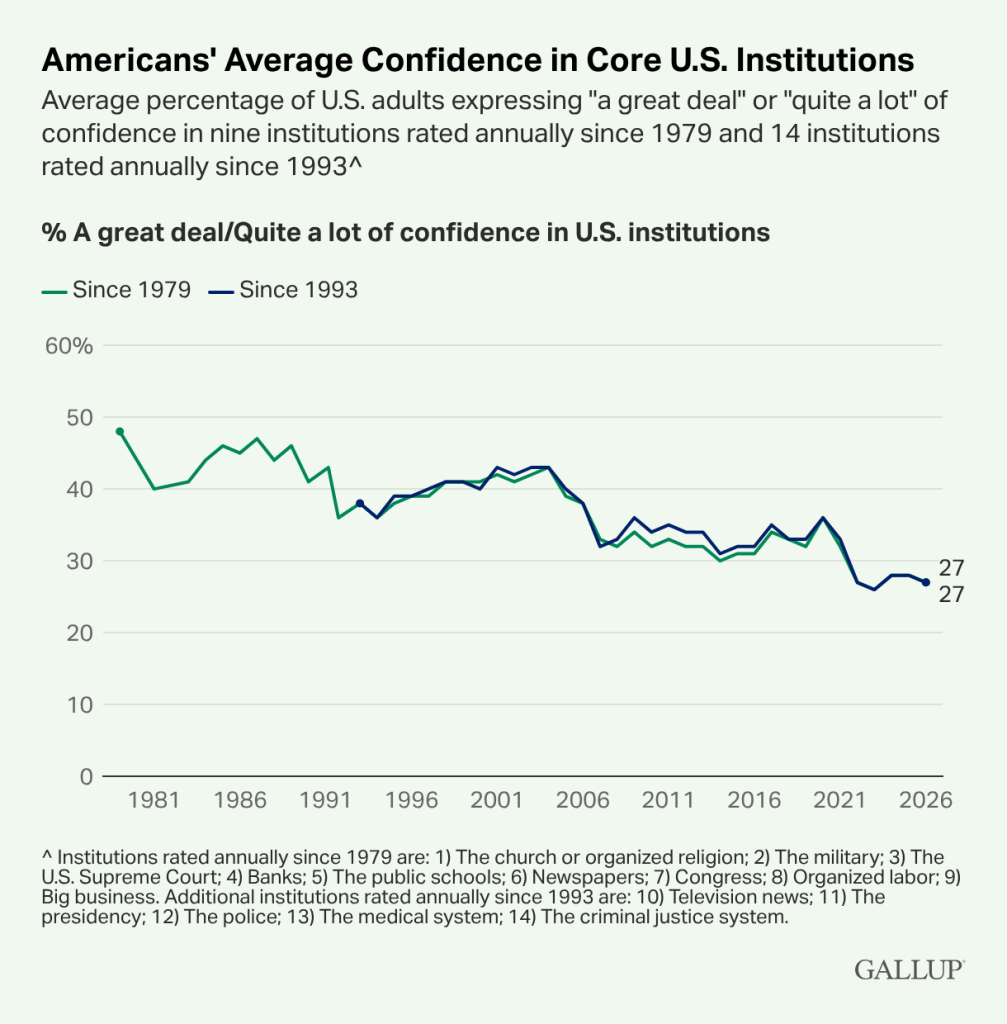
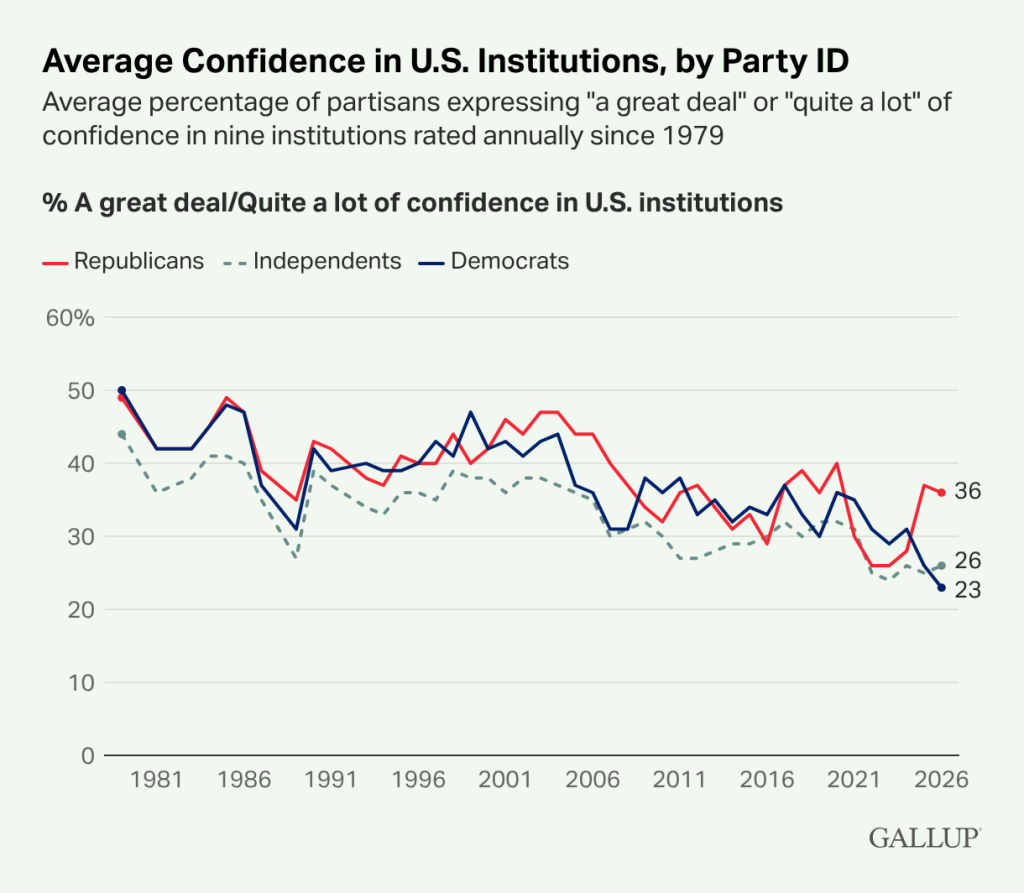
Importantly, the decline in trust toward churches cannot be understood in isolation. The Gallup survey paints a picture of a society increasingly skeptical of virtually all centers of authority. The average confidence level across major institutions now stands at 27%, compared with 48% in 1979.
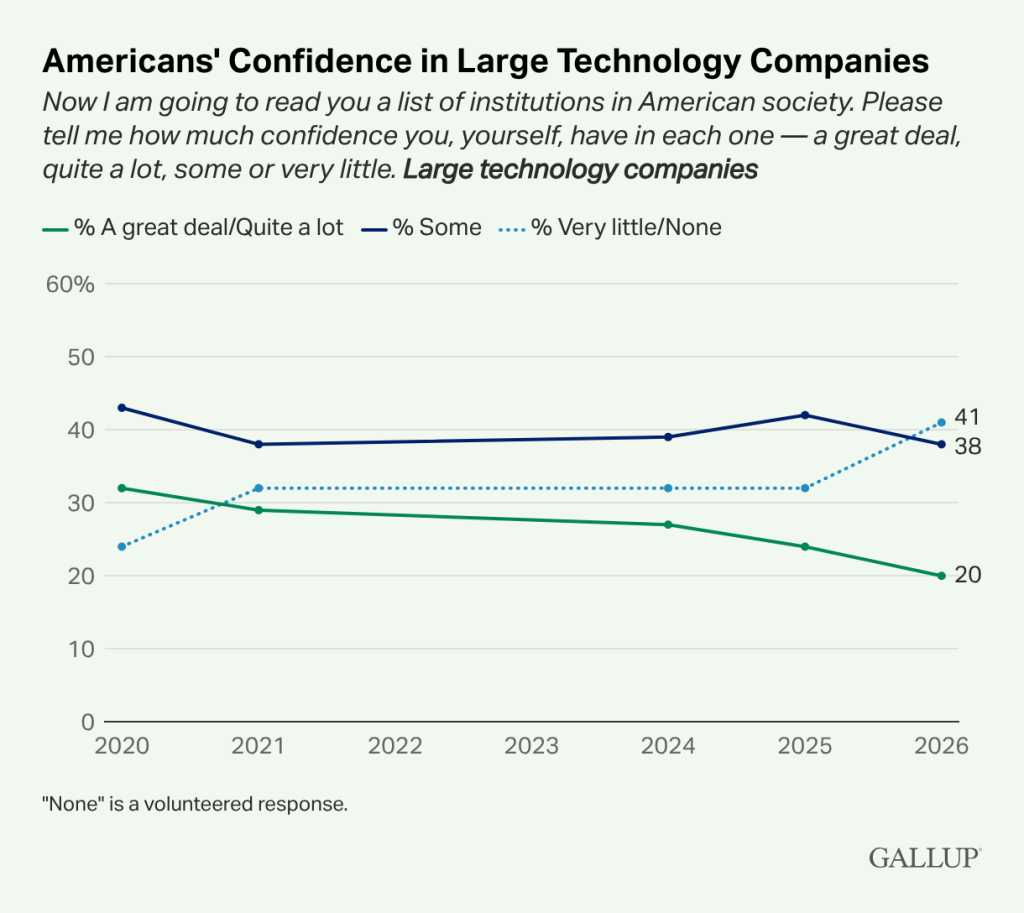
Only two institutions still enjoy the confidence of a majority of Americans: small businesses, trusted by 67% of respondents, and the military, trusted by 61%. Churches, at 33%, remain ahead of many sectors but no longer occupy the prominent place they once held in the national imagination.
The findings also reveal a profound political divide. Among Republicans, 57% continue to express confidence in the Church. That figure drops to 29% among independents and only 17% among Democrats.
This gap reflects a broader transformation in American religious life. Increasingly, many worshippers seek congregations where the prevailing political culture aligns with their own views. At the same time, Americans who identify outside the Republican orbit are statistically more likely never to attend religious services. The result is a growing risk that churches become perceived less as spiritual communities open to all and more as institutions associated with particular political identities.
Such polarization presents a serious challenge for Christian communities. Historically, churches often served as one of the few places where citizens from different social classes, ethnic backgrounds, and political opinions gathered under one roof. The more religious life mirrors political divisions, the harder it becomes to maintain that unifying role.
The survey also highlights important demographic differences. Older Americans continue to place far greater trust in organized religion than younger generations. Among adults aged 55 and older, 41% report substantial confidence in the Church, compared with only 26% among those under 55.
Educational attainment appears to influence attitudes as well. Confidence is highest among Americans with a high school education or less, at 36%, and gradually declines among those with more advanced academic backgrounds. College graduates report confidence levels of just 27%.
Meanwhile, non-white Americans express slightly lower confidence in organized religion than white Americans, with figures of 29% and 34% respectively.
For religious leaders, these numbers raise questions that go beyond statistics. The challenge is not merely institutional reputation but credibility itself. Many Americans increasingly distrust authorities of every kind, whether political, media, economic, judicial, or religious.
From a Catholic perspective, this findings may also serve as a reminder that credibility cannot be restored primarily through public relations campaigns. Historically, the Church has renewed trust most effectively through holiness, service, intellectual seriousness, charitable works, and visible solidarity with families, the poor, and the vulnerable. Institutions regain confidence when people encounter integrity in practice rather than promises in theory.
The Gallup data suggest that America is living through something larger than a crisis of religion. It is experiencing a crisis of trust. Churches remain among the more respected institutions in the country, but they are no longer exceptional. For generations raised amid polarization, scandal, social fragmentation, and digital skepticism, confidence must increasingly be earned rather than assumed.
Thank you for reading our content. If you would like to receive ZENIT’s daily e-mail news, you can subscribe for free through this link.

Publicaciones relacionadas:
 What Would Happen or What Protocol Would Be Activated on the Death of Benedict XVI?
 20% of the Congressmen of the New U .S. Congress Are Catholics
 The Ten Countries That Made the Most Financial Contributions to the Pope in 2023
 On the Exhortation Dilexi te: when Peter reminds us that the poor are at the heart of the Gospel
