

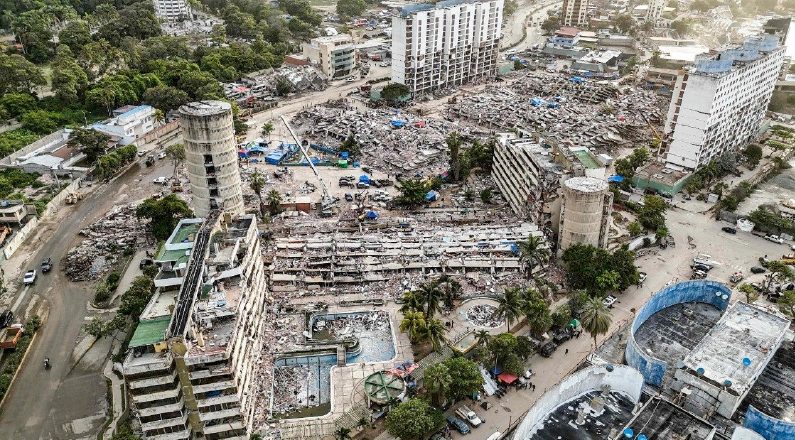
(ZENIT News / Caracas, 07.23.2026).- One month after a devastating double earthquake struck Venezuela, the country is confronting a second disaster: the immense and complicated task of reconstruction.
The tremors of June 24 left at least 4,118 people dead, damaged hundreds of buildings and exposed the deep vulnerability of a nation whose economic and institutional capacity was already under severe strain. The damage is now estimated at nearly $40 billion, according to an assessment cited by the dean of the Faculty of Engineering at the Catholic Andrés Bello University in Caracas.
The official early figures recorded 855 damaged buildings nationwide, including 189 that completely collapsed. Approximately eight out of every ten of those collapses were concentrated in the coastal state of La Guaira.
But the real scale of the destruction is likely greater.
An analysis by the United Nations Office for Disaster Risk Reduction estimated direct damage at approximately $24 billion to public and private buildings and another $13 billion to infrastructure. Those figures cover physical destruction alone and do not include the indirect economic losses caused by the disaster.
The catastrophe was particularly severe along the coastal corridor between Catia La Mar and Caraballeda. A study by Anova Policy Research, conducted with the Microsoft AI for Good Research Lab, used high-resolution satellite imagery and artificial intelligence to examine individual buildings. Of 38,798 residential structures analyzed, 4,958—12.8 percent—showed visible damage. Some 2,654, or 6.8 percent of the total, were classified as severely damaged or destroyed.
View this post on Instagram
The study estimates that approximately 73,500 people lived in buildings with some degree of damage, while around 37,600 were living in structures with serious structural damage or collapse.
The destruction cannot be explained simply by the earthquake’s distance from the epicenter. According to engineering specialists, the second earthquake, with a magnitude of 7.5 on the San Sebastián fault, produced an unusually extensive rupture and strong west-to-east directivity along the coast. The geology of the area amplified the danger: large urban areas were built on deep alluvial deposits, in some places between 50 and more than 100 meters thick, capable of intensifying seismic movement and undergoing liquefaction.
The age and condition of the buildings added another layer of vulnerability. Much of the coastal housing stock was constructed between the 1950s and 1980s, while years of insufficient maintenance, inconsistent application of seismic standards and uncontrolled urban densification increased the risks.
The lesson is stark. A natural disaster may trigger the destruction, but the scale of the human tragedy is also shaped by decisions made long before the ground begins to move.
That is why the reconstruction now facing Venezuela cannot consist simply of replacing what collapsed in the same places and according to the same standards. The engineering experts consulted identify four essential priorities: planned and selective resettlement, reinforcement of surviving buildings, updated construction regulations and a credible financing and governance system.
The financial challenge alone is enormous. Rebuilding the damaged housing infrastructure along the coastal corridor is estimated to cost approximately $2.37 billion, equivalent to between 2 and 3 percent of Venezuela’s nominal gross domestic product. That estimate excludes public infrastructure, basic services, economic losses, demolition and the removal of rubble.
The scale of the destruction, experts warn, exceeds the country’s internal fiscal capacity. Multilateral financing, dedicated reconstruction funds and public-private co-financing mechanisms will therefore be indispensable.
The Church, meanwhile, is confronting the disaster not only as a provider of spiritual consolation but as a community whose own buildings and institutions have been damaged.
Of more than 100 churches in the Archdiocese of Caracas, at least 25 suffered damage of varying severity. In most of them, Masses have been moved outside because of safety concerns. The priority, the archdiocese’s vicar general has stressed, is not to expose parishioners to unnecessary danger.
Among the most seriously affected buildings are the Church of Saint Joseph of Ñaraulí, where an entire side of the nave collapsed, and the Church of Our Lady of Perpetual Help in Pagüita, together with its adjoining parish school. The Church of Our Lady of Mercy and Caracas Cathedral also suffered significant damage. Of the 25 affected churches, between eight and ten are believed to have serious damage.
The problem is not merely religious. Several of these buildings are national monuments or historic heritage sites. Their reconstruction will therefore require a balance between safety, structural engineering and the preservation of Venezuela’s architectural and cultural memory.
One month after the disaster, the Venezuelan bishops have placed the country’s reconstruction within a broader moral framework. In their message, titled “Samaritans, Witnesses of Hope,” they call for a rapid and profound rebuilding effort that provides the displaced with decent homes and work, as well as spiritual and psychological support.
But the bishops also issue a warning: reconstruction must not become an opportunity for corruption, political manipulation or the repetition of the negligence that helped leave vulnerable populations exposed.
Natural disasters cannot be prevented, they argue, but public institutions have a duty to prepare for them. The rebuilding process must therefore correct past failures rather than reproduce them.
That appeal is especially significant in a country already burdened by profound social and economic hardship. The bishops say reconstruction must not forget other groups suffering from poverty and exclusion, including political prisoners, workers and pensioners living on extremely low incomes, the sick and migrants.
Their message is rooted in the parable of the Good Samaritan, but it is not a call to passive charity. To be a “Samaritan” in the aftermath of the earthquake means to enter into the suffering of others and accept responsibility for relieving it.
The bishops have praised the solidarity shown by ordinary Venezuelans, particularly the poor, whom they describe as among the first and most generous rescuers. They have also honored those who risked their lives searching for survivors in the ruins, as well as national and foreign rescuers and volunteers who crossed borders to help.
That solidarity has become one of the few elements of light in a catastrophe that has exposed so much institutional weakness.
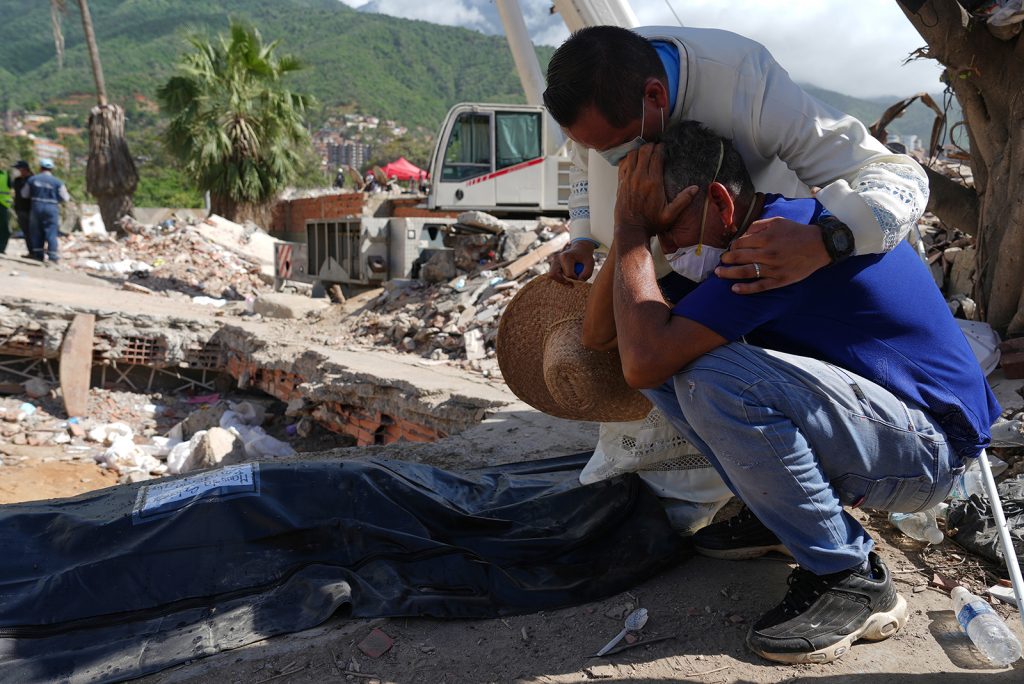
A Catholic priest comforts Carlos Berroterán beside the body of his niece, Manuela Solórzano, 17, recovered from the rubble of their home three weeks after it collapsed during the earthquakes that struck La Guaira, Venezuela, Friday, July 17, 2026. (AP Photo/Ariana Cubillos)
The bishops have also rejected attempts to portray the earthquakes as divine punishment. In a country asking where God can be found amid such anguish, their answer is that God is present with the victims—and in those who come to their aid.
The question now is whether Venezuela can transform that spirit of solidarity into a reconstruction capable of protecting lives in the future.
The engineering challenge is immense. The financial obstacles are formidable. The institutional conditions are fragile. But the alternative is clear: rebuilding quickly without correcting the weaknesses that made the disaster so devastating would merely preserve the conditions for another tragedy.
The earthquake has destroyed homes, churches and infrastructure. Venezuela’s response will determine whether it also becomes the beginning of a more responsible approach to urban planning, construction standards and public safety.
For the Catholic Church, the task is both practical and spiritual: to preserve its historic places of worship where possible, continue accompanying the wounded and bereaved, and remain alongside a population that must rebuild not only its cities but its confidence.
The real test of reconstruction will therefore not be how quickly the ruins disappear. It will be whether the people who return to the rebuilt cities are safer than those who lived there before June 24.
Thank you for reading our content. If you would like to receive ZENIT’s daily e-mail news, you can subscribe for free through this link.

Publicaciones relacionadas:
 Cardinal Ambongo: statements on the new colonialisms and Fiducia Supplicans
 Easter massacre: extremists kill 10 people, including a pregnant woman and her baby in the womb
 Research Shows Slump in Pope Francis’ Popularity in the United States
 American Catholic Church Commends President Trump for Acknowledging Starvation in Gaza and Urges Administration to Expand Humanitarian Access
