

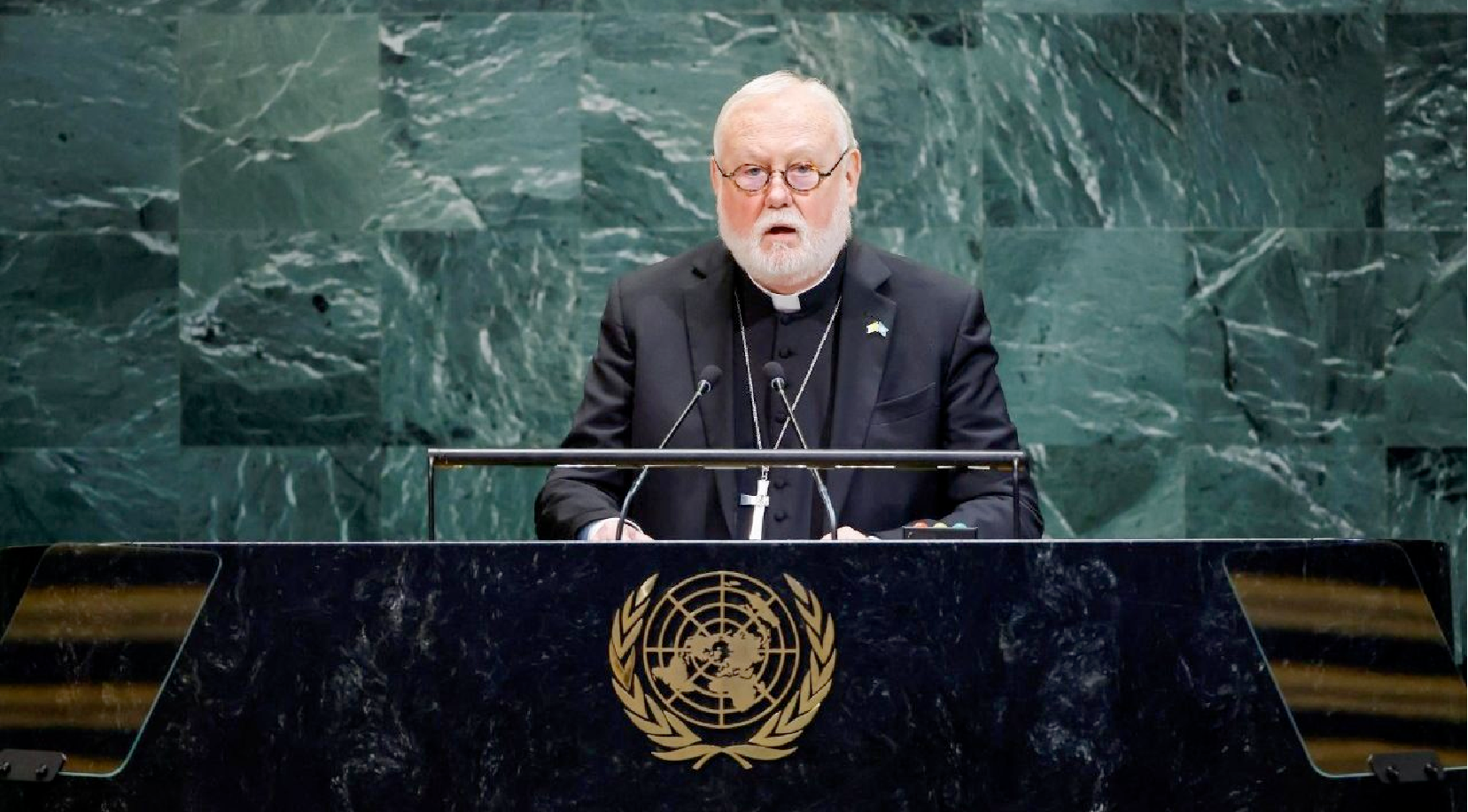
(ZENIT News / Moscow, 08.24.2026).- The Vatican is once again testing the possibilities of diplomacy in Moscow. Archbishop Paul Richard Gallagher, the Holy See’s secretary for relations with states and international organizations, arrived in the Russian capital on August 24 for a four-day mission that places him in direct contact with senior Russian officials, the Moscow Patriarchate and the country’s small Catholic community.
The timing is significant. Gallagher’s visit comes as Russia’s war against Ukraine continues and as European leaders gathered in Kyiv on August 24 to mark Ukraine’s 35th anniversary of independence. The contrast is striking: while political leaders were demonstrating solidarity with Ukraine, the Vatican’s senior diplomat was entering Moscow. Yet the two movements are not necessarily contradictory. For the Holy See, maintaining a channel to an aggressor does not mean abandoning the victims of aggression; it is part of preserving whatever diplomatic space might eventually be useful for peace and humanitarian action.
Gallagher’s schedule makes that strategy unusually clear. On August 25 he is due to meet Foreign Minister Sergey Lavrov and Metropolitan Antoniy of Volokolamsk, who heads the Moscow Patriarchate’s department for external church relations. On August 26, he is scheduled to meet Yuri Ushakov, foreign-policy adviser to President Vladimir Putin. The following day, Gallagher will turn his attention to Catholics, meeting clergy and religious and celebrating Mass at Moscow’s Cathedral of the Immaculate Conception before meeting the country’s bishops. He is due back in Rome on August 28.
There is an important distinction in this itinerary. Gallagher is not traveling simply as an intermediary between Moscow and Kyiv. His meetings encompass state diplomacy, relations with the Russian Orthodox Church and the pastoral concerns of Catholics. The Holy See has therefore constructed a mission with several channels operating simultaneously.
That approach has survived the transition from Pope Francis to Pope Leo XIV. Before his election, Robert Francis Prevost had spoken more forcefully about Russian aggression than Francis sometimes did. Yet the change of pope has not produced a retreat from Vatican diplomacy. Rome has continued to favor dialogue over diplomatic isolation while keeping humanitarian concerns at the center of its efforts.
Gallagher’s return to Moscow is particularly noteworthy because his previous visit took place in November 2021, only months before the full-scale invasion of Ukraine. At that time he met Russian Prime Minister Mikhail Mishustin, Lavrov and Metropolitan Hilarion, then the principal foreign-relations figure of the Moscow Patriarchate. Much has changed since then, including the Vatican’s relationship with Moscow’s Orthodox leadership.
The ecumenical dimension may be among the most difficult aspects of the mission. The war has deepened divisions within Eastern Christianity and strained relations between Rome and the Moscow Patriarchate. A planned meeting between Pope Francis and Patriarch Kirill that had been under consideration before the invasion never materialized. Hilarion, once regarded as an important interlocutor for Rome, was subsequently moved to Budapest.
Gallagher’s meetings therefore involve more than diplomatic protocol. Reopening lines of communication with Moscow’s religious and political authorities could help preserve a channel that may become valuable for humanitarian initiatives, prisoner issues or future peace efforts. Cardinal Matteo Zuppi’s separate mission has already demonstrated the Vatican’s preference for combining formal diplomacy with humanitarian engagement. Zuppi traveled to Ukraine in July and met Russian prisoners of war there; Russian sources have reported that another trip to Moscow could follow in September.
Moscow, meanwhile, appears to see advantages of its own. Russian officials have described Gallagher’s visit as an opportunity to present their assessment of international affairs directly to the Holy See. Grigory Karasin, chairman of the Russian Federation Council’s foreign-affairs committee, said Moscow hoped the visit would produce concrete proposals or useful assessments and create conditions for further progress.
That does not mean Russia and the Vatican share the same interpretation of the war. Nor does dialogue erase the moral and humanitarian questions raised by Russia’s invasion. Rather, Moscow’s willingness to receive a senior Vatican diplomat illustrates why the Holy See continues to regard diplomatic access as an instrument rather than a reward.
The Catholic community itself is another reason for Gallagher’s presence. Catholic life in Russia is numerically small and geographically scattered across an enormous territory, organized into the Archdiocese of Moscow and dioceses centered in Saratov, Novosibirsk and Irkutsk. For these Catholics, the visit offers something different from geopolitical diplomacy: a visible connection with Rome and an opportunity for their concerns to reach the highest levels of the Holy See.
The broader diplomatic sequence is also revealing. Gallagher visited Ukraine in July as Pope Leo XIV’s representative for celebrations marking 35 years since the restoration of the structures of the Latin Catholic Church there, and his trip culminated in a meeting with President Volodymyr Zelenskyy. Now he is in Moscow.
For the Vatican, that symmetry is the point. Gallagher’s journey should not be read as a Moscow-centered initiative detached from Ukraine, but as the Russian side of a broader diplomatic effort. Zuppi’s humanitarian work and Gallagher’s institutional diplomacy complement one another.
Whether such diplomacy can produce a breakthrough remains uncertain. The war has already caused immense human suffering, and there is no guarantee that a Vatican channel can overcome the fundamental political and military obstacles. But diplomacy only becomes useful when communication remains possible. By going to Moscow while maintaining contact with Kyiv, the Holy See is betting that even amid war, a door left open may prove more valuable than one permanently closed.
Thank you for reading our content. If you would like to receive ZENIT’s daily e-mail news, you can subscribe for free through this link.

Publicaciones relacionadas:
 Israeli embassy attacks Catholic leaders in the Holy Land for comments on Gaza massacre
 Vatican speaks out on assassination attempt against Trump
 Two years after October 7: interview with the Vatican Secretary of State on Hamas terrorism and the massacre in Gaza
 A Tested Church in a Tense Land: Beijing’s Recognition of a Detained Bishop Rekindles Debate Over the Vatican–China Deal
