

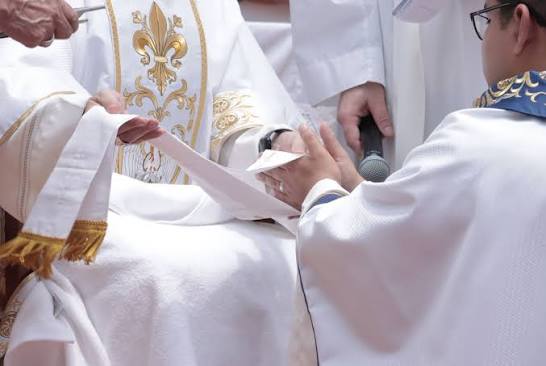
(ZENIT News / Washington, 08.29.2026).- A deceptively simple question from the ordination to the priesthood rite has become the starting point for a much larger debate about the formation of priests in the United States: how does the Church determine whether a man is truly ready to assume the responsibilities of the priesthood?
That question takes on particular urgency in a report from the McGrath Institute for Church Life at the University of Notre Dame. Drawing on national research conducted by the Center for Applied Research in the Apostolate, priests and formation specialists Thomas Berg and Timothy Lock examine how bishops, seminary rectors, spiritual directors, vocation directors and mental-health professionals assess candidates for Holy Orders.
The report, published in July 2026, reveals significant disagreements among those responsible for deciding who should ultimately reach the altar. One of the clearest divisions concerns candidates who experience deeply rooted same-sex attraction while professing a firm commitment to celibacy.
Twenty-two percent of surveyed U.S. bishops said they would be willing to ordain such a man; 10% said they were completely in agreement with doing so. The corresponding figures were lower among other groups involved in formation: 17% of mental-health professionals, 16% of seminary rectors, 12% of formation directors and spiritual directors, and 9% of vocation directors expressed such willingness.
The significance of those figures lies not simply in the controversy surrounding homosexuality, but in what they reveal about the coherence of priestly formation itself. A candidate can spend years being evaluated by several people, yet those responsible for making judgments about his suitability may not be applying the same standards.
Berg and Lock report that experienced seminary personnel have encountered situations in which rectors and formation teams felt pressure to advance candidates despite their reservations. They warn against allowing the numerical need for priests to influence judgments about whether particular men are suitable for ordination. Their recommendation is striking: although the bishop retains ultimate canonical responsibility, he should ordinarily accept the judgment of the rector and formation team unless he has moral certainty that their assessment is substantially mistaken.
There is a practical reason for that recommendation. Bishops may encounter a seminarian only periodically, while formators can observe him over several years — in prayer, community life, intellectual formation, pastoral work and personal relationships. A negative judgment from those who know a candidate most closely therefore cannot easily be dismissed as a bureaucratic obstacle.
The authors go further on the question of same-sex attraction. Their report describes an emerging consensus among the experts consulted: a seminarian with a stable same-sex attraction should not proceed to the advanced configurator stage of formation immediately. In some cases, they suggest, formation may need to be interrupted temporarily so that his understanding of his identity, affective life, capacity for celibacy and readiness for priestly self-gift can be examined more carefully.
This recommendation needs to be understood alongside the Church’s existing policy. A 2005 instruction from the Congregation for Catholic Education stated that men who practice homosexuality, possess deeply rooted homosexual tendencies or support what it called a gay culture should not be admitted to seminaries or Holy Orders. For a temporary homosexual tendency, the document required that it have been clearly overcome for at least three years before diaconal ordination.
Interestingly, a majority of several professional groups surveyed regarded the existing criterion as useful: 68% of bishops and rectors, 63% of formation directors and spiritual directors, and 57% of vocation directors supported it. Among mental-health professionals, however, only 36% did so.
The report also identifies a conceptual difficulty that is easy to overlook. Terms such as “deeply rooted” belong to the Church’s disciplinary vocabulary rather than standard clinical terminology. Berg and Lock therefore discuss a possible additional measure: persistence over time. They cite an emerging practice among Catholic mental-health professionals of considering an attraction maintained for more than five years to be deeply rooted unless there are indications that it is diminishing.
Yet the authors’ concern extends well beyond sexual orientation.
One of the most revealing findings is that 23% of recently ordained priests acknowledged that, while in seminary, they had concealed personal realities that should have been disclosed to their formators. The report identifies potential areas of concern including sexual compulsivity, unresolved trauma, immature dependencies, poor personal boundaries and deeply rooted psychosexual difficulties.
That finding raises a fundamental issue of trust. Seminary formation is not merely academic preparation followed by an examination at the end. The Church is attempting to determine whether a candidate possesses the human, spiritual and relational maturity required for a lifetime of pastoral responsibility.
Psychological assessment consequently receives considerable attention in the report. Berg and Lock propose that candidates ordinarily undergo two comprehensive psychological evaluations: one before admission and another toward the end of the discipleship stage or at the beginning of the configurator stage. Their rationale is that a psychological assessment may have limited usefulness beyond roughly three years, while priestly formation can last seven years or longer.
The gap between theory and practice is striking. Every seminary rector surveyed considered the initial psychological assessment necessary for identifying areas in which a candidate needs to grow, as did 94% of formation directors and spiritual directors. Yet only 48% of rectors and 51% of formation directors said they actually used those assessments to develop individualized formation plans. Among mental-health professionals, the figure was only 36%. Moreover, 57% of mental-health professionals said they had encountered seminarians referred for therapy who subsequently received little or no follow-up.
The report therefore treats celibacy not as a narrow test of sexual abstinence but as a question of integrated human maturity. Before entering the advanced stage of formation, candidates should demonstrate several months of stable continence; before ordination to the diaconate, the authors propose normally requiring at least 12 months. External continence alone, however, is insufficient. Interior freedom, affective stability and the capacity to form healthy relationships are equally important.
This is perhaps the report’s most important contribution. It shifts the discussion from whether a candidate can technically obey a rule to whether he can genuinely inhabit the vocation that the rule serves.
The title of the study, Do You Know Them to Be Worthy?, comes from the ordination rite itself. Before the bishop, the priest presenting the candidates is asked whether he knows them to be worthy. The question assumes that suitability is established through the testimony of those who have accompanied and evaluated the men seeking ordination.
That makes the report’s concerns about formation more than an internal administrative matter. The consequences of a mistaken decision are borne not only by a seminarian or bishop but by the faithful who will eventually entrust their marriages, families, confessions, spiritual lives and communities to a priest.
At a time when many dioceses face the temptation to focus on the number of men entering seminaries, Berg and Lock argue for a different priority: quality before quantity. A shortage of priests is a genuine pastoral difficulty, but it cannot justify lowering the standard for those who will be entrusted with the priesthood.
The deeper lesson is one the Church has understood for centuries but must repeatedly recover: ordination is not simply the successful completion of a training program. It is a judgment about whether a man is capable of giving his whole life in service of Christ and his people.
That is why the question remains so demanding — and why the answer cannot responsibly become a formality.
Thank you for reading our content. If you would like to receive ZENIT’s daily e-mail news, you can subscribe for free through this link.

Publicaciones relacionadas:
 About the Scandal in New York’s Cathedral of Gay Irreverence During a Funeral and What This Has To Do with Fiducia Supplicans
 Gays in Seminaries? In Regard to Homosexuals and the Priesthood, the Norms Have Not Changed at All
 How many Catholic radio stations are there in the U.S., and how many listeners tune in via streaming? Major study on religious radio released
 The Impact of the Bible in 2026: Openness to the Bible’s message is on the rise, while its use and reading are declining. Findings from a study by the American Bible Society
