

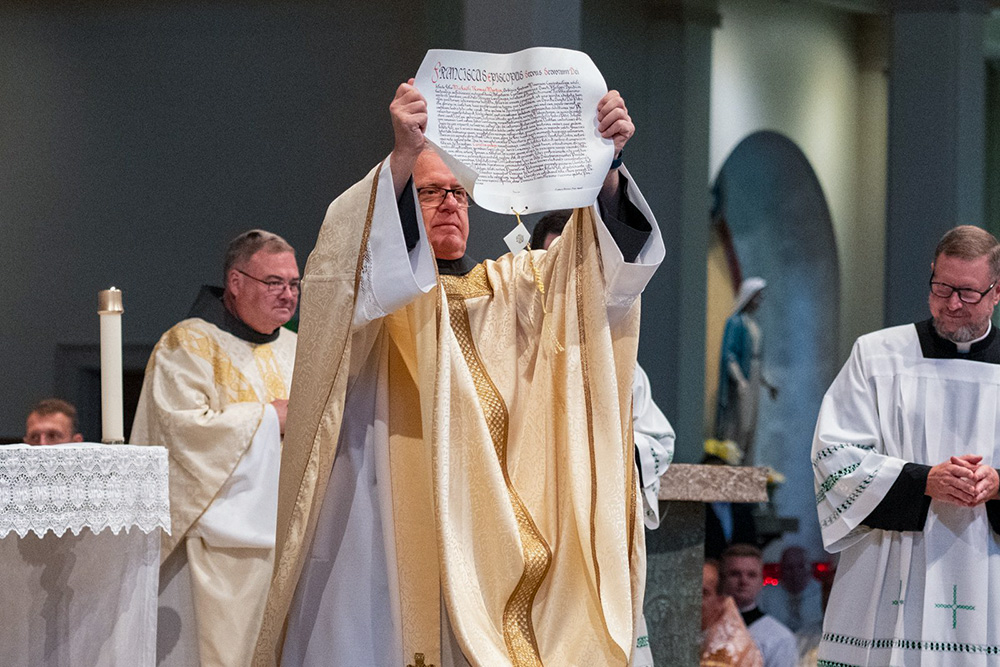
(ZENIT News / Rome, 11.19.2026).- The Vatican has upheld Bishop Michael Martin’s restrictions on the use of altar rails and kneelers for the distribution of Holy Communion in the Diocese of Charlotte, North Carolina, rejecting an appeal from a Catholic father whose family was repeatedly passed over when they knelt to receive the Eucharist.
In a decision dated August 3, 2026, Archbishop Vittorio Francesco Viola, then secretary of the Dicastery for Divine Worship and the Discipline of the Sacraments, concluded that the diocese’s policy did not constitute an unlawful denial of the sacrament. The ruling distinguishes between the right of Catholics to receive Holy Communion and the right to choose the precise place or arrangement through which it is administered—a distinction that lies at the heart of the increasingly contentious dispute.
The family’s complaint stemmed from incidents at Our Lady of Grace parish in Greensboro, where the father, his wife and their two children reportedly were repeatedly denied Communion after presenting themselves kneeling at the altar rail. Bishop Martin’s regulations require the faithful to receive Communion standing, following a bow, and prohibit the use of altar rails, kneelers, presbyteries or similar arrangements as distribution points during public liturgies. The rules took effect on January 16, 2026, with movable kneelers ordered removed, although permanent altar rails were not required to be dismantled.
Viola’s letter argues that the diocesan policy regulates the external manner of distributing the sacrament rather than denying access to it. Citing Canon 843 §1 and Canon 912 of the Code of Canon Law, which establish the conditions under which the sacraments may not be withheld from properly disposed faithful, the Vatican concluded that the family’s decision to approach in a manner contrary to diocesan instructions did not amount to an unlawful refusal.
The ruling, however, explicitly preserves an important principle: Catholics remain free to kneel when receiving the Eucharist, and a minister cannot refuse Communion simply because someone adopts that posture. Viola states that an actual denial would occur if a person approached according to the prescribed arrangements and was refused solely for kneeling at the moment of reception. The distinction is therefore not between kneeling and standing as expressions of devotion, but between the individual’s posture and the bishop’s authority.
Martin’s policy has provoked substantial resistance within the diocese. In January, 31 priests—roughly a quarter of Charlotte’s diocesan clergy—submitted questions to the Vatican’s Dicastery for Legislative Texts, challenging whether a bishop could prohibit altar rails and kneelers used by Catholics who wish to receive Communion kneeling. Some reportedly feared repercussions for speaking publicly about the controversy.
The dispute also raises a broader pastoral question that the legal ruling does not resolve. The Church recognizes kneeling as a legitimate expression of reverence before the Eucharist, and for many Catholics, receiving Communion at an altar rail is not simply a preference about furniture but a deeply rooted devotional practice. Removing that practice can carry spiritual and emotional significance, particularly for those who associate it with continuity, reverence and the sacredness of the liturgy.
Viola defended the bishop’s authority by invoking the responsibility of diocesan bishops to govern liturgical life and the Church’s teaching that a common posture can visibly express unity among those gathered for Mass. He encouraged the faithful to accept the manner indicated by their pastors, citing liturgical documents that emphasize shared gestures as signs of ecclesial communion.
Yet legal authority and pastoral wisdom are not identical questions. A bishop may possess the power to regulate liturgical practice while still facing the responsibility to weigh the spiritual needs, traditions and sensitivities of the people entrusted to him. The controversy show how a measure intended to reinforce unity can, if it disregards the attachment of faithful Catholics to established devotional customs, become a source of division itself.
The Vatican’s decision rejects the father’s hierarchical appeal, but it does not settle every canonical question surrounding the bishop’s regulations or the circumstances of the reported refusals. The family could potentially seek further review before the Apostolic Signatura, the Church’s highest administrative judicial tribunal, within the applicable deadline following formal notification.
For now, the ruling reinforces episcopal authority over the external arrangements of Communion while reaffirming that kneeling remains a legitimate way to receive the Eucharist. The tension between those two principles is precisely what makes the Charlotte controversy more than a dispute over liturgical posture: it is a test of how authority, reverence and the faithful’s sense of belonging can coexist without one becoming an obstacle to the other.
Thank you for reading our content. If you would like to receive ZENIT’s daily e-mail news, you can subscribe for free through this link.

Publicaciones relacionadas:
 10 short questions and answers on the Instrumentum Laboris for the Synod on Synodality 2024
 Vatican Clarifies US Holy Day Obligations, Raising Questions About USCCB’s Policy
 Vatican Limits Traditional Latin Mass in Texas Diocese Following Bishop’s Removal
 Full English Translation of the Vatican’s Response Letter Rejecting Lay People’s Homilies Requested by the German Episcopate
