

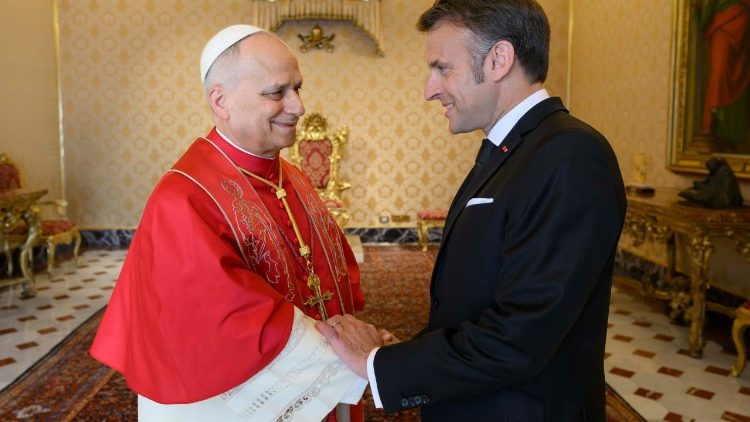
(ZENIT News / Rome, 09.17.2026).- When Pope Leo XIV arrives in France on September 25, he will enter a country where the Church and the state have spent months preparing for the same journey from rather different perspectives. Emmanuel Macron sees an opportunity for France to receive a pope with whom it wants to engage on Europe, Ukraine and the Middle East. French bishops see something else: a chance to show Leo XIV a Church that, after decades of decline, is again attracting thousands of young people. And the Vatican has carefully insisted that the two dimensions should not be confused.
That tension helps explain a series of apparently minor protocol decisions that have attracted considerable attention in France. The trip will last four days, from September 25 to 28, and will take the Pope to Paris, Saint-Denis, Lourdes and Metz. Yet the most revealing element of the itinerary may be what will not happen.
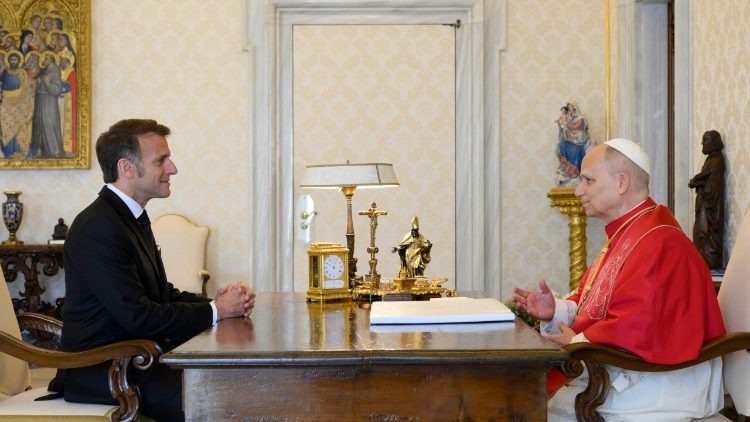
Macron had sought the grandeur normally associated with a state visit: a full military welcome, ceremonial displays, the Grand Cross of the Legion of Honour, and an official meal with the Pope. Rome progressively scaled back those elements. The French president will receive Leo XIV at the Élysée on the first day and accompany him to his aircraft on the last, but there will be no state banquet. The Pope will eat and sleep at the apostolic nunciature in Paris. The clearest example comes at Notre-Dame.
Macron had requested a private moment with Leo XIV inside the cathedral so that he could personally show him the reconstruction undertaken after the 2019 fire. The request was transmitted through diplomatic channels and the answer from the Holy See was no. Leo XIV will enter Notre-Dame on the evening of September 25 not for a presidential tour but to celebrate Vespers with clergy and consecrated people.
The distinction is more than protocol. Vespers is the Church’s evening prayer, and the Vatican’s preference is that Notre-Dame be presented during this moment primarily as a living church rather than as a national monument displayed to a visiting head of state. The cathedral’s restoration is one of the most prominent symbols of contemporary France, but the Pope’s presence there has been given a liturgical rather than ceremonial purpose.
This has prompted speculation that the decision reflects disagreements between Macron and the Church over France’s debate on end-of-life legislation. The material surrounding the trip, however, gives a simpler explanation: the state and the Church prepared different dimensions of the journey. The Vatican uses the term “apostolic journey” for papal trips, emphasizing the Pope’s role as pastor meeting the Church in a particular country, even though he is also the sovereign of the Holy See.
That does not make the political dimension disappear. It merely prevents it from defining the entire visit.
The French Church has been preparing its own message for Leo XIV. Cardinal Jean-Marc Aveline, president of the French Bishops’ Conference, was among those who urged the new Pope to come to France. He sees the country not simply as a society marked by secularization but as a place where an unexpected religious phenomenon is taking place: growing numbers of adolescents and adults are seeking baptism.
France’s recent experience is particularly interesting because it was once regarded in Rome as an early warning of European secularization. Other traditionally Catholic countries later followed similar trajectories. Now French bishops are being asked how their country is producing a new generation of catechumens. More than 20,000 adults and adolescents were baptized at Easter in 2026, according to figures cited in the preparations for the journey.
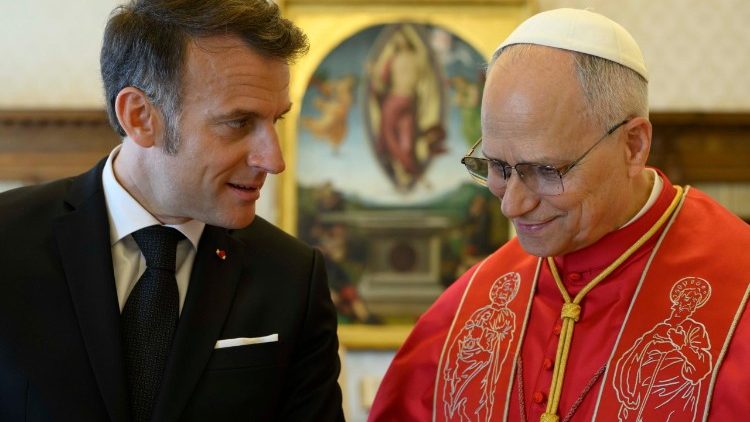
Leo XIV therefore wants to understand what is happening. The question is not simply how many people are entering the Church, but what is drawing them toward Christianity in a society often described as religiously exhausted.
This is one reason why the journey has been designed around places that carry very different meanings.
Paris represents the capital and the country’s public life. Saint-Denis will host a major gathering of young people, with the event at the Stade de France designed for around 80,000 participants. Lourdes gives the journey its explicitly Marian and devotional center. Metz, meanwhile, allows Leo XIV to speak about Europe from a region whose history embodies both its divisions and its subsequent attempts at reconciliation.
The choice of Metz over Strasbourg is telling. Lorraine experienced three wars, including two world wars, as well as two annexations and decades in which the nationality of its inhabitants changed. It was also the home territory of Robert Schuman, the Catholic statesman regarded as one of the founding figures of European integration and declared venerable by Pope Francis in 2021.
For Leo XIV, the symbolism is straightforward: Europe can be discussed not only through its institutions but through the historical memory of peoples who experienced the catastrophe of European division.
The itinerary also reflects the bishops’ desire to bring the Pope into contact with people whose lives are far removed from political ceremonies. A planned visit to the Maison Bakhita, a refuge for exiled people in Paris, fits that approach. Other possibilities, including a visit to the Jeanne-Garnier palliative-care center, were considered but ultimately removed from the programme.
Lourdes will provide another particularly sensitive encounter. During his approximately 36 hours at the sanctuary, Leo XIV is scheduled to meet privately with seven victims of sexual abuse within the Church. The visit also comes amid the continuing controversy surrounding the mosaics created by Marko Rupnik, which Bishop Jean-Marc Micas has decided to cover completely during the Pope’s visit.
The sanctuary thus combines some of the central themes of the French journey: devotion, human suffering, the dignity of vulnerable people and the Church’s continuing confrontation with the failures of some of its members.
Macron’s role, meanwhile, remains substantial even if the Vatican has limited the ceremonial dimension.
The French president was ultimately indispensable to the journey. On April 10, 2026, he formally extended his invitation to Leo XIV. The Holy See confirmed on May 16 that the Pope would visit France in response to invitations from both the head of state and the country’s ecclesiastical authorities. Eleven days later, Macron appointed Charles Personnaz as France’s ambassador to the Holy See, ending a vacancy that had lasted since December 2025.
The political relationship had not always been smooth. Two planned meetings between Macron and Leo XIV were cancelled before the two finally met on April 10. In January, reports that the Pope had refused to receive Macron were publicly denied by both the French Foreign Ministry and the Holy See.
Yet the eventual journey demonstrates that disagreement and diplomacy can coexist.
Macron regards the Holy See as a significant diplomatic interlocutor, particularly regarding Ukraine and the Middle East, as well as a rare institution with global moral and diplomatic reach. He also has a domestic political horizon: he will not run in the French presidential election expected in spring 2027, but his political influence and his effort to shape what follows his presidency remain part of the backdrop to the visit.
The Vatican, however, appears determined not to let that political context become the organizing principle of the Pope’s programme.
The same pattern can be seen in the preparations by the French bishops. Aveline began pursuing the visit almost immediately after Leo XIV’s election in May 2025. Bishop Jean-Marc Micas formally invited him to Lourdes in June that year. Archbishop Laurent Ulrich had his own history with Notre-Dame: when he arrived in Paris in 2022, the cathedral was still closed after the fire. He celebrated Vespers outside it and later entered alone to pray. Four years later, he will welcome a Pope to the reopened cathedral for the same liturgy.
The symbolism is difficult to miss. A bishop who began his ministry in Paris beside a wounded cathedral will now stand inside its restored walls with a Pope.
There have also been moments when French enthusiasm for the visit has outrun the Vatican’s plans. Metz supporters explored the possibility of bringing Ukrainian President Volodymyr Zelensky to the European-themed programme, but the idea reportedly encountered opposition at the Holy See because it could have made the event overwhelmingly about the war. Invitations to European heads of state were sent only in early September, with their availability complicated by the final day of the United Nations General Assembly in New York.
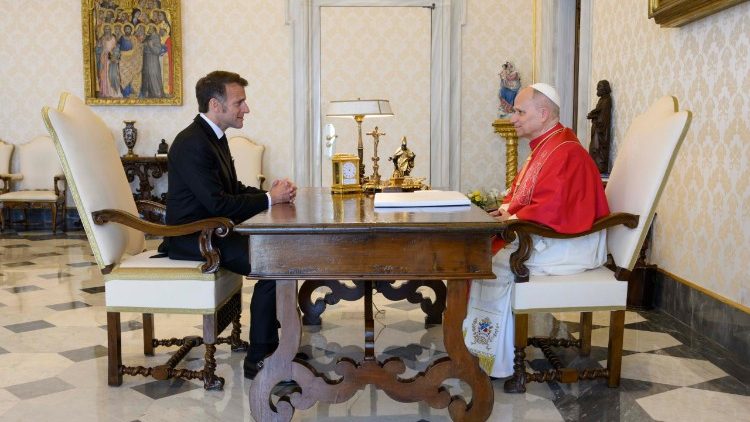
Even the route to Metz illustrates the different institutional interests involved. The idea emerged through contacts between Lorraine representatives and the Pope rather than through a conventional diplomatic initiative. By the time the stop was officially announced on June 9, it had become one of the defining elements of the trip.
What emerges is not a confrontation between the Élysée and the Vatican so much as a negotiation over what a papal visit actually is.
Macron will have his meetings and his cameras. The French Church will have its young people, its saints, its wounds and its hopes. And Leo XIV will have the task of moving through all worlds without allowing any one of them to absorb the others.
That may prove to be the defining characteristic of his first French journey: not a rejection of the political stage, but a deliberate refusal to let the political stage become the whole story.
Thank you for reading our content. If you would like to receive ZENIT’s daily e-mail news, you can subscribe for free through this link.

Publicaciones relacionadas:
 3 key words of the missionary action of the Church and of the work of the Holy See’s diplomacy, according to Leo XIV
 A Church Against the Logic of War: Vatican Voices, Middle East Realities, and the Risk of a Vanishing Christianity
 Trump responds to Pope Leo XIV: I don’t want a ceasefire
 Ceasefire on the Brink: Pope Leo XIV, Global Powers and the Moral Battle Over War in the Middle East
