

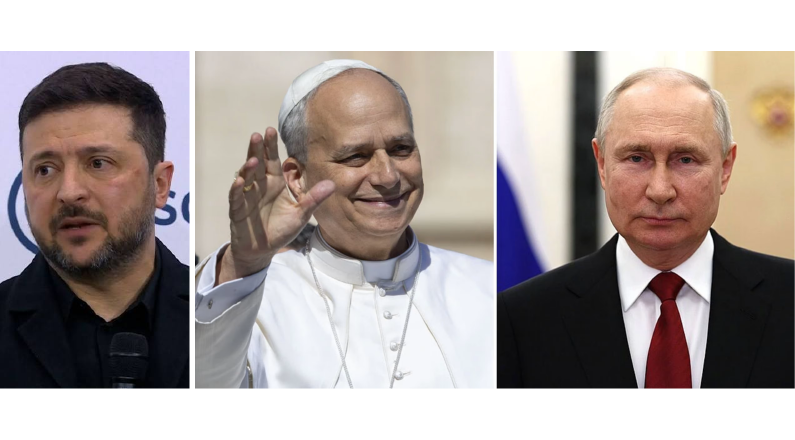
(ZENIT News / Rome, 11.17.2026).- Some weeks ago, Russian President Putin and Ukrainian President Zelenskyy held separate telephone conversations with Pope Leo XIV. In both calls, the Pope requested that the delivery of aid be guaranteed, as well as the safe, voluntary evacuation of residents in the Russian-occupied city of Kherson — people who were in desperate circumstances, with all escape routes cut off.
The Pope placed the call to Putin on October 16 from his hospital bed at the Gemelli Hospital. On October 19, back at the Vatican and still recovering from surgery, he spoke by phone with President Volodymyr Zelenskyy.
The Pope’s diplomatic efforts bore fruit. On October 27, Russia and Ukraine initiated a partial truce to facilitate a humanitarian mission aimed at evacuating residents in critical condition from Oleshky, in the Ukrainian region of Kherson. This «humanitarian diplomacy,” a cornerstone of the Holy See’s work in fostering paths toward peace, coincided with the deployment of the Papal Almoner, Monsignor Luis Marín de San Martín, Prefect of the Dicastery for the Service of Charity, to Ukraine. Marín visited various organizations in the cities of Kyiv, Zaporizhzhia, Dnipro, and Fastiv.
The Holy See’s diplomatic efforts have also extended to missions in Moscow and Kyiv led by Cardinal Matteo Zuppi, President of the Italian Episcopal Conference, focusing on the exchange and release of prisoners, as well as the repatriation of minors. On October 21, Cardinal Zuppi met with the Ukrainian Ambassador to the Holy See, Andrii Yurash. During this meeting, «special attention was given to the humanitarian situation in the temporarily occupied city of Oleshky, where the civilian population is suffering from severe food shortages due to the Russian occupation.» They also «discussed potential mechanisms to assist the civilian population, as well as further steps to implement concrete humanitarian initiatives.»
On October 23, the Pope held an audience with the Primate of the Ukrainian Greek Catholic Church, Sviatoslav Shevchuk, Major Archbishop of Kyiv-Halych. The Archbishop thanked the Pontiff for his attention to the humanitarian catastrophe in Oleshky and for his recent discussions with the Presidents of Russia and Ukraine. He also briefed the Pope on preparations for another difficult winter. At the end of the audience, Shevchuk handed the Pope lists of Ukrainian prisoners of war.
Following the meeting, Archbishop Sviatoslav Shevchuk gave an interview to Vatican News in which he noted that the Pope’s calls to the leaders of both countries at war were «a prophetic gesture in the midst of a humanitarian desert. Without the voice and direct intervention of the Holy Father, this truce would not have been possible.»
The Archbishop explained: «Before the war began, 40,000 people lived in this small town. We do not know the exact number of current inhabitants, but earlier this year the town was surrounded and besieged. All the roads were mined by the Russian army, and it was not even possible to bring food in. During the summer, people were forced to eat the leaves off the trees. A terrible hunger… And we all knew that, if nothing were done, no one would survive the winter. But in order to open those humanitarian corridors, military operations had to cease. That is why the Holy Father made those calls.»
He added: «Every time I make pastoral visits, people come to me and share their tragedies. And they keep giving me names. I gather them all and tell them: ‘I will pass these on to the Pope.’ And they reply: ‘Then they will be in God’s hands!'»
His Beatitude Sviatoslav Shevchuk concluded: «We have many pastoral initiatives, as well as many movements, where families organize to help one another. And the Church finds space within the parishes, thanks to the presence of a priest.»

Publicaciones relacionadas:
 Pope Leo XIV, the US-Iran war, and a forceful call in a Middle East on the brink of the abyss
 Pope Leo XIV Speaks Again About Trump and the War (and It Is Announced That the Pope Will Carry the Cross Throughout the Stations of the Cross on Good Friday)
 Trump Attacks the Pope for the Second Day, and Meloni Defends Him. The World Reacts While the Catholic Vice-President of the USA Supports Him
 Lebanon Turns to the Pope: Lebanese President Visits Leo XIV Amid the Israeli Siege
