

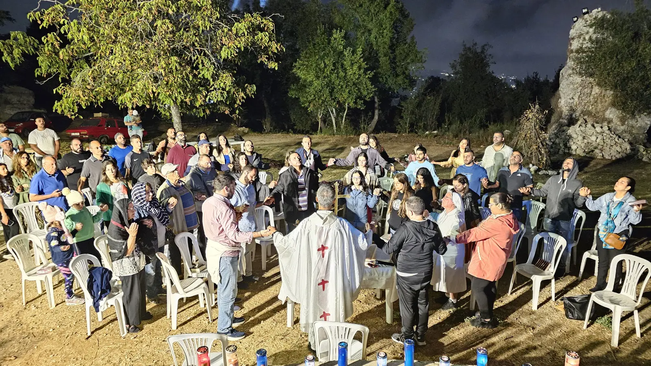
(ZENIT News / Beirut, 11.17.2026).- Christian communities in Lebanon and Jordan are confronting two different but increasingly interconnected challenges: in Lebanon, the struggle to remain rooted amid war, displacement and political uncertainty; in Jordan, the shock of a deadly attack against Christians in a country long regarded as one of the region’s safer places for religious minorities. The developments highlight how the survival of Christianity in the Middle East depends not only on freedom of worship, but also on security, economic opportunity, political representation and the ability to remain on ancestral land.
In Lebanon, President Joseph Aoun sought to reassure an international delegation of French lawmakers on October 28 that the country’s Christian presence was not endangered, insisting that Lebanon’s tradition of Christian-Muslim coexistence distinguished it from neighboring states. But the president’s assurances come against a backdrop of killings, damaged villages, displacement and mounting anxiety over the future of Christian communities.
The country’s political architecture formally protects Christian participation in public life. Lebanon’s presidency is reserved for a Maronite Christian, the prime ministership for a Sunni Muslim and the parliamentary speakership for a Shiite Muslim, while parliamentary seats are divided equally between Christians and Muslims. Yet constitutional representation cannot, by itself, guarantee that communities can live safely, retain their property or build a future.
Recent deaths have underscored those concerns. Maronite priest Samir Daou was found murdered on October 29, reportedly killed by a Syrian worker. Father Pierre al-Rahi had died months earlier in an Israeli bombardment, while Armenian Apostolic archimandrite Anania Kojanian was found dead at his home in February 2025. Civilians have also suffered devastating losses, including dentist James Karam and his children Tony and Theodosia, killed in an Israeli strike, as well as Pierre Moawad, his wife Flavia Mourad and Roula Matar.
Other killings involving Christian political figures or their associates, including Pascal Sleiman and Elias Hasrouni, and the death of Fadi Bejjani in a 2023 confrontation involving Hezbollah gunmen, have further contributed to fears that violence and armed power remain beyond the effective control of state institutions.
The situation is particularly precarious in southern Lebanon, where Christian villages have been caught in the conflict between Israel and Hezbollah. In Qawzah, residents were displaced, homes damaged and the parish church affected, according to its pastor, Father Antonios Hanna. Communities in Rmeish, Ain Ebel and Debel have endured isolation from workplaces, universities and hospitals, relying on coordinated convoys to travel in and out of their villages.
For families who wish to remain, attachment to their homes is increasingly being tested against the practical demands of survival. Returning is not simply a question of courage or faith: it requires security, functioning infrastructure, access to livelihoods and the prospect that another round of fighting will not force them to flee again.
The concerns extend to land ownership. Maronite Patriarch Bechara Boutros al-Rai has urged Christian property owners not to sell, warning that land represents more than an asset—it is part of the community’s roots and future. Reports of purchases in Christian areas by Hezbollah-linked interests, including allegations of coordinated acquisitions and opaque financing, have fueled suspicions of political and territorial expansion. Such claims require scrutiny and transparency, but the underlying concern is understandable in a country where demographic presence, local influence and ownership are closely intertwined.
Economic insecurity is adding another pressure. Reports of limited Christian representation in certain public-sector recruitment processes have raised questions about equal access to state employment, while an Arab Barometer survey found that 58% of Lebanese aged 18 to 29 wanted to emigrate. That figure applies to young Lebanese generally, not exclusively Christians. Nevertheless, sustained departure among young Christians would weaken village life, parish communities and the social networks necessary for their long-term survival.
Jordan offers a different, though far from uncomplicated, picture. With a population of approximately 11.5 million, around 97% Muslim and just over 2% Christian, the kingdom has historically been considered a comparatively safe environment for Christians in a region marked by religious persecution. Its 138-member lower house reserves nine seats for Christians, giving them parliamentary representation above their share of the population.
That reputation was shaken on October 23, when three gunmen opened fire on a Greek Orthodox funeral procession outside a church in the Karak region, killing nine Christians and injuring dozens. Authorities arrested the three attackers. The massacre was particularly alarming because Jordan had experienced nearly a decade without a mass-casualty terrorist attack, despite security services reporting the disruption of extremist plots.
A Jordanian Christian interviewed in the source material, identified as Jibril, described the attack as evidence that radicalization could no longer be regarded as a problem confined to neighboring countries. He stressed that most Muslims he had encountered were friendly toward Christians, while warning that a smaller extremist current could pose a lethal threat. The distinction matters: the danger of religious extremism should not be confused with the attitudes of an entire Muslim population, particularly when many Muslims themselves have expressed solidarity with the victims.
King Abdullah II condemned the attack and ordered a strong security response. His longstanding opposition to extremist movements has been a defining feature of Jordanian policy, including during the rise of ISIS, which itself threatened the monarch. The government banned the Muslim Brotherhood in April 2025, amid concerns over its activities and security implications.
Yet religious freedom in Jordan has limits, particularly for converts from Islam to Christianity. Although the penal code does not prescribe a specific punishment for apostasy, conversion is not fully recognized by the state, and converts can face serious legal complications, family pressure and social ostracism. A 2015 estimate placed the number of converts from Islam to Christianity in Jordan at approximately 6,500, although the figure is not a current census. The vulnerability of these believers illustrates how freedom of religion must include the right to change one’s faith, not merely the ability of established religious communities to worship.
Jordan’s economic difficulties also weigh heavily on its future. Youth unemployment among those in their twenties and thirties is reported to exceed 50%, helping explain why many young people consider leaving regardless of religious affiliation. For Christians, however, emigration carries an additional consequence: the gradual loss of families, churches and communities that have preserved a Christian presence in the region for centuries.
Lebanon and Jordan are not facing identical circumstances. Lebanon’s crisis is shaped by armed conflict, political paralysis, displacement and disputes over the authority of Hezbollah; Jordan’s challenge is to prevent extremist violence from destabilizing a comparatively peaceful model of coexistence. But both illustrate a wider truth about the Middle East: minorities cannot thrive through symbolic guarantees alone.
A Christian community’s survival requires more than a reserved parliamentary seat or the absence of formal restrictions on worship. It requires protection from violence, the freedom to educate children, access to employment, respect for property, the ability to practice or change religion without coercion, and confidence that the next generation can remain without sacrificing its safety or prospects.
For the Christians of Lebanon and Jordan, the question is no longer merely whether they are welcome in their own countries. It is whether those countries can provide the conditions under which staying remains a viable choice.
Thank you for reading our content. If you would like to receive ZENIT’s daily e-mail news, you can subscribe for free through this link.

Publicaciones relacionadas:
 Traditional Congregation Accused of “Brain Washing”: Superior Faces Prison
 Preserving Christianity in Iraq 10 years after Daesh invasion
 500 Attacks on U.S. Catholic Churches since May 2020 to 2025
 American missiles, persecuted Christians, and a country that cannot protect them: why did Trump bomb part of Nigeria?
