

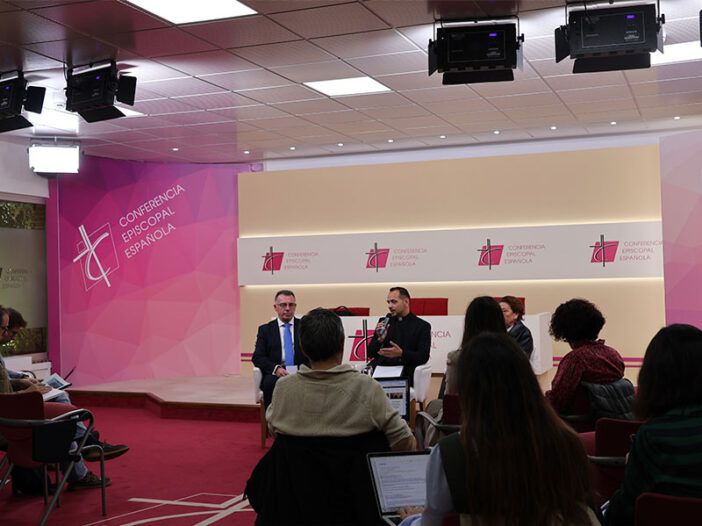
(ZENIT News / Madrid, 11.19.2026).- Spain is facing renewed scrutiny over how it records hostility toward Christians, as a new report by the country’s bishops documents 131 incidents potentially involving violations of religious freedom in 2025, while European monitoring organizations argue that anti-Christian hate remains largely invisible in official government statistics.
The controversy centers not only on the number of attacks, but on whether Spain’s system adequately identifies the religious communities targeted. Civil society organizations argue that without a specific category for anti-Christian hate crimes, authorities cannot accurately assess the scale of the problem or devise an effective response.
The Spanish bishops’ Religious Freedom Office presented its first report on such incidents on November 19, during the bishops’ plenary assembly. Compiled largely from press reports and information submitted by some dioceses, the document recorded 131 incidents last year, although its authors acknowledged that the figures remain incomplete because not all dioceses have supplied information.
The most common incidents were thefts, accounting for 56 cases. The report also identified 12 instances of other vandalism, 11 cases of alleged defamation through freedom of expression, and nine incidents each involving threats, attacks on places of worship or desecration of graves and religious images. Physical assaults and desecration of tabernacles accounted for seven cases apiece, while six incidents involved alleged defamation through artistic expression. No murders or deliberate arson attacks were recorded.
The figures are considerably lower than the 173 incidents reported by Spain’s Observatory for Religious Freedom and Conscience for the same year, highlighting the difficulties of compiling reliable data when reporting mechanisms and classifications differ.
Father Rafael Vázquez, head of the bishops’ office, described the report as significant rather than exhaustive and said the Church needed to become more attentive to offenses that often go unreported. He acknowledged a reluctance within Catholic circles to file complaints, calling for greater awareness and training among diocesan officials on how to report incidents and follow procedures recommended by law enforcement.
The bishops’ initiative comes amid criticism from the Observatory on Intolerance and Discrimination Against Christians in Europe (OIDAC), which argues that Spain’s official hate-crime statistics distinguish antisemitic and anti-Muslim incidents but lack a specific category for crimes targeting Christians.
OIDAC recorded 2,465 anti-Christian hate crimes across Europe in 2025, compared with 2,211 in 2024 and 2,444 in 2023. France, the United Kingdom and Germany registered the highest numbers. Particularly concerning was the increase in attacks against individuals, which rose from 274 to 395 in one year — approximately 44 percent. France alone saw a 70 percent increase in crimes against people, while physical attacks against clergy and other church personnel reportedly quadrupled.
The organization’s report also documents restrictions on religious freedom extending beyond physical violence, including cases involving public worship, evangelization, religious symbols, freedom of expression, church autonomy, conscientious objection, parental rights and religious education. It raises particular concerns about discrimination against Christians over their convictions on marriage, sexuality and the protection of unborn life, as well as criminal proceedings arising from peaceful prayer and religious expression.
The dispute over Spain’s statistical framework is reinforced by figures submitted to the Organization for Security and Cooperation in Europe (OSCE) by civil society groups. Its 2025 reporting records 188 hate incidents in Spain reported by non-governmental organizations, of which 113 — around 60 percent — were classified as anti-Christian. The same dataset includes 23 antisemitic and 26 anti-Muslim incidents. Eight in ten anti-Christian attacks reportedly targeted property, including churches, religious images and monuments, although assaults, intimidation and threats against priests and Christian communities were also documented.
Meanwhile, Spain’s official figures cited by the Observatory for Religious Freedom and Conscience list 69 antisemitic incidents, 35 anti-Muslim incidents and 75 cases categorized broadly as involving religious beliefs or practices, without specifying how many targeted Christians.
The observatory’s president, María García, argues that the omission creates an unequal standard of recognition. If authorities identify antisemitism and islamophobia separately, she says, anti-Christian hostility should likewise be recorded under its own category, not subsumed within a general religious classification. The objective, she insists, is not preferential treatment but equal visibility and protection.
The debate has gained a European dimension following a European Parliament resolution calling for a coordinator dedicated to combating anti-Christian hatred, comparable to existing positions addressing antisemitism and anti-Muslim hostility. The resolution cited the scale of worldwide persecution of Christians, estimated to affect more than 380 million people.
Spain’s bishops have stopped short of formally labeling the incidents in the country as “christianophobia.” Vázquez said the term clearly applies if understood as hostility or attacks directed at people because they are Christian, but declined to endorse a broader interpretation implying a coordinated ideological phenomenon. The Spanish Royal Academy has recently incorporated the term into its dictionary, defining it as aversion to Christianity, Christians or Christian things.
The distinction between documenting hostility and establishing its ideological causes remains important. Theft, vandalism, threats, discrimination and violence do not necessarily share the same motive, and accurate reporting must avoid conflating ordinary crime with religiously motivated attacks. But the absence of a specific category can make patterns harder to identify in the first place.
Thank you for reading our content. If you would like to receive ZENIT’s daily e-mail news, you can subscribe for free through this link.

Publicaciones relacionadas:
 USA: Transexual Woman Kills Three Children and Three Adults in a Christian School
 Nigeria: epicenter of a crisis of extermination against Christians. Another village massacred
 A Tested Church in a Tense Land: Beijing’s Recognition of a Detained Bishop Rekindles Debate Over the Vatican–China Deal
 53 Humanitarian Organizations Denounce «False Narratives» to Sabotage Those Saving Lives in Palestine
