

(ZENIT News / Rome, 10.19.2025).- As global divisions deepen under the weight of war, ecological collapse, and growing inequality, thousands of grassroots leaders from across the world are preparing to gather in Rome later this month for the Fifth World Meeting of Popular Movements. The event, which will take place from October 21 to 24 at Spin Time Labs—a social center born from urban occupation and renewal—represents one of the most significant encounters between the Catholic Church and the organized poor in the past decade.
Since its inception in 2014, the World Meeting of Popular Movements (WMPM) has become a global platform for the excluded: a network of workers, farmers, migrants, artisans, and community leaders who take seriously Pope Francis’s call for the poor to be “protagonists of their own history.” Now, under the pontificate of Pope Leo XIV, the meeting enters a new phase, one that seeks to transform solidarity into political and social action at a time when human dignity and the planet itself are at risk.
The movement’s three founding principles—land, housing, and work—still form the backbone of its vision. But this year’s gathering expands the conversation, linking those issues to broader struggles for democracy, ecological justice, and peace. “We exist, we resist, and we organize,” reads the declaration of intent, echoing a decade of collective experience among movements that have learned to translate indignation into community-based action.
Participants will come from every continent: from the recyclers and informal workers of Latin America to the small farmers of Africa, the migrant laborers of Asia, and the urban cooperatives of Europe. Their diversity underscores what the organizers describe as “a culture of encounter”—a social and spiritual alternative to the isolation of global individualism. The delegations will be joined by bishops, theologians, and members of diocesan justice and peace commissions, who will walk alongside the movements rather than above them.
On October 23, Pope Leo XIV will meet the participants in the Paul VI Hall, continuing the dialogue opened by Pope Francis more than a decade ago. For many, this encounter symbolizes the continuity of a pastoral vision that places the Church squarely within the struggles of the poor and the working class. The audience is expected to set the tone for what the organizers call a “new chapter” of collaboration between the institutional Church and the popular sectors that live faith through resistance, community, and daily labor.
The meeting’s agenda revolves around three urgent themes:
– Land: agrarian reform, food sovereignty, and ecological justice.
– Housing: access to dignified homes and the defense of popular neighborhoods.
– Work: labor rights, cooperative economies, and the self-management of excluded workers.
Alongside these, participants will address the global democratic crisis, the rise of authoritarianism, forced migration, and climate disruption—issues that increasingly interlock in the daily lives of the poor. The gathering will culminate on October 25 and 26 with a Jubilee Pilgrimage of Popular Movements to the Vatican, intended as both a spiritual act and a political gesture: a reaffirmation of the shared journey toward social justice, peace, and the common good.
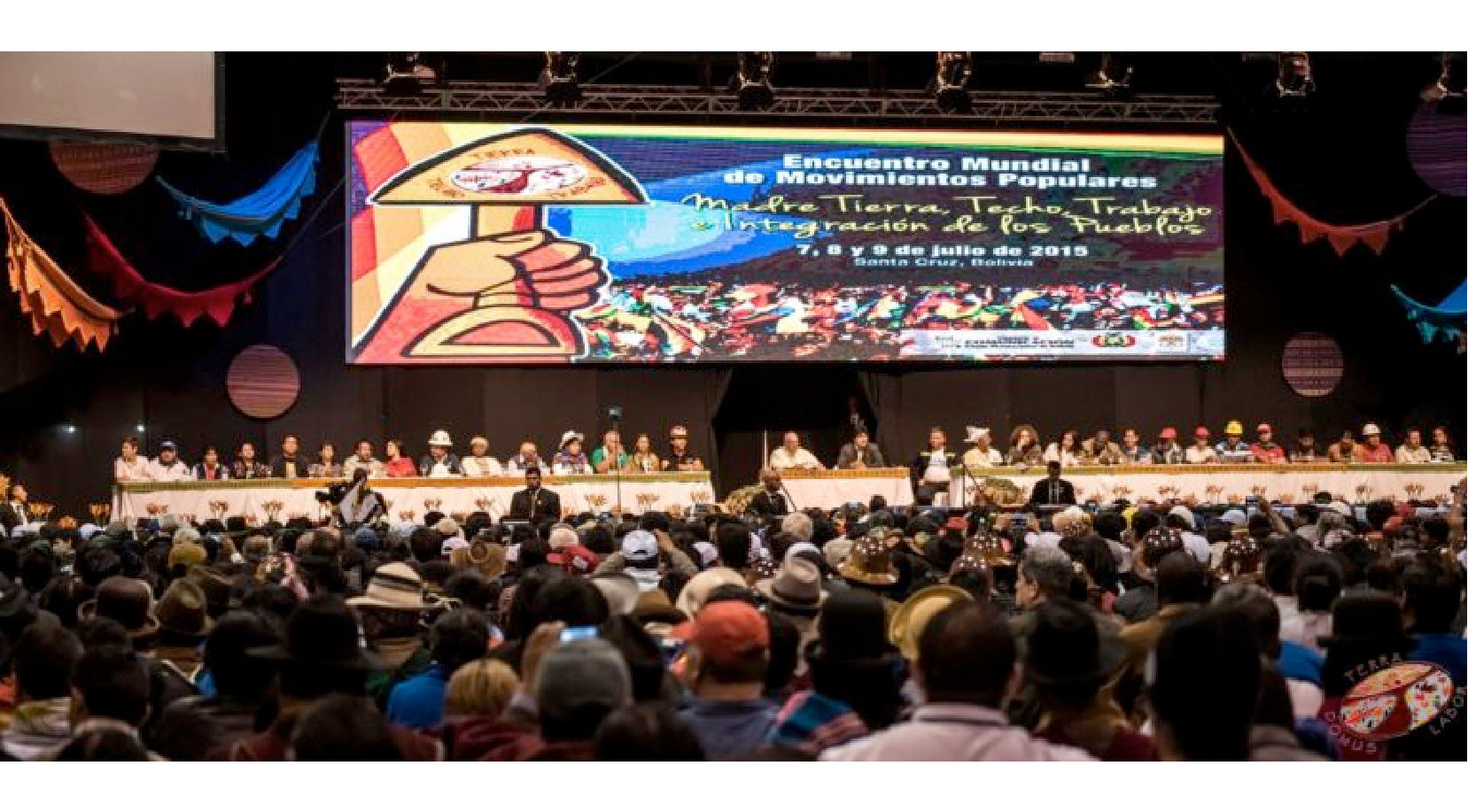
Over the years, each WMPM has marked a milestone in the relationship between the Church and the grassroots. The first meeting, in Rome in 2014, introduced Pope Francis’s “three Ts”—tierra, techo, trabajo (land, housing, and work)—as sacred rights rooted in Catholic social teaching. In Bolivia the following year, more than 1,500 delegates drew connections between social and environmental crises, giving birth to the “Santa Cruz Charter,” a manifesto that called for a new social order where “the economy serves people, not profit.”
In 2016, the Vatican hosted the third meeting, which broadened the dialogue to include democracy, displacement, and ecological stewardship. Francis urged participants to resist both paralysis and corruption, describing politics as “one of the highest forms of charity.” When the pandemic struck in 2020, he wrote directly to the movements, proposing a universal basic income for workers excluded from formal economies—a gesture that many interpreted as a prophetic political stance. The 2021 online edition, held amid global lockdowns, reiterated the call to emerge from the crisis “better, not worse,” through solidarity and systemic change.
The Rome meeting of 2025 is expected to carry that same spirit forward while reflecting the leadership of a new pope. Organizers say it will emphasize not only resistance but also the creation of viable alternatives—cooperative networks, community-based economies, and forms of popular democracy capable of healing the fractures of a world dominated by markets and exclusion.
The coordinating committee includes figures from major movements around the globe: Alejandro Gramajo of Argentina’s UTEP; Ayala L. Dias of Brazil’s MST; Rose Molokoane of Slum Dwellers International in Africa; Charo Castelló of Spain’s HOAC; Gloria Morales-Palos of the U.S. PICO Network; Luca Cassarini of Italy’s Mediterranea Saving Humans; and Fr. Mattia Ferrari, coordinator of the WMPM. Together they maintain direct dialogue with the Vatican through the Dicastery for Promoting Integral Human Development.
Beyond its political content, the meeting is also a sign of endurance. Eleven years after its beginnings, what started as an experiment in dialogue between the Church and the marginalized has become a living network—a kind of popular synod that operates from the peripheries of the world. In an era when globalization too often deepens division, the World Meeting of Popular Movements insists that fraternity itself can be revolutionary.
Thank you for reading our content. If you would like to receive ZENIT’s daily e-mail news, you can subscribe for free through this link.

Publicaciones relacionadas:
 Cardinal Ouellet Says “The Interpretation and Diffusion of Accusations as Sexual Aggressions Is Defamatory”
 197 Cardinals Attend Meetings in the Vatican, with a Pre-Conclave Scent
 [PHOTOS] This was the first Mass of a non-Catholic patriarch in the Pope’s cathedral
 This Will Be the Rome of the 2025 Jubilee: 5G in the Entire City and New Streets and Parking Lots Around the Vatican
