

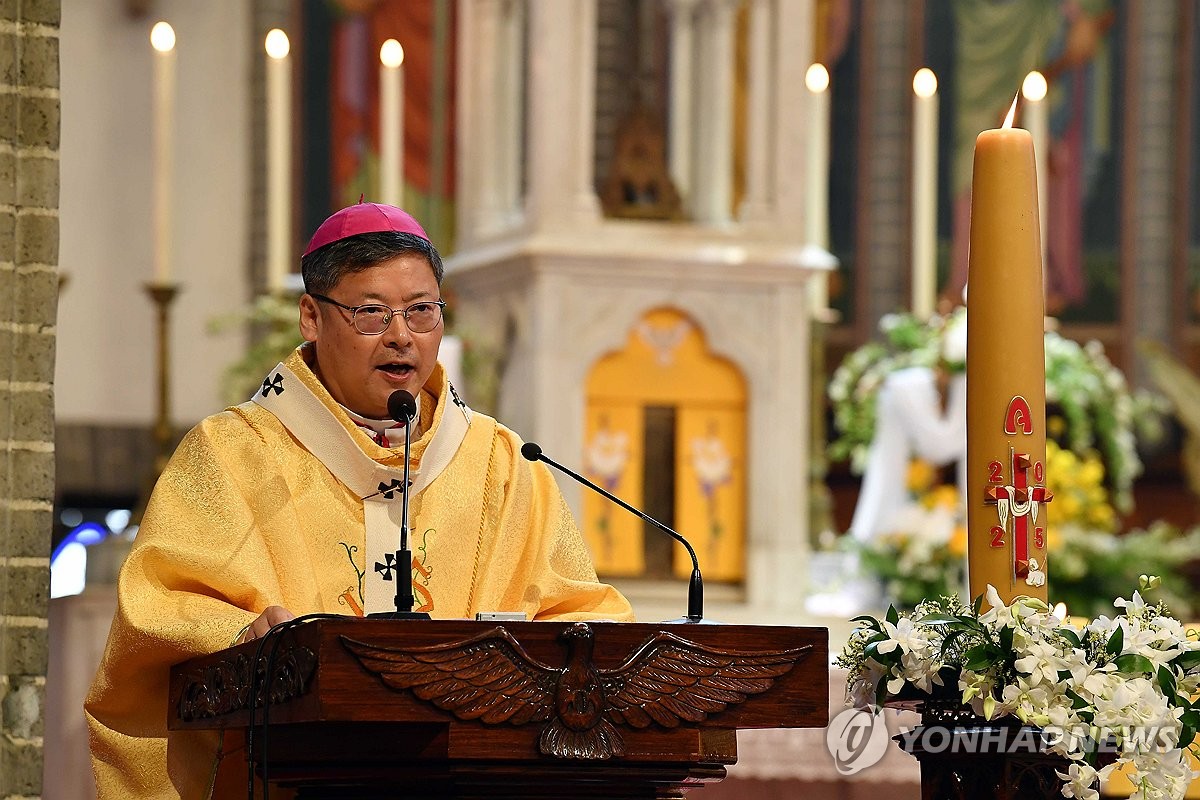
(ZENIT News / Seoul, 08.31.2026).- «On this 180th anniversary of the Ordination of the first Korean-born priest, Saint Andrew Kim Dae-geon, the number of diocesan priests in the Archdiocese of Seoul has reached one thousand.» This is how the Archbishop of Seoul, Monsignor Peter Chung Soon-taick, announced the great news during a Mass he celebrated at Myeondgdong Cathedral, attended by clergy, religious, and hundreds of lay faithful dedicated to fostering vocations within the Church.
The figure was made public as 2025 marked the 50th anniversary of the Archdiocese’s Association for the Support of Vocations, founded in 1975. During the thanksgiving Mass, Monsignor Soon-taick emphasized that this achievement is not the result of a pastoral plan devised in an office, but rather the fruit of the sustained effort of the faithful over the course of half a century.
«By the grace of our good and loving Father, and through your care, support, and generous contributions, we have reached a historic moment,» he stated.
Prayer, Financial Support, and Formation
The Association for the Support of Vocations operates on three clearly defined and complementary pillars. The first is spiritual: prayers and Masses offered specifically for priestly vocations. The second is financial: donations intended for the material support of seminarians during their years of formation. The third concerns community and formation, accompanying the future priest and connecting him to the people he will serve.
The Archbishop emphasized that none of the three can be dispensed with or replaced by the others. «A vocation is indeed a gift from God, but it is also a gift that must be nurtured and cultivated so that it may reach its fullness,» he noted.
This fact must be viewed against the backdrop of Korean Catholicism, one of the most unique in the world. The first Korean priest, Saint Andrew Kim Dae-geon, was ordained one hundred and eighty years ago, in 1845, and died a martyr shortly after his Ordination. Today, he is the patron of the Korean clergy, and his figure remains a vital point of reference for the country’s seminarians.
The Archdiocese of Seoul currently has more than one and a half million Catholics. Two years ago, the ratio was 1,385 faithful for every priest, a comparatively low figure when contrasted with the global average.
Faith Tempered in Persecution and Martyrdom
While numerous European dioceses are merging parishes and closing seminaries, an Asian archdiocese in Korea has reached the milestone of one thousand priests, supported by a lay community that prays for vocations, provides financial backing, and ensures rigorous formation –all without diluting the identity of the priesthood to suit the spirit of the times.
The Church in Korea did not originate from a pastoral strategy or a program of cultural adaptation; it was born of laypeople who read books on doctrine, became convinced of the truth, and requested priests. It was subsequently tempered in persecution and the blood of martyrs.
The history of the Catholic Church in Korea is unique, as Korea is one of the few countries where Catholicism was initially introduced by Korean laypeople before the arrival of missionary priests.
The Encounter with Christianity: The 18th Century
Catholicism arrived in Korea in a unique context. During the 18th century, some Korean intellectuals came into contact with Western books introduced from China. Among them was Yi Seung-hun, who traveled to Peking [today Beijing] in 1783-1784.
There, he received Baptism, and upon returning to Korea, he began baptizing and instructing others. Thus, an initial Catholic community emerged without permanent priests.
One of the key early figures was Yi Byeok, an intellectual who studied Christian teachings and helped organize the community.
The Arrival of Priests
For several years, Korean Catholics lived out their faith largely on their own. Finally, in 1794, the Chinese priest Zhou Wen-mo arrived clandestinely, sent by the Church to minister to the community. He found a community that was already relatively organized.
However, the authorities began to view Christianity as both a religious and social threat. Catholics rejected certain traditional rites that the authorities considered essential to the social and familial order.
Between the 18th and 19th centuries, there were several major persecutions. Thousands of Christians died for their faith.
One of the most significant martyrs is Saint Andrew Kim Daegon, born in 1821. He was the first Korean priest. After completing his training abroad, he returned secretly to Korea to carry out his ministry. He was arrested and executed in 1846 at the age of 25.
His story is extraordinary because it represents a Church that desired its own native priests rather than relying solely on foreign missionaries.
The Canonization of the Martyrs
The blood of those early Christians became the seed for the Korean Church.
In 1984, during his visit to Korea, Pope Saint John Paul II canonized 103 Korean martyrs. The Canonization took place in Seoul, a remarkable event, as Canonizations are typically held in Rome.
Among those canonized was Saint Andrew Kim Daegon.
Today, there are numerous sites associated with those martyrs, including Jeoldusan in Seoul, where many Christians were executed.
The Growth of the Church During the 20th Century
Following the persecutions, the Church began to consolidate. The arrival of Religious Congregations and missionaries enabled the development of schools, hospitals, seminaries, charitable works, publications, and lay associations.
During the Japanese occupation of Korea (1910–1945), Catholics also had to face new challenges.
After World War II, the Peninsula was divided into North Korea and South Korea. The Church suffered particularly in the North, where the Communist regime persecuted priests, religious, and laypeople. They endured another severe persecution in the 1960s.
The Korean Church Today
The Catholic Church currently has a very significant presence in South Korea. It comprises millions of faithful, numerous dioceses, priests, and religious, as well as strong lay participation.
A particularly interesting characteristic is precisely this lay participation, which has its roots in the early days of evangelization.
There is also a profound spirituality centered on martyrdom. The Korean Saints are not merely figures of the past; their tombs and the sites of their martyrdom are centers of pilgrimage.
The history of the Church in Korea — born of a search for truth, strengthened through persecution, and made fruitful by the blood of its martyrs — now looks toward the future.
In August 2027, Seoul will welcome young people from around the world for World Youth Day, a gathering that will have as its motto: «Take courage! I have conquered the world» (John 16:33).
In this way, the Korea that once received the Gospel amidst great difficulties will now become the host to a new generation of pilgrims. The story continues: the seed watered by the blood of martyrs is blossoming once again in the hearts of thousands of young people called to bring the Gospel to the world.

Publicaciones relacionadas:
 PHOTO GALLERY: Jesus’ crown of thorns returns to Paris’ Notre Dame cathedral
 Europe’s Largest Statue of Virgin Mary Will Be in Poland, Financed by One of the Country’s Richest Men
 Catholic Church in Singapore to Receive Largest Number of New Catholics at Easter 2026: Here Are the Numbers
 The largest statue of Jesus in the entire Middle East is being built in Lebanon, and here’s how it’s coming along
