

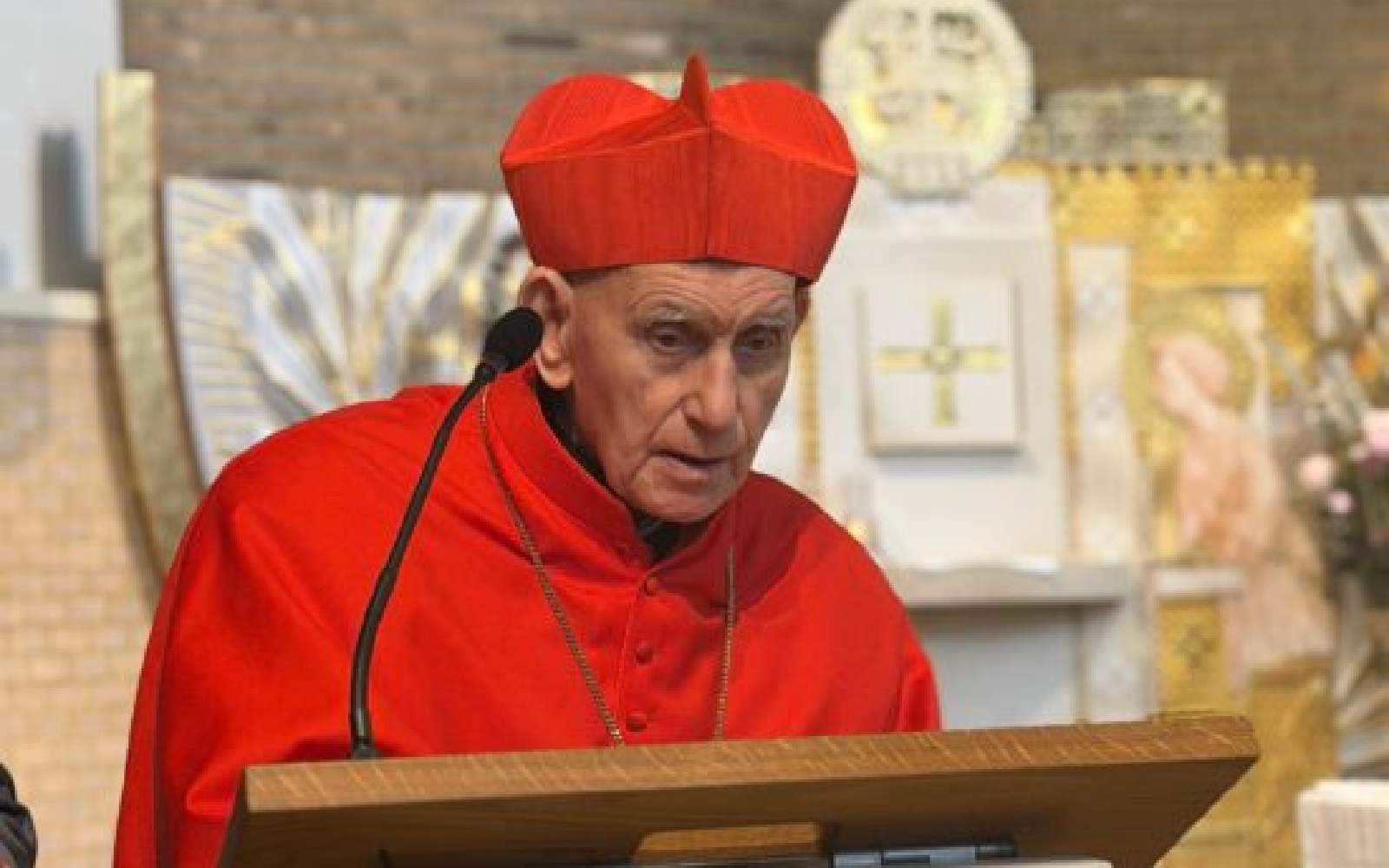
(ZENIT News / San Giovanni Rotondo, 11.20.2026).- A 98-year-old cardinal who survived Albania’s communist persecution recited a 19th-century exorcism prayer in Latin at the shrine of Padre Pio in San Giovanni Rotondo on November 17, during a ceremony livestreamed by the Capuchin television network. Screams could be heard in the broadcast shortly after the prayer began, drawing attention to a rite rarely heard publicly in Catholic churches.
Cardinal Ernest Simoni, one of the oldest members of the College of Cardinals, recited the Exorcismus in Satanam et angelos apostaticos, a lengthy prayer ordered by Pope Leo XIII in 1890 as an exorcism against the action of the devil in the Church and the world. The prayer is distinct from the shorter invocation to St. Michael that Leo XIII introduced for recitation after Mass in 1886.
Before beginning, Simoni asked those present to pray for world peace, political leaders and Pope Leo XIV, describing the prayer as a powerful spiritual appeal against evil. The livestream captured cries and groans from inside the church. Some witnesses reportedly described people contorting themselves during the prayer.
The cardinal has spoken openly over the years about his ministry of exorcism, for which he has been authorized by the Church. He has said he continues to use the Latin version promulgated by Leo XIII rather than the revised rite, explaining that it is the prayer he has always used. The late Father Gabriele Amorth, the former chief exorcist of the Diocese of Rome, also preferred the older formula.
The prayer, however, is not intended for unrestricted use by the faithful. In 1985, the Congregation for the Doctrine of the Faith, then headed by Cardinal Joseph Ratzinger, instructed bishops to prevent laypeople from using the formula, particularly in liberation prayer groups where its use risked abuse and confusion with the Church’s formal ministry of exorcism. The distinction is important: Catholic Church recognizes spiritual warfare, but solemn exorcisms are subject to ecclesiastical authority and require appropriate authorization.
Simoni’s decision to recite the prayer publicly is not unprecedented. He did so in July 2022 at the shrine of Boccadirio in the Bologna Apennines and again on October 25, 2025, at St. Peter’s Basilica following a pontifical Mass celebrated by Cardinal Raymond Burke.
His personal history gives the scene at San Giovanni Rotondo a particular significance. Ordained in 1956, Simoni was arrested by Albania’s communist regime under Enver Hoxha in 1963, accused among other things of having performed an exorcism on a woman. He was sentenced to death, a punishment later commuted to forced labor, and remained imprisoned until the dictatorship collapsed.
During Pope Francis’ visit to Albania in September 2014, Simoni recounted his ordeal at Tirana’s St. Paul Cathedral. The pope embraced him in tears. Two years later, Francis made him a cardinal, bringing international recognition to a priest whose life had been marked by imprisonment, forced labor and religious persecution.
San Giovanni Rotondo, where Padre Pio spent more than five decades, remains a destination for pilgrims seeking spiritual healing and prayers of deliverance, alongside the millions who visit because of the saint’s legacy.
The cries heard during the broadcast may fuel speculation, but the central significance of the event lies less in what viewers think they heard than in the Church’s longstanding understanding of exorcism as a serious, regulated ministry — one rooted in prayer, discernment and pastoral responsibility, rather than spectacle.
Thank you for reading our content. If you would like to receive ZENIT’s daily e-mail news, you can subscribe for free through this link.

Publicaciones relacionadas:
 Pope Francis removes Belgian bishop convicted of abuse from the clerical state
 Pope Francis’ confessor dies in Argentina at age 98
 Pope Leo XIV accepts resignation of bishop whom Pope Francis appointed cardinal, but who “did not want” to receive the appointment
 Following Controversy at the Basilica of Guadalupe, the Cardinal of Mexico City Announced Reforms Inspired by Rome and Appointed a New Rector
