

(ZENIT News / Washington, 11.20.2026).- A growing interest in religion among young Americans is beginning to challenge assumptions about an increasingly secular generation, although renewed curiosity about faith has yet to translate into stronger religious practice. For young Catholics in particular, beauty, sacred liturgy and the experience of worship appear to be playing a surprisingly influential role in rediscovering their faith.
The findings come from the “Beauty and Belief Survey,” conducted by Gallup in March and April 2026 among 5,000 U.S. adults, including 1,165 people aged 18 to 29. The results were presented at the fall meeting of the U.S. Conference of Catholic Bishops in Baltimore on November 18, prompting renewed discussion about whether the Church is witnessing the early signs of a religious revival.
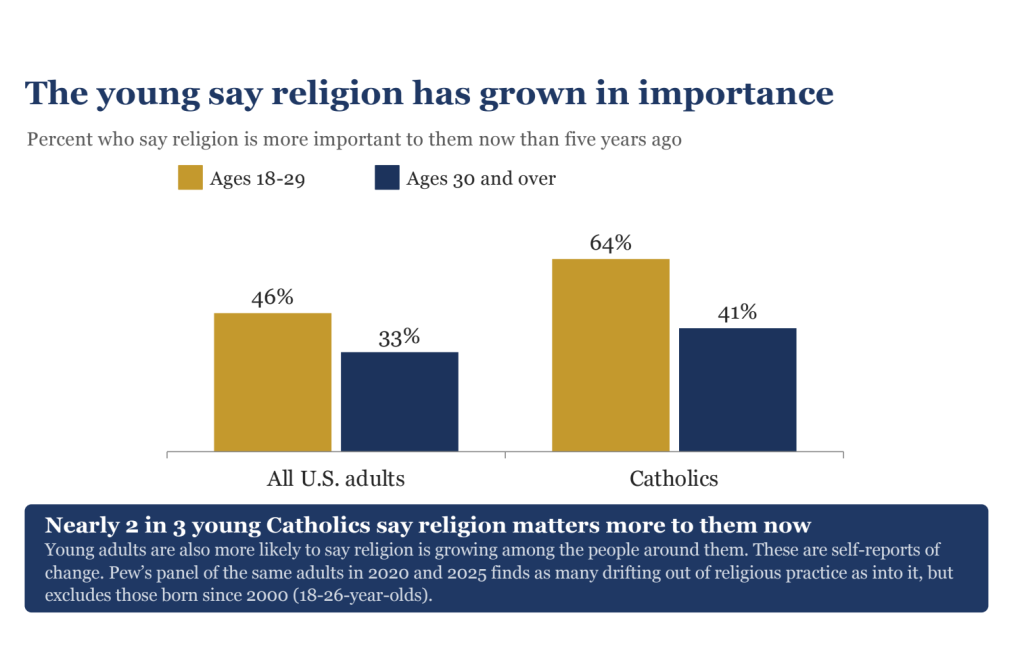
“It is probably premature to claim a Catholic revival is underway, but the signs of new life are real,” said Aaron Weldon, director of New Wineskins at The Catholic University of America, who participated in the presentation.
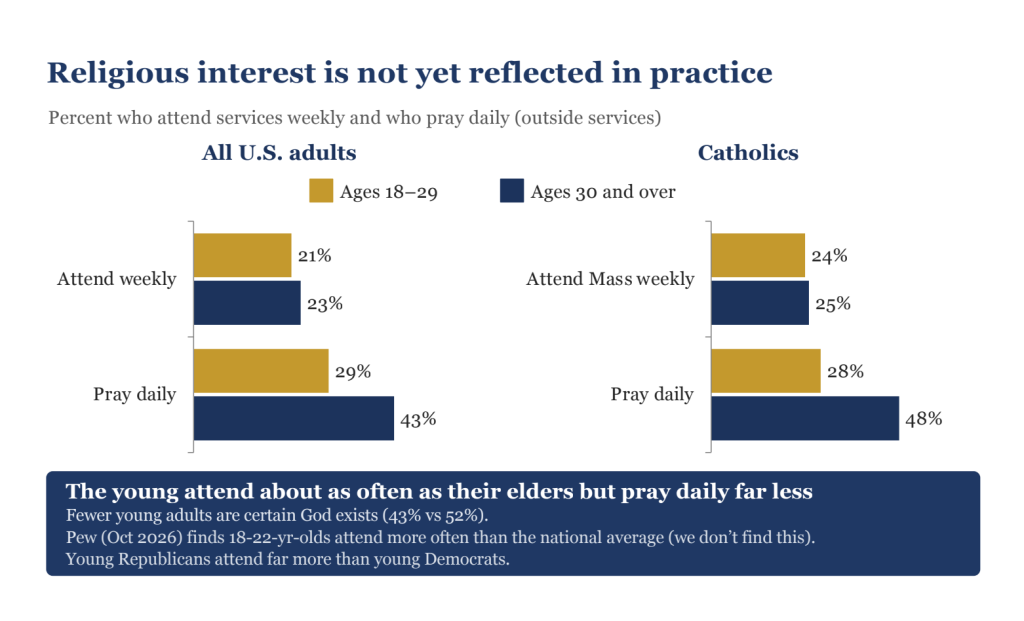
The survey offers reasons for optimism, but also exposes a persistent gap between believing, belonging and practicing. Nearly two-thirds of young adult Catholics say religion has become more important to them over the past five years. Yet only about one in four attends Mass weekly, while just 28% report praying every day — significantly below the 48% recorded among Catholics overall.
The figures suggest that faith is gaining renewed relevance in the lives of many young people without necessarily becoming a regular habit.
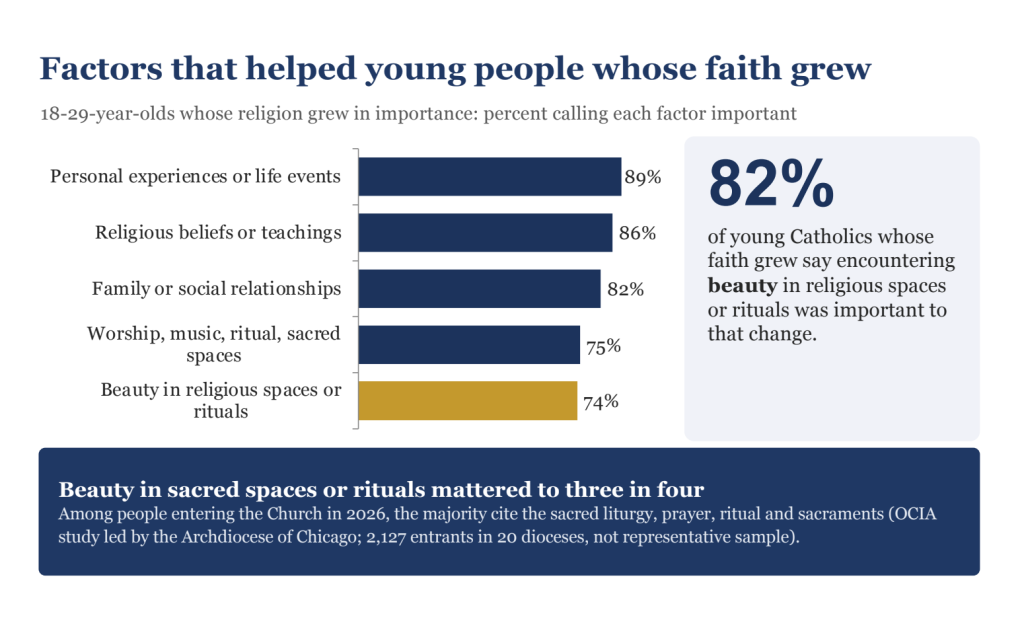
Beauty emerges as one of the most revealing elements of the survey. Among young Catholics whose religious commitment has grown, 82% said encountering beauty in religious spaces or rituals was an important factor. Across young adults who reported a growing interest in religion, 74% cited beauty in sacred environments or ceremonies, while 75% pointed to worship, music, rituals and sacred spaces more broadly.
These findings reinforce the idea that Catholicism’s appeal cannot be reduced to arguments, social identity or moral teaching alone. The liturgy, the architecture of churches, music, silence and the tangible sense of the sacred can themselves become paths toward faith. Another study cited during the presentation found that many adults who entered the Church in 2026 identified sacred liturgy, prayer, ritual and the sacraments as significant influences on their decision.
The other factors behind renewed religious interest were equally striking: personal experiences or life events (89%), religious beliefs and teachings (86%), and family or social relationships (82%). The data suggest that faith is often rediscovered through a combination of personal searching, relationships and an encounter with something that transcends everyday life.
That trend, however, should not obscure the Church’s difficulties in retaining members. Weldon noted that, for every adult entering the Catholic Church in the United States, 8.4 people raised Catholic leave it — a sobering imbalance despite recent increases in conversions and adult entries.
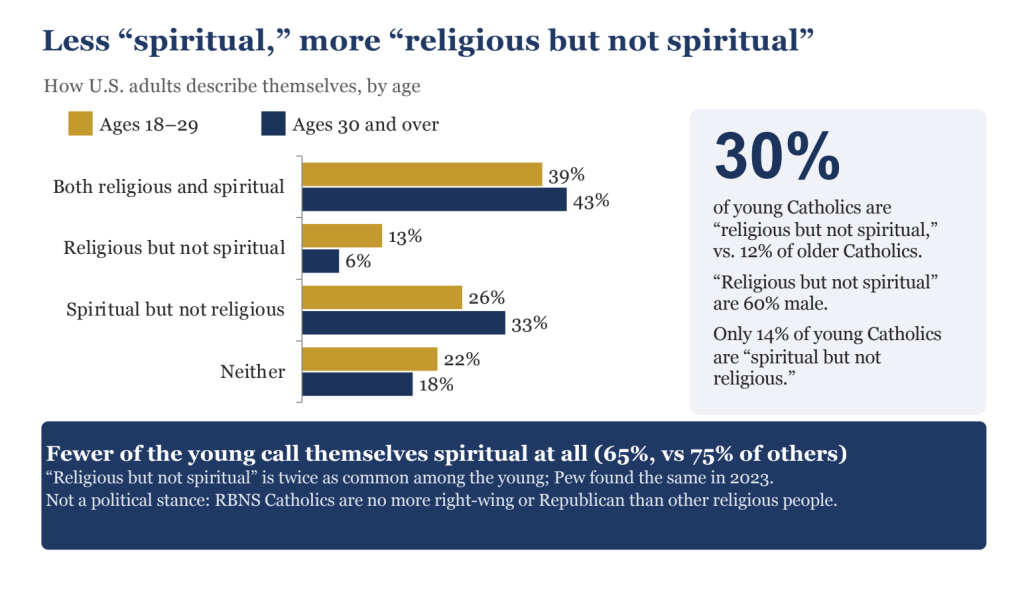
The survey also points to a shift in how younger Americans understand their spiritual identity. The label “spiritual but not religious,” once associated particularly with younger generations, appears to be losing ground among them. While roughly one-third of Americans over 30 identify that way, only a quarter of younger adults do.
Conversely, 13% of young adults describe themselves as “religious but not spiritual,” twice the proportion found among older adults. Among young Catholics, the figure rises to 30%, compared with 12% among older Catholics. Six in 10 people in this category are men, suggesting that religious affiliation and institutional belonging may be gaining particular resonance among young males.
Overall, 39% of young adults identify as both religious and spiritual, while 22% say they are neither — compared with 43% and 18%, respectively, among older adults. The differences indicate that younger Americans are not simply abandoning religion in favor of an undefined spirituality; some appear more willing to embrace explicitly religious identities.
Gender differences nevertheless remain significant. Young men and women report similar levels of Christian identification, weekly worship attendance and growing religious interest. But among those whose faith has become more important, 54% of women pray daily, compared with 35% of men. Women are also more likely to describe themselves as spiritual, while men more frequently say they are neither religious nor spiritual.
Religious interest does not always mean exclusive reliance on traditional spiritual practices, either. Among young adults who consider themselves religious, 30% of women reported using astrology, divination or tarot during the previous year — roughly twice the rate among men. Among those identifying as spiritual but not religious, the figure reached 42%, revealing how conventional religious belief and alternative spiritual practices can coexist.
The search for meaning also appears to be particularly pressing among younger Americans. Around four in 10 adults across age groups said they strongly desired a relationship with God. But young adults were more likely than older people to seek moral guidance — 26%, against 16% — and a sense of community, 33% compared with 20%.
That desire for connection comes amid concerns about loneliness and technology. Young adults are more likely to say social media harms their mental health and nearly twice as likely as older adults to report that artificial intelligence tools provide emotional support. Yet the survey also found an association between using AI for emotional support and poorer mental health, raising questions about the risks of substituting digital interaction for human relationships.
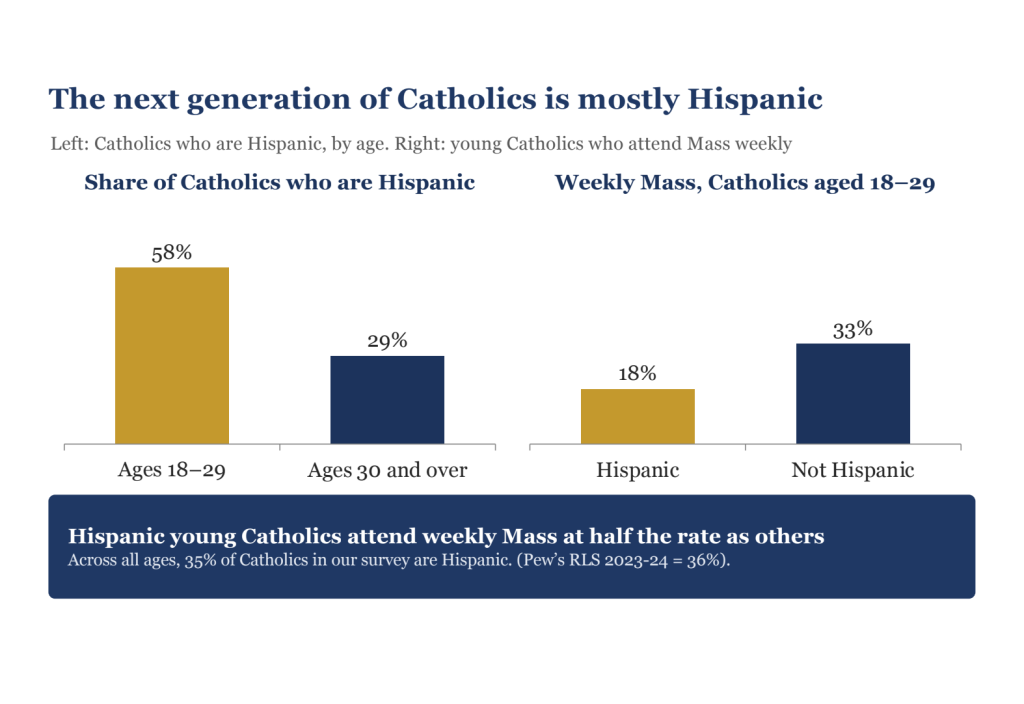
The demographic future of American Catholicism is also becoming clearer. Hispanics account for 58% of young adult Catholics, compared with 29% of older Catholics, making them central to the Church’s future. But their participation remains uneven: only 18% of young Hispanic Catholics attend Mass weekly, compared with 33% of their non-Hispanic peers.
The picture emerging from the survey is neither one of straightforward revival nor of continued religious decline. Young Americans appear to be reconsidering faith, seeking moral direction, community and an encounter with God — sometimes through the very things that institutional religion has struggled to communicate. For the Catholic Church, the challenge will be to turn that renewed interest into a lasting relationship with Christ, one that moves beyond attraction and identity toward prayer, sacramental life and a faith capable of shaping everyday decisions.
Thank you for reading our content. If you would like to receive ZENIT’s daily e-mail news, you can subscribe for free through this link.

Publicaciones relacionadas:
 Report Reveals That Children Inherit Their Parents’ Faith and Political Ideas
 Research Shows that Catholics Are the Fourth Group That Most Attends Religious Services in the USA
 According to The New York Times, Progressive Priests Have No Generational Replacement in the American Clergy
 How often do Catholic students attend Mass or listen to the Pope? The surprising revelations of a study
