(ZENIT News / Dublin, 11.17.2025).- For generations, Dubliners lived with an ecclesial anomaly: a Catholic population that far outnumbered every other religious group in the city, yet lacked a cathedral of its own. That historical quirk has now come to an end. By decree of Pope León XIV, St. Mary’s—long known as the Pro-Cathedral—has been designated the official cathedral of the Archdiocese of Dublin, formally restoring to the Catholic community a status lost half a millennium ago.
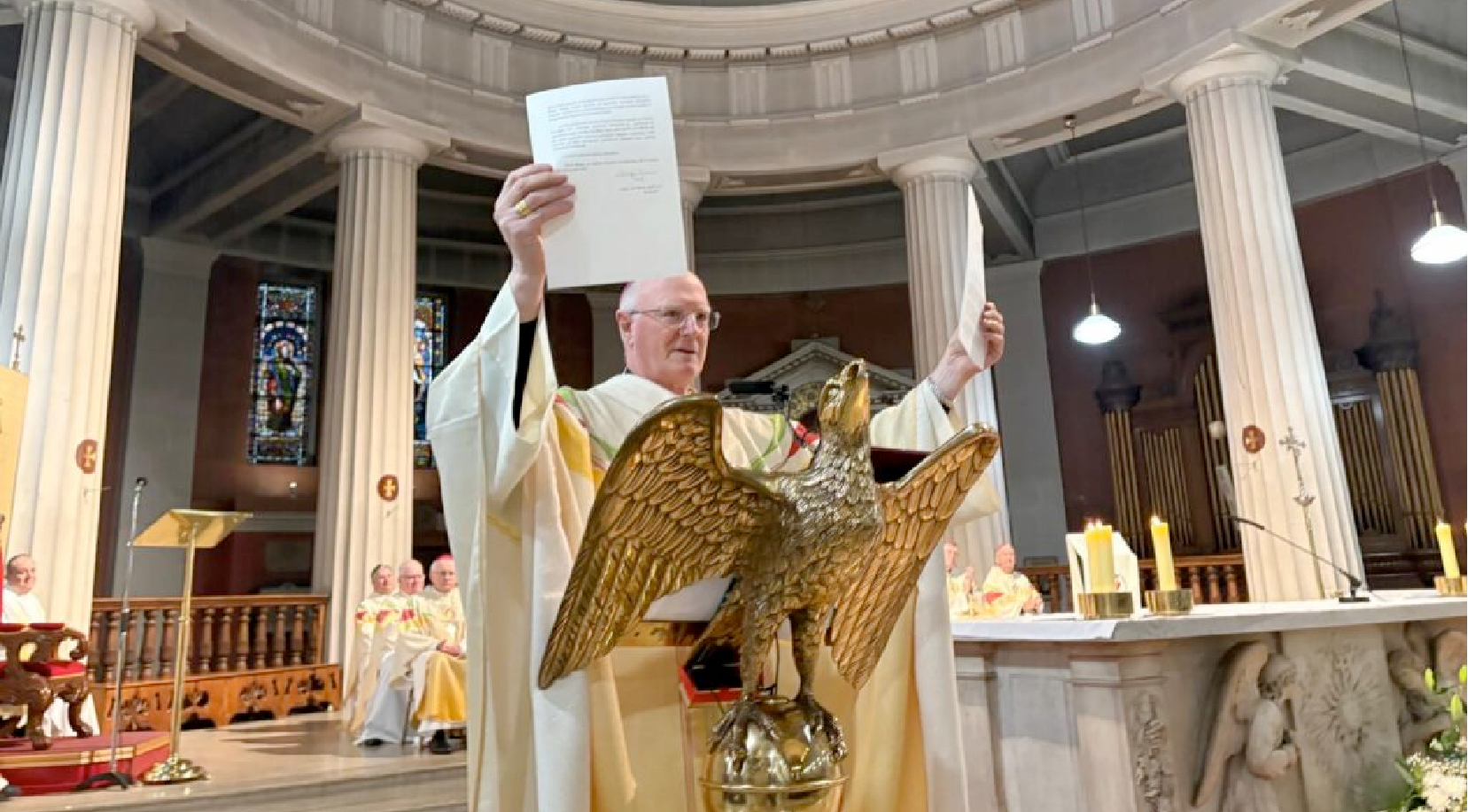
The announcement was delivered on 14 November by Archbishop Dermot Farrell, during a liturgy marking the 200th anniversary of the church’s consecration on the feast of St. Laurence O’Toole. The timing was deliberate: what began in 1825 as a provisional structure—built with the hope that a true cathedral might someday follow—has now been confirmed as the permanent ecclesial heart of the Irish capital.
For Dublin’s Catholics, the news carries a weight that extends beyond architectural identity. The city has not had a Catholic cathedral since the Reformation, when both Christ Church and St. Patrick’s, the medieval seats of the old hierarchy, passed fully into the hands of the Church of Ireland (anglicans). The Penal Laws and centuries of political exclusion ensured that the Catholic majority remained without a cathedral until the nineteenth century, when St. Mary’s was erected as a stopgap solution. The building’s title, Pro-Cathedral—pro tempore, “for the time being”—was a reminder of a long, unfinished story.
That story, it seems, has now reached its conclusion.
Archbishop Farrell told worshippers that the Pope had responded “with great joy” to his request, submitted as part of the bicentenary celebrations. By removing the “Pro” designation, León XIV not only stabilized the cathedral’s canonical identity but also placed a symbolic cornerstone at the center of a city undergoing rapid change. The archbishop described the decision as a “great transition,” one that aligns the life of the archdiocese with the lived faith of a community rooted for centuries in resilience.
Although the exterior signs of the change may be modest—Dubliners, Farrell noted wryly, are unlikely to adjust overnight to calling the church anything other than what they have always called it—the consequences are more than decorative. St. Mary’s is now formally the mother church of the archdiocese, a title that carries liturgical, pastoral, and civic implications.
The designation arrives just as the cathedral prepares for substantial restoration work approved earlier this year by Dublin City Council. The building’s history is layered with moments of national significance. Its crypt houses the remains of nearly a thousand people, including former archbishops, notable Catholic families, and ordinary Dubliners. Its nave has hosted funerals that drew the attention of the nation, among them those of Michael Collins in 1922 and the Fenian figure Jeremiah O’Donovan Rossa. Even in recent decades, it has served as a point of encounter between the universal Church and Ireland; Pope Francis requested a personal visit here during his trip for the World Meeting of Families in 2018.
What makes the new cathedral’s identity distinct, however, is not only its past. It is its placement. St. Mary’s stands in a part of the city marked by poverty, transience, and social strain—the very realities that Archbishop Farrell highlighted in his homily. He spoke candidly about a Dublin in flux, where commercial development rises alongside homelessness and addiction, and where older communities feel overshadowed by the city’s rapid evolution. In such a landscape, he argued, the cathedral serves as a prophetic reminder that the poor are not a social category but members of the same family of faith.
Farrell described the cathedral as a place of encounter—between God and the people of the city, between the Church’s history and its present challenges, between prayer and the difficult texture of everyday life. Drawing on Scripture and monastic writers, he emphasized the importance of a sacred space that offers refuge, silence, and the possibility of renewal. A cathedral, he said, must not be a museum of Catholic memory but a living home from which proclamation, service, and peace radiate outward.
The archbishop did not romanticize the moment. He acknowledged the deep transformation facing Irish Catholicism, a change driven both by cultural shifts and by the Church’s own failures. But he insisted that St. Mary’s, strengthened by its musical and liturgical heritage, can serve as a center of evangelization in a city searching for stability and hope.
Pope León XIV’s decree, then, is more than an administrative adjustment. It binds together past and present: an unfinished chapter from the Reformation era now meeting a Church navigating the uncertainties of the twenty-first century. And it situates the cathedral not atop a hill or behind monumental stone, but at street level—near those whom the Gospel calls first.
For Dublin, a city where the lines of history run deep, the name on Marlborough Street finally matches the faith of the people who have filled it for two centuries. St. Mary’s is no longer a cathedral in waiting. It is, once again, the city’s Catholic home.
Thank you for reading our content. If you would like to receive ZENIT’s daily e-mail news, you can subscribe for free through this link.