

(ZENIT News / Guadalajara, 11.25.2026).- There are sufferings that cannot always be explained in words. Anxiety, depression, anguish, and a sense of loneliness can turn daily life into a silent struggle. Amidst such circumstances, many people find a source of comfort in an ancient Catholic devotion: the prayer of the Holy Rosary.
Beyond the mere repetition of «Hail Mary’s,» this prayer invites us to journey, hand-in-hand with Mary, through the key events in the life of Jesus. Its mysteries become an opportunity to bring one’s own wounds before God, to find strength in faith, and to regain hope. The testimonies of those who have turned to the Rosary during their most difficult moments, show how an apparently simple practice can become a vital spiritual support.
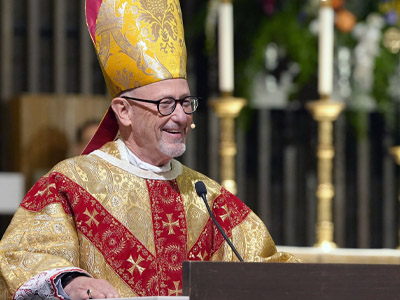
During a talk at St. Catherine of Siena Parish on October 18 — part of the second annual Family Rosary Gathering for the Diocese of Wichita, Kansas — Bishop Conley recalled the 11 months he spent on medical leave after becoming overwhelmed by the clergy sexual abuse crisis in 2019. His Excellency stated that the Rosary remained a spiritual lifeline during a period when even celebrating Mass had become difficult.
“The only prayer that really held me together was the Rosary,” Bishop Conley told those present, according to the Diocese of Wichita’s newspaper Catholic Advance of the Diocese of Wichita.
The Bishop of Lincoln requested a leave of absence in December 2019, after developing anxiety, insomnia, and clinical depression in the wake of the sexual abuse crisis, which included cases within his own Diocese. Cardinal Christophe Pierre, then the Apostolic Nuncio to the United States, had expressed concern about his condition, telling him that he looked terrible and needed to rest.
Subsequently, Bishop Conley spent 11 months at a retreat center in the Diocese of Phoenix, where he found support through daily Mass, the Liturgy of the Hours, and the Rosary.
«I would always go out to pray the Rosary,» the Bishop of Lincoln recalled. «Even though I couldn’t meditate well on the mysteries, I was still able to… pray the Our Father, the Hail Mary, and the Glory Be, and that gave me the strength to keep going.»
His Excellency compared this devotion to a chain that anchored him to the foundations of his faith at a time when he felt stripped of everything else.
«It was almost like a chain connecting me to the truth, goodness, and beauty of our faith; when I was completely stripped of everything else, the Rosary took on an entirely new meaning for me. I never prayed the Rosary the same way again.»
Bishop Conley had previously spoken publicly about his illness when announcing his return to the Diocese of Lincoln on November 12, 2020. At that time, he revealed that he had been diagnosed with anxiety, depression, chronic insomnia, and tinnitus.
During his speech in Wichita, Bishop Conley also referred to the historical influence of the Rosary, drawing upon the Meditations and Devotions of Saint John Henry Newman. He recalled its connection to the Church’s resistance against the Albigensian heresy, as well as the victories at Lepanto and Vienna.
Bishop Carl Kemme of Wichita also spoke at the event, sharing how the Rosary is part of his daily prayer routine. He explained that he prays it while traveling between his home and the diocesan offices.
«It takes exactly five mysteries to get there, and five mysteries to return home,» said Bishop Kemme. He linked this practice to Saint Paul’s exhortation to pray without ceasing, explaining how the Rosary encompasses vocal prayer, intercession, meditation on the lives of Jesus and Mary, and contemplation.
The Bishop identified contemplation as the highest form of prayer, describing it as «simply gazing upon the Face of Christ» and «delighting in the warmth of His love, His mercy, and His grace.»
The event was organized by Father Edmond Kline, a priest at Most Holy Trinity Parish in Little River, Kansas, and author of the 2024 books Miracles of the Rosary and The Rosary of Miracles. The initiative grew out of a retreat on the Rosary that he led at the Catholic Spiritual Life Center.
Father Kline requested permission from Bishop Kemme to organize the gathering — a request the Bishop gladly granted, according to the priest. The first two meetingss were held at St. Catherine of Siena Parish in Wichita.
The program included reflections, a procession, the crowning of a statue of the Blessed Virgin Mary, hymns, the Consecration of families to the Hearts of Jesus and Mary, and the communal recitation of the Rosary.
Testimonies from the Laity
Another testimony came from Erin and Alex Flood, of St. Mary Parish in Newton, Kansas, who spoke about their journey toward the Catholic Church. The couple entered the Church in 2024 after Alex — a former Protestant pastor who had served in ministry for about a decade in St. Paul, Minnesota — began investigating the alleged 1917 Apparitions and questioning their veracity.
Erin also shared her initial reservations about the Rosary, admitting that she had felt fear and anger at the prospect of praying it because she considered it «very Catholic.»
During a period when she was seeking to understand the faith, an unexpected experience of peace, which occurred while she was sitting in her car during a break from her family responsibilities, helped her shift her perspective.
Later, she discovered that meditating on the life of Christ through the Rosary enriched her contemplative prayer and drew her closer to Him.
Dan Rose, also an American, grew up in a family with no religious background and identified as an atheist from a very young age.
During his adolescence, he suffered from severe depression and anxiety, as well as insomnia. He received medical treatment and had to be admitted to psychiatric hospitals.
What is interesting about his story is that it did not begin with him praying for a religious conversion; rather, he was seeking relief from his anguish. Nevertheless, that practice gradually drew him closer to the Catholic Church.
It took him approximately fifteen years to take the definitive step. At the Easter Vigil in 2018, at the age of 39, he received Baptism, First Communion, and Confirmation. Recalling the death of his mother, he also explained that he turned to the Virgin Mary to find solace during his time of grief.
There is an interesting study published in 2021 in the Journal of Religion and Health, titled «Experiences and Perceived Effects of Rosary Praying: A Qualitative Study.»
The study interviewed ten German Catholics who regularly prayed the Rosary. Participants described experiences of greater stability and tranquility, a sense of contemplative connection with God, comfort in difficult situations, and acceptance and spiritual strength in the face of adversity.
The researchers highlighted two elements of this prayer: the rhythmic repetition of the prayers and the physical contact with the beads of the Rosary. It is important to note that this is a small, qualitative study based on personal experiences; it does not prove that the Rosary cures depression or anxiety.
Faith does not deny psychological suffering; rather, it can accompany those who experience it, reminding them that their illness does not define their dignity or their identity.

Publicaciones relacionadas:
 Cardinal Ambongo: statements on the new colonialisms and Fiducia Supplicans
 Cardinal of Jerusalem: both Palestinian and Israeli Catholics are suffering. What should the Church do?
 “Not in my name”: German bishop turns his back on document full of gender ideology from his country’s episcopate
 The Wonderful Spiritual Testament of Cardinal Camillo Ruini and His Confession of Discomfort with Pope Francis Regarding Reopening Wounds Healed After the Council
