
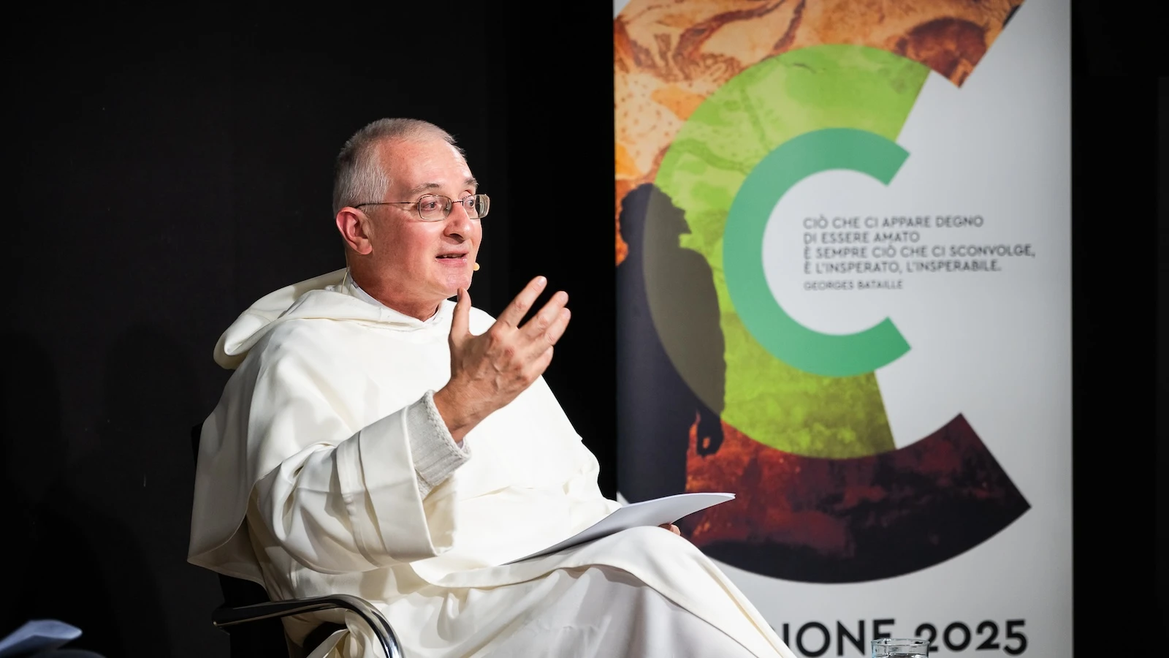
(ZENIT News / Rome, 11.23.2026).- Pope Leo XIV has chosen a seasoned Thomist scholar to become his closest theological adviser, appointing French Dominican Serge-Thomas Bonino as Theologian of the Papal Household in a move that brings a specialist in the relationship between faith, reason and contemporary culture into one of the Vatican’s most discreet but influential positions.
The appointment, announced on November 21, places Bonino, 65, in a role that involves reviewing papal speeches and texts for theological accuracy before they reach the Pope, helping ensure that the Church’s doctrinal voice remains coherent as it addresses increasingly complex cultural and intellectual challenges. He succeeds Polish Dominican Wojciech Giertych, who is stepping down at 75 after serving since 2005 under three pontiffs.
Bonino is no stranger to the Vatican’s theological institutions. He served on the International Theological Commission from 2004 and became its secretary-general in 2011, remaining in the position until 2020. Since 2014, he has also presided over the Pontifical Academy of St. Thomas Aquinas and taught philosophy and theology at the Angelicum, the Dominican university in Rome, where he previously served as dean of the Faculty of Philosophy until 2023.
His academic formation spans theology and philosophy, with doctorates from the University of Fribourg in Switzerland and the University of Poitiers in France. He spent much of his early academic career in Toulouse, teaching medieval philosophy and dogmatic theology, and was editor-in-chief of the Revue Thomiste for more than two decades, according to one of the reports.
The office he now assumes is far older than its contemporary title suggests. Formerly known as the Master of the Sacred Palace, it dates back to the medieval papal court and has traditionally been entrusted to a Dominican. Its history is closely tied to the Order of Preachers, although Bonino has cautioned against a persistent misconception: St. Thomas Aquinas himself never held the office, despite his close relationship with the popes of his time and his contributions to theology at their request.
The position is not intended to impose theology on the Pope. The main task is not, evidently, to teach the Holy Father. It should rather be the other way around. His role is one of intellectual assistance, doctrinal scrutiny and theological dialogue, rather than authority over the pontiff’s thinking.
His appointment comes at a moment when Leo XIV has placed human dignity and the consequences of technological change prominently on the Church’s agenda, particularly through his first encyclical, Magnifica Humanitas, devoted to the human person in the age of artificial intelligence. Bonino has acknowledged that society is undergoing a profound transformation, while arguing that technological and cultural shifts do not erase the enduring foundations of human nature. People, he maintains, continue to seek meaning and remain dependent on relationships and realities beyond themselves.
That perspective reflects the Thomistic tradition he represents: the conviction that reason and faith are not enemies, and that Christian belief must engage intellectual objections rather than retreat from them. Bonino has argued that theology should begin with contemplation and the pursuit of truth, but must also communicate clearly enough to be understood by those searching for answers. He has particularly emphasized the need for younger generations to find solid foundations in a culture where uncertainty can make every conviction appear interchangeable.
Clarity, he says, will be his guiding principle. His Dominican formation, he believes, demands that the word carry meaning and that truth be proclaimed coherently and intelligibly. It is a significant approach for a pontificate seeking to navigate debates over technology, anthropology, faith and the future of humanity without losing sight of the Church’s intellectual inheritance.
The appointment also brings a personal sacrifice. Bonino will leave the ordinary life of his Dominican community to reside in the Apostolic Palace, a change he admits will be difficult after years of benefiting from the fraternity, criticism and example of his fellow religious. Yet he has framed his new responsibility in terms of service rather than prestige, expressing the hope that he will simply be useful to others — a desire he associates with St. Dominic himself.
Alongside Bonino’s appointment, Leo XIV named Enrico Massignani under-secretary of the Dicastery for the Clergy, granted the personal title of archbishop to Aurelio García Macías and Paul Desmond Tighe, and appointed Venezuelan diplomat Javier Domingo Fernández González as apostolic nuncio to Liberia and Sierra Leone, elevating him to the rank of archbishop.
Thank you for reading our content. If you would like to receive ZENIT’s daily e-mail news, you can subscribe for free through this link.