

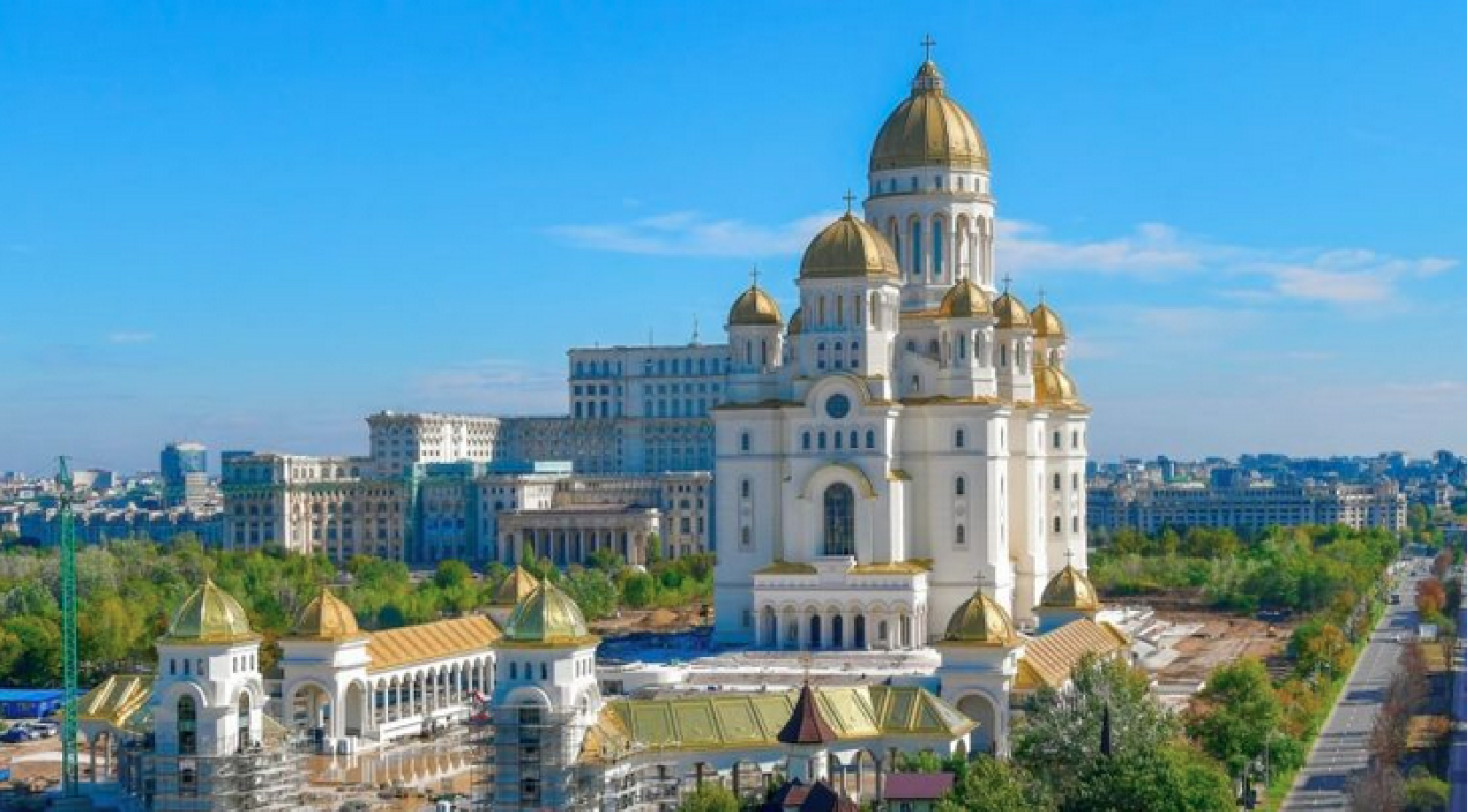
(ZENIT News / Bucharest, 10.31.2025).- Bucharest’s skyline has gained a new and striking landmark — one that redefines the city’s spiritual and architectural landscape. On Sunday, October 26, the Romanian Orthodox Patriarch Daniel blessed the interior and exterior of the nation’s long-awaited Patriarchal Cathedral, officially dedicated to Christ’s Ascension. Known popularly as the “Cathedral of the Salvation of the People,” it now stands as the largest Orthodox church in the world — and, symbolically, as a vertical reply to the colossal Palace of Parliament that looms beside it.
The ceremony, attended by Ecumenical Patriarch Bartholomew I and numerous religious and civil authorities from Romania and abroad, marked a new chapter in the country’s religious narrative. The Catholic Church was represented by Apostolic Nuncio Archbishop Giampiero Gloder, Archbishop Aurel Percă of Bucharest, and Bishop Cristian Crișan of the Romanian Greek-Catholic Church.
The timing of the dedication was deliberate. The Romanian Orthodox Church will soon celebrate two milestones: the 140th anniversary of its autocephaly in 2025 and the centenary of its elevation to patriarchal status. Though construction began only in 2010, the idea of a grand national cathedral dates back to the late 19th century — a dream long deferred by wars, political upheavals, and decades of atheistic communism.
The new cathedral, rising 127 meters high with a total surface area of 55,000 square meters, is an architectural and theological statement. It contains 27 bronze doors weighing 800 kilograms each, 25,000 square meters of vibrant mosaics crafted by Romanian artists with tesserae from Venice’s famed Orsoni workshop, and seven monumental bells totaling 33 tons — the largest of which is the biggest church bell in Europe. To date, the project has cost an estimated 270 million euros.
Architect Constantin Amâiei, speaking to Romania’s HotNews, described the cathedral as part of a “dialogue in contrast.” While the Parliament building — a remnant of Nicolae Ceausescu’s grandiose urban vision — sprawls horizontally across the city, the cathedral rises vertically, “like an arrow toward heaven,” he explained. “Tradition holds that the church tower should be the central point around which a community gathers. We wanted it to be visible from every direction.”
The cathedral will eventually anchor a larger monastic complex surrounded by parkland — a spiritual heart for the capital in both form and function. Within its walls, the faithful will soon venerate the relics of Saint Andrew, the apostle who, according to Christian tradition, preached the Gospel in Romania’s Dobruja region. A reliquary, blessed on October 23 by Patriarch Daniel, contains fragments of the saint’s leg bones — the fibula and kneecap — gifted by Archbishop Orazio Soricelli of Amalfi-Cava de’ Tirreni, in collaboration with Bishop Siluan of the Romanian Orthodox Diocese of Italy.
The reliquary itself, a miniature replica of the cathedral, was crafted in the Patriarchate’s own workshops. “Saint Andrew calls us to preserve the apostolic faith, to transmit it, and to rejoice in the communion of saints,” said Patriarch Daniel, expressing hope that the relics would “strengthen faith and nurture fraternal unity.”
This monumental project also carries a quiet thread of ecumenical history. When Pope John Paul II visited Romania in 1999 — the first papal visit to an Orthodox-majority country since the Great Schism — he donated $200,000 to support the construction of the future national cathedral. The funds were later used to help purchase the cathedral’s bells, manufactured in Austria and blessed in 2018. Patriarch Daniel has since referred to the Polish pontiff as “one of the cathedral’s principal benefactors.”
“The bells have a symbolic value,” the patriarch explained, “for in both Orthodox and Catholic traditions they represent the voice of God, calling people to prayer and to fraternal cooperation.”
Pope Francis continued that spirit of dialogue during his own visit to Romania in 2019. Standing inside the newly consecrated cathedral, he offered a meditation on the Lord’s Prayer, recalling that “every time we say ‘Our Father,’ we reaffirm that the word Father cannot stand without also saying Our.” He added, “In those words lies our shared identity as children — and today, in a special way, as brothers praying side by side.”
At that encounter, Patriarch Daniel presented Francis with a mosaic icon of Saint Andrew, crafted in the same Venetian style as those adorning the cathedral’s walls — a fragment of Romanian Orthodoxy entrusted to the Bishop of Rome.
Thank you for reading our content. If you would like to receive ZENIT’s daily e-mail news, you can subscribe for free through this link.

Publicaciones relacionadas:
 [Photo Gallery] Poignant: Eight Children Make Their First Communion in War-Torn Gaza
 The Boom and Vocational “Miracle” of a Men’s Monastery in Austria
 Secularized Netherlands joins list of countries showing percentage growth in conversions to Catholicism
 London’s Trafalgar Square to Host Landmark 15th Anniversary Performance of the Passion of Jesus on Good Friday
