
(ZENIT News / Rome, 11.18.2026).- For the first time, the lighting of the Christmas tree in St. Peter’s Square will be linked to a location of great symbolic significance: Gubbio, which marks the 800th anniversary of the death of Saint Francis of Assisi. This is the site of the encounter between the Saint and the famous wolf, as recounted in The Little Flowers of Saint Francis.
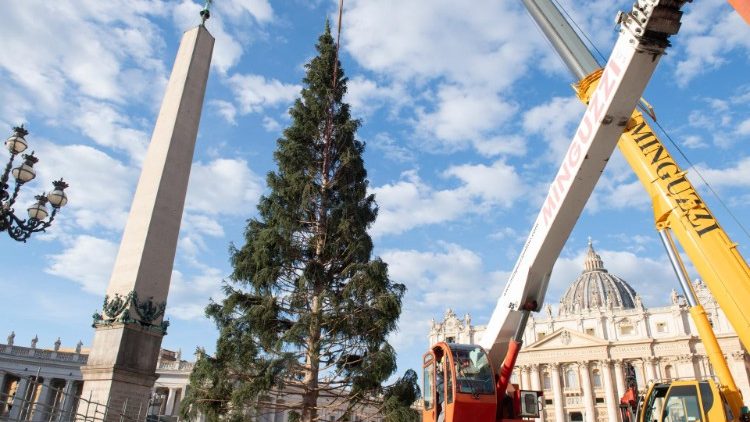
The tree in St. Peter’s Square — a majestic silver fir, 24 meters tall and weighing 7,500 kg — comes from the Cugno dell’Acero forest in the Pollino National Park. It will arrive at the Vatican on the morning of November 19 and be put in place immediately.
It is a gift from the municipality of Terranova di Pollino, in the province of Potenza, an area noted for its significant natural beauty and landscapes.
Children receiving treatment in the Oncology Departments of Italian Hospitals will light the tree on Monday, December 7, at 5:30 p.m. The event will be broadcast live from Gubbio, the site of the world’s largest Christmas tree, located on Mount Ingino.
The tree will be adorned with decorations inspired by the «The World I Would Like» initiative, which gives a voice to children participating in the Lene Thun Foundation’s ceramic therapy workshops — sessions held weekly in hospitals across Italy.
Ver esta publicación en Instagram
The children have poured their hopes and thoughts into the clay ornaments decorating the tree, which will be illuminated by more than 50,000 smart LED lights, creating evocative and dynamic light displays.
In addition to the tree chosen for the Square, several smaller trees will also be brought to the Vatican. These decorated trees will be displayed throughout the offices and buildings of the Holy See, as well as at the Apostolic Palace in Castel Gandolfo.
When selecting the Christmas tree, the forestry service chooses mature trees, ensuring a natural replacement process that aligns with the principles of sustainability.
The tree will remain on display until the end of the Christmas season. Through a collaboration with Conlegno of Milan, the spruce wood will be used to craft items for social, artistic, and liturgical purposes, thereby promoting a circular economy in line with the encyclical Laudato Si’.
This year, the traditional Nativity Scene in St. Peter’s Square is a gift from the Archdiocese of Chieti-Vasto, in partnership with the «Friends of the Nativity Scene» Association of Atessa, the Free Guild of Artists, and the San Pio da Pietrelcina Penitentiary Education Center in Vasto.
The theme is «The Great Mystery,» and it is notable for its scale as well as the values of solidarity and hospitality it embodies. In fact, several inmates participating in an educational and vocational training program also contributed to its creation. Ninety municipalities in the provinces of Chieti and Pescara, along with the 146 parishes of the Archdiocese, also took part in this artistic endeavor.
The Nativity Scene is set among distinctive structures with thatched roofs, inspired by the traditional Pagliarelli or Pinciare, simple rural dwellings built from earth and straw. Life-sized figures and evocative landscapes are designed to recreate Bethlehem as it would have appeared at the time of Jesus’s birth.
The Nativity Scene in the Paul VI Hall is the work of master craftsmen from the Viareggio Carnival. Its goal is to recreate a maritime atmosphere, inextricably linked to the lives of fishermen. In this context, the Three Wise Men are depicted as sailors, bringing gifts drawn from the riches of the Mediterranean.