
(ZENIT News – Porta Luz / Zamora, 08.12.2026).- A few weeks ago, we reported on the controversy sparked in Argentina by the construction of a statue to San La Muerte. Now, Brazil is the center of attention following the erection of a statue honoring the devil; its promoter claims that, at eleven meters tall, it is «o mais grande do mundo» (the largest in the world). Once again, this is a specific event that transcends mere anecdote — and controversy –, as it promotes the «normalization» of occultism and Satanic worship.
Under the Banner of Religious Freedom
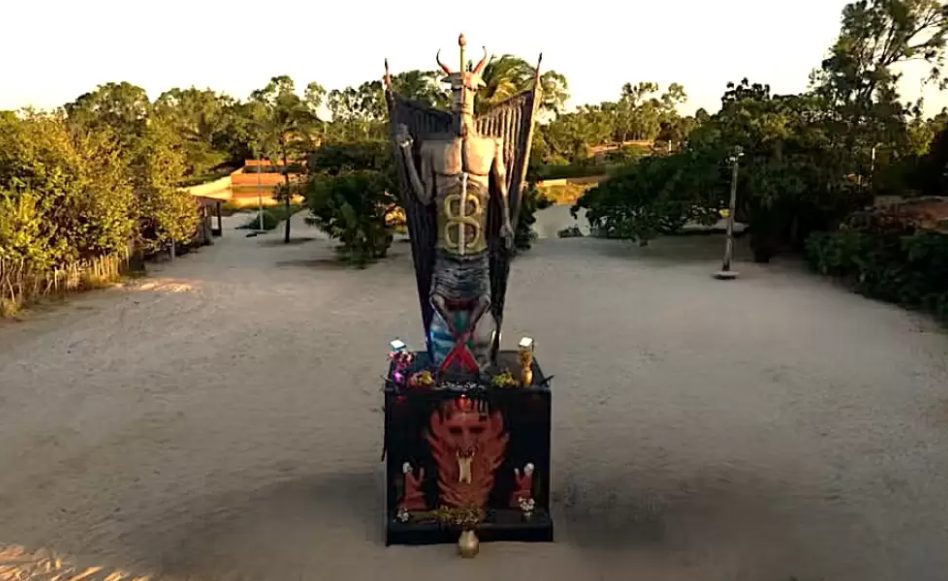
A statue of the devil has been erected in Taíba, a coastal town in the state of Ceará near Fortaleza, one of Brazil’s most populous cities. It stands there defiantly, bearing the traditional iconography of Baphomet — the same imagery used by the infamous Satanic Temple in the U.S. — derived from 19th-century ritual occultism: a goat’s head, a torch between the horns, an inverted five-pointed star on the forehead, wings, one hand pointing up and the other down, the caduceus (Hermes’s staff) at the midsection, and a seated pose with crossed legs.
Brazilian media outlets have provided numerous details about this aberrant monument: it cost 100,000 reais (approximately US$20,000) and is located on the grounds of the so-called «Palace of the Black Star of Quimbanda.» Its inauguration took place on July 25, coinciding with the esoteric site’s 29th anniversary.
«All the money came out of my own pocket. I did it all with my own money, on my own land, which is mine, because the land here is mine, the property is mine,» said the project’s promoter. She claims to hold the necessary construction permit, though she refuses to disclose how long the build took, according to the newspaper “O Globo”. Municipal authorities confirmed in a statement that the temple complies with current legislation, including zoning and environmental requirements (as well as a specific state license, given its location in a specially protected environmental zone).
The local government did not merely justify the construction’s legality; it went further, issuing a somewhat grandiloquent statement to defend itself against emerging criticism. The statement reads: «The municipality of São Gonçalo do Amarante reaffirms its commitment to legality, transparency in administrative actions, and respect for freedom of worship and belief, a fundamental right guaranteed by Article 5, Section VI, of the Federal Constitution.»
A Mysterious Sorceress
The person behind all this is a figure who presents herself as a woman using the esoteric name “Mãe Rainha das Trevas.” She uses the title «Mãe» (Mother), a term for female spiritual leaders in syncretic cults widely practiced in Brazil, such as Umbanda, Quimbanda, Candomblé, and Batuque. Her name translates from Portuguese to «Queen of Darkness,» which gives a clear indication, so to speak, of her chosen realm: black magic. Her real name and surname are unknown, as is her age.
She enjoys a certain level of popularity on Instagram, where she has amassed 820,000 followers on one profile and 789,000 on another. She not only presents herself as a sorceress but also claims to be «the politicians’ sorceress,» employing a hackneyed publicity tactic: making statements that make her appear important yet are impossible to verify, such as her claim to have a client base within circles of power.
As previously mentioned, this “Mãe” states that she founded her center of worship 29 years ago under the name “Palacio de la Estrella Negra de Quimbanda” (Palace of the Black Star of Quimbanda). And this is not the first controversy she has been at the center of, beyond her routine «work» involving black magic and witchcraft. She herself explained it this way in “O Globo”: «The prejudicial comments didn’t start with the construction of the world’s largest statue of the Devil,» but rather «began much earlier, when I opened the ‘House of Coffins'» — a house painted entirely black, containing four coffins used for her dark rituals.
Her Deception: «Demons Are Good»
Mãe Rainha das Trevas insists on clinging to the idea that Brazil is a «secular country,» and therefore, «I have the right to religious freedom and to profess my beliefs.» According to her, «People need to understand that beliefs different from their own shouldn’t be judged so harshly. Because I respect everything that differs from my beliefs. And all I ask is that they respect my faith, too.»
She says that between 200 and 300 people participate in her rituals (known as “giras”), which she holds monthly, as well as in other events dedicated to worshipping her «deities.» Furthermore, she insists on the typical deconstruction of the «demonic» identity found in these occult, and even Satanic, cults, turning the Christian narrative on its head. «Demons help. Demons are always there with open arms to welcome those who need their help,» she asserts.
She acknowledges that animal sacrifices take place during rituals held at her «Black Star of Quimbanda» Palace — a common practice in Afro-American syncretic cults intended to appease spirits — and that the shedding of blood becomes even more central when delving into the darkest, most malevolent forms of these rites. She claims to donate tons of meat from the sacrificed animals each year, using this method of feeding the needy to legitimize her practices. She even hosts a «Children’s Day» celebration every October, where toys are donated and her practice is presented in a positive light to the little ones.
What is the Quimbanda Cult?
Quimbanda is one of various Afro-American syncretic cults — often black magic or sorcery –, as it involves making contact with entities considered «lower spirits.» As previously mentioned, animal sacrifices are performed. Furthermore, the «works» (rituals) are frequently intended to cause harm or are carried out to undo it.
Some authors point out the difficulty of distinguishing the Umbanda cult from Quimbanda, since both are frequently practiced in the same locations, Umbanda by day, Quimbanda by night. Quimbanda is said to have a more negative and sinister character because it seeks to do harm and appease the “Exus” (spirits), centering on bloodshed (animal sacrifice) and the use of the colors red and black (as opposed to the white associated with Umbanda). It is significant that the most common phrase in this syncretic cult is «God is good, but the Devil is not bad,» implying — as Francisco Sampedro and Juan Daniel Escobar assert in the essay “Las Sectas: Análisis desde América Latina” (“The Sects: Analysis from Latin America,” published in 2003 by the Latin American Episcopal Council) — that «there is a clear cult of demons.»
One need not consult Catholic experts to verify the demonic nature of the Quimbanda cult. Any serious academic can explain it, as Fernando Klein, a Professor of Social and Cultural Anthropology at the University of Labor of Uruguay, has done. In a research article, he stated that within this syncretic cult, «Exu» is often identified with Lucifer, working alongside Beelzebub and Astaroth. He clarified that for practitioners, «evil nature spirits are necessary for black magic» and that they are «specialists in witchcraft and sorcery.» Consequently, «if the prayers are successful, victims can lose their jobs, their romantic partners, and their families, and eventually die.»
The Goal: Becoming Spirits… or Demons?
The newspaper O Globo quotes a leading Quimbanda authority in Brazil — a supreme sorcerer named Barok — who tells journalists that «Quimbanda is an ancestral cult in which we seek spiritual evolution.» He speaks as if it were merely a run-of-the-mill New Age practice, attempting to distance the cult from its association with «black magic» –despite the fact that it truly is black magic—in the public imagination. He asserts that the view of Quimbanda as a perverse version of the Umbanda cult is «a story invented by prejudiced people.»
Barok himself acknowledges that the word originates from «Kimbanda«, the name certain Bantu peoples gave to their healers, who «practiced the art of magic to heal.» Enslaved people, brought to Spanish-American countries, syncretized this with Christianity, yet it gave rise to a cult incompatible with the Christian faith. In fact, Quimbanda believes in reincarnation, but views it as a curse; thus, the goal of its practices is «to evolve our spirit within the religion so as not to have to return to this world.» Furthermore, «our goal is to evolve spiritually to become Exus and Pomba-Giras — that is, to be blessed in the spiritual realm.»
The Catholic Church’s Position
The Catholic Church maintains a critical stance toward Afro-American cults in general, and Quimbanda in particular, reminding the faithful that these practices are incompatible with the Christian faith. It notes that they sometimes involve the invocation of demons, something expressly condemned in the sections of the Catechism of the Catholic Church addressing the grave sins of idolatry, superstition, magic, and divination (specifically regarding the First Commandment: nos. 2110–2117).
Believers and society at large are sometimes intentionally misled into thinking that the Church’s lack of public statements against individuals and groups practicing Quimbanda, combined with its tolerant attitude, equates to acceptance or positive endorsement. Nothing could be further from the truth.
A case in point is what occurred in Brazil in April 2025, when a retired judge participated in the inauguration of a Quimbanda temple and was introduced as a «representative of the Justice and Peace Commission of the National Conference of Bishops of Brazil,» with organizers claiming he «represented the leaders of the Catholic Church.» The local Bishop (of Araguaína), Monsignor Giovane Pereira de Melo, was compelled to issue a statement clarifying that the judge did not represent the Bishops’ Conference or the Church, given the «scandal and conflict» that had arisen. The prelate affirmed the Church’s commitment to freedom of worship and opposition to religious intolerance, yet noted that dialogue and respect do not entail equating Christian Revelation with other religions.
This monument to the devil in Brazil will be neither the first nor the last, appearing at a time when many applaud such news, believing it represents an advance in religious pluralism and tolerance, when in reality, it marks a regression in our humanity. Back in 2024, Portaluz reported on the construction of a temple dedicated to Lucifer, also in Brazil! And a year prior, we reported on a similar site in Colombia. As Brazilian exorcist Father João Paulo Veloso noted regarding the first case, frequenting such places and participating in their esoteric rituals «can be one of the instrumental causes of the so-called ‘extraordinary action of the Evil One,’ leading to instances of vexation, obsession, and even diabolical possession.»