

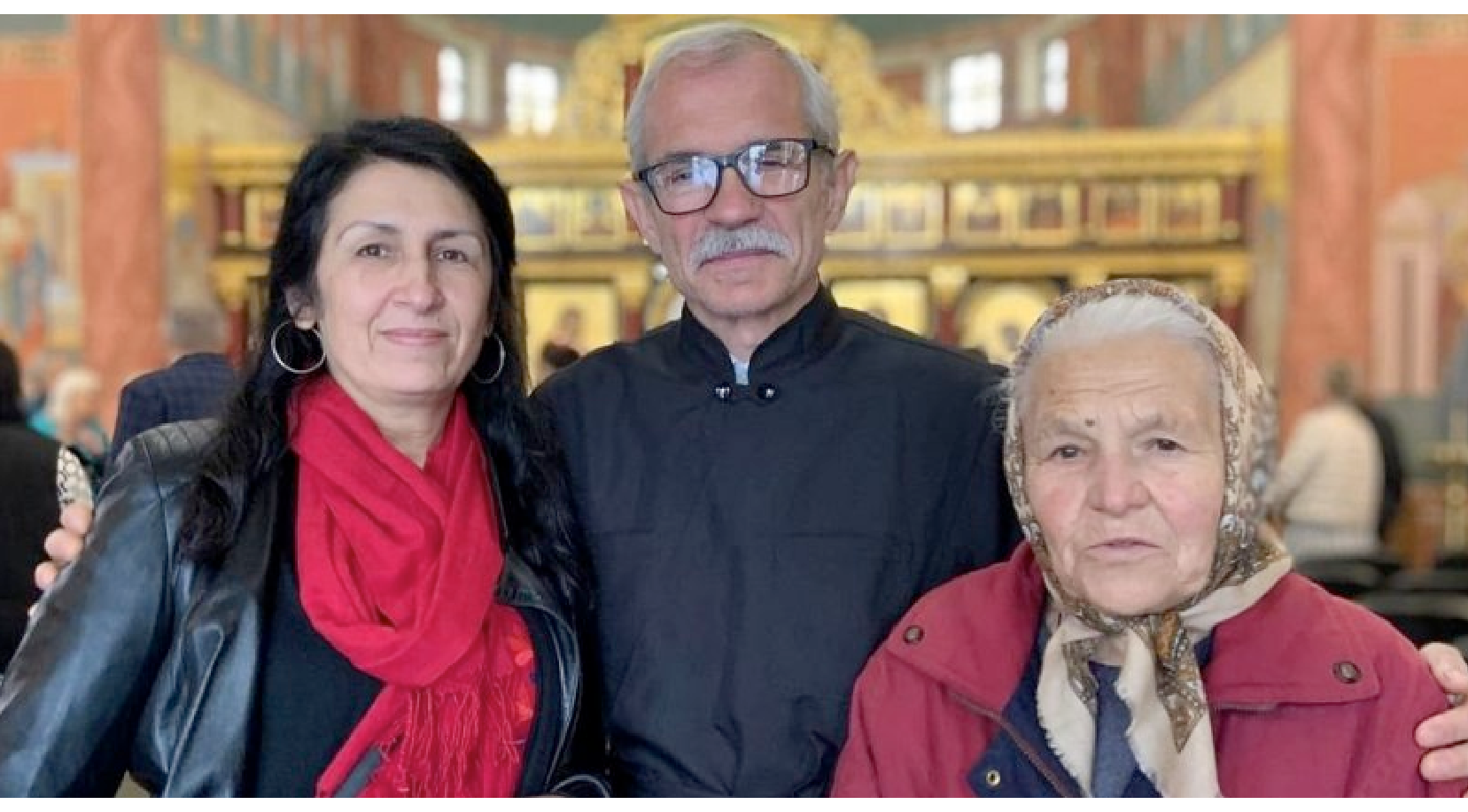
(ZENIT News / Rome, 12.20. 2025) — Petro Didula, a 59-year-old Ukrainian journalist, married and father of five, has decided to embark on a radical path: entering the Greek-Catholic Seminary to train as a priest, with the intention of serving as a military chaplain in the midst of the war between Ukraine and Russia.
His vocation wasn’t born in his youth, but in a moment of profound sorrow. In 2023, during the funeral of Dmytro Pashchuk — a young soldier and his daughter’s fiancé — Petro felt something he described as a true experience of the Resurrection. It shook him to his core: the pain of loss became a call to give meaning to death.
One day, while cycling home, a persistent thought came to him: «Go to the Seminary now.» He called the Rector of the Seminary in Lviv, who encouraged him to go ahead, reminding him that he wasn’t the first to respond late to the call, as Father Taras Panat had been ordained at the age of just 69 in July 2023.
Undoubtedly, the weight of an established family life made him hesitate. «Humanly speaking, I didn’t want to continue my studies,» he confessed, especially when he felt his memory couldn’t retain all the information. But an eight-day Ignatian retreat and the support of the Catholic priests who accompanied him, gave him the clarity he needed to persevere.
His family’s reaction was one of astonishment, but also of respect. His wife, Natalia, and his mother, present in many interviews, expressed tenderness and pride in such a courageous decision. For them, it is not just the abandonment of a professional career, but an offering of a new life, guided by faith.
What motivates Petro is his deep desire to be with those who need him most: the soldiers on the front lines. In a heartbreaking conflict, he wants to offer not only spiritual comfort, but also hope and a human presence. He believes that as a priest he can be «the hand of God» for those who experience horror every day.
But his path has not been easy. At almost sixty years old, he has to study dense subjects, adapt to Seminary life, and live with much younger seminarians. Furthermore, the war adds an extra urgency: his training must prepare him not only to administer the Sacraments, but also to serve in dangerous areas as a military chaplain. He mentions that, if he manages to be ordained a priest, his greatest desire is to be able to stand firmly alongside his compatriots on the battle front.
The Ukrainian Greek-Catholic Church is in full communion with Rome, but with a different discipline: unlike the Latin Rite, in this Church married men can be ordained priests, provided they marry before ordination. However, in the case of married men with families, the process is more difficult since they must separate from their families for six years to study at the Seminary, which creates some complications for the candidate’s family.
This difference from the Latin Rite is understood in its historical context: Eastern Catholic Churches, like the Ukrainian, have maintained the practice of allowing married priests for centuries. Even so, they cannot marry after being ordained, and Bishops must be celibate, according to the norms of that Rite.
The Major Archbishop of the Ukrainian Greek Catholic Church, Sviatoslav Shevchuk, has pointed out that this model does not exclude challenges: although it allows married priests, there is no automatic increase in vocations because of it, and marriage is no guarantee of an increase in the clergy or of the holiness of the priest’s life.
Petro Didula’s testimony joins that of many other military chaplains who, since the beginning of the war, have made the decision to accompany soldiers in the midst of the fighting, bringing comfort, forgiveness, and the presence of Christ in an environment as hostile as armed conflict.
Today, Petro Didula’s figure represents a symbol: that of a man who, when life seemed already written, dared to answer a calling greater than himself. In a country ravaged by war, his vocation becomes a living message of hope, sacrifice, and faith in the midst of darkness.

Publicaciones relacionadas:
 Christian survivor of Islamist attack in Nigeria receives award
 Convert Jew Is Baptized in Madrid While His Son Prepares for His First Communion
 Prince Hassan invites Patriarchs and Church Leaders to a conference on the role of Arab Christians in the Middle East
 Inspiring: More Than 400 Iraqi Children Make Their First Communion
