

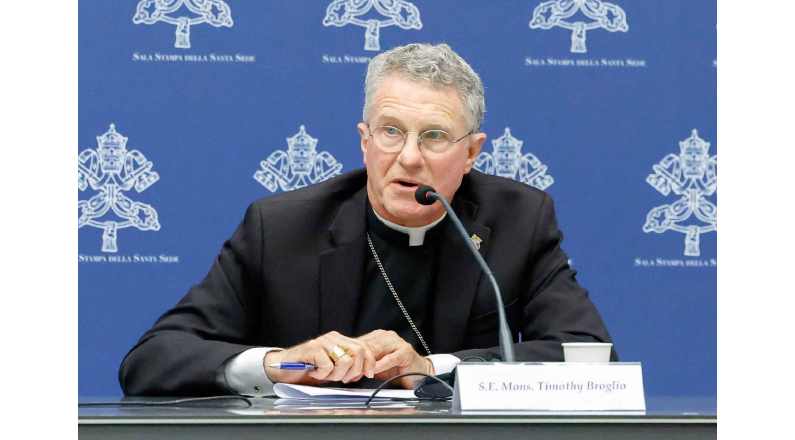
(ZENIT News / London, 01.21.2026).- As Washington’s rhetoric over Greenland hardens, an unusual moral alarm is being sounded—not from foreign ministries or security analysts, but from the Catholic Church’s highest-ranking shepherd of U.S. troops. Archbishop Timothy P. Broglio, who oversees the pastoral care of Catholics in uniform, has publicly raised the possibility that American service members could, in good conscience, refuse orders to participate in a military operation aimed at seizing the Danish territory.
Broglio’s intervention, articulated in a series of recent interviews and statements, places Catholic moral theology squarely in the path of contemporary geopolitics. At issue is not only Greenland itself, but a broader question that has resurfaced with urgency: under what circumstances, if any, can the use of force by a powerful nation against an ally be morally justified?
Speaking to the BBC on January 18, the archbishop was blunt. He said he could see no scenario in which a U.S. military action to take control of Greenland—or the territory of any allied nation—would satisfy the classical Catholic criteria for a just war. Those criteria, developed over centuries and refined in modern Church teaching, require, among other things, a just cause, proportionality, last resort, and a reasonable chance of success. In Broglio’s assessment, Greenland meets none of those thresholds.
Greenland, while geographically vast and strategically significant in the Arctic, is an autonomous territory within the Kingdom of Denmark. Denmark, in turn, is a NATO ally of the United States. For Broglio, that fact alone carries decisive moral weight. “It does not appear reasonable,” he has said, “for the United States to attack and occupy a friendly nation.”
The archbishop’s concerns are not abstract. President Donald Trump has repeatedly insisted that Greenland is essential to U.S. national security, particularly in connection with plans for an expanded missile defense system sometimes referred to as the “Golden Dome.” Trump has renewed earlier demands that Denmark sell the territory, while also refusing to rule out coercive measures. Over the weekend of January 17–18, he reportedly threatened punitive tariffs against Denmark and other European countries and told Norway’s prime minister that he no longer felt bound to “think purely in terms of peace,” citing his failure to receive the Nobel Peace Prize.
Such language, Broglio warned, carries consequences of its own. Even apart from concrete actions, he said, the tone and posture of U.S. policy risk damaging the country’s standing in the world. Rhetoric, in this sense, becomes a moral act: it shapes expectations, legitimizes certain behaviors, and can normalize the idea that force is an acceptable tool of persuasion.
For Catholics serving in the armed forces, the dilemma is especially acute. Military culture is built on obedience, cohesion, and chain of command. Broglio openly acknowledged how difficult it would be for a soldier, Marine, or sailor to refuse a direct order. Yet Catholic teaching holds that conscience cannot be overridden, even by lawful authority. In strictly moral terms, he said, disobedience could be justified if the order itself were gravely immoral—though such a decision could place the individual service member in what he called an “untenable” personal and professional position.
This is not the first time Broglio has spoken out against U.S. military actions he considers morally flawed. In December 2025, he condemned a U.S. strike in the Caribbean that resulted in the deaths of all aboard a boat suspected of drug trafficking. He argued that deliberately killing non-combatants or incapacitated individuals violates an absolute moral norm and that alternative options—such as interception and arrest—were available. The principle he invoked then is the same one animating his concerns now: the end does not justify the means.
The archbishop’s voice is part of a wider Catholic unease. On January 19, three prominent U.S. cardinals—Blase Cupich of Chicago, Robert McElroy of Washington, and Joseph Tobin of Newark—issued a joint statement warning that the United States is entering its most serious debate about the moral foundations of its global actions since the end of the Cold War. They cautioned that questions of sovereignty, peace, and the common good are increasingly being reduced to partisan talking points, eroding any shared ethical framework.
Their warning echoed recent remarks by Pope Leo, who has lamented the global erosion of the post–World War II consensus that forbade the use of force to change borders. In a speech to diplomats, the pope argued that diplomacy grounded in dialogue and consensus is being replaced by a logic of dominance, where peace is pursued through weapons rather than mutual recognition. War, he said starkly, is once again being treated as fashionable.
While high-level debates continue in Washington and European capitals, the human dimension of the crisis is perhaps most visible in Greenland itself. The island has a population of roughly 55,000, including about 500 Catholics, who are pastorally cared for by Conventual Franciscan friars based in Denmark. Father Tomaž Majcen, parish priest at Christ the King Church in Nuuk, has described local reactions as a mixture of anxiety and quiet resolve. For many Greenlanders, he says, the most painful aspect of the debate is the sense that their homeland is being discussed as a strategic asset rather than as a living society with its own culture and aspirations.
In that light, the Church’s interventions—whether from an archbishop responsible for soldiers or from friars serving a tiny Arctic flock—are less about geopolitics than about anthropology. They insist on seeing persons before power, conscience before command, and peoples before property.
Thank you for reading our content. If you would like to receive ZENIT’s daily e-mail news, you can subscribe for free through this link.

Publicaciones relacionadas:
 Catholic Patriarch Emeritus of Jerusalem demonstrates that Israel’s security cannot be achieved through violence
 Leader of all U.S. bishops to migrants: “Count on our commitment to accompany you in these difficult times”
 Bishop of El Paso to immigration agents: No one is obligated to follow an immoral law
 Unexpected: Vatican court rules trial against Cardinal Becciu partially invalid and orders a retrial
