

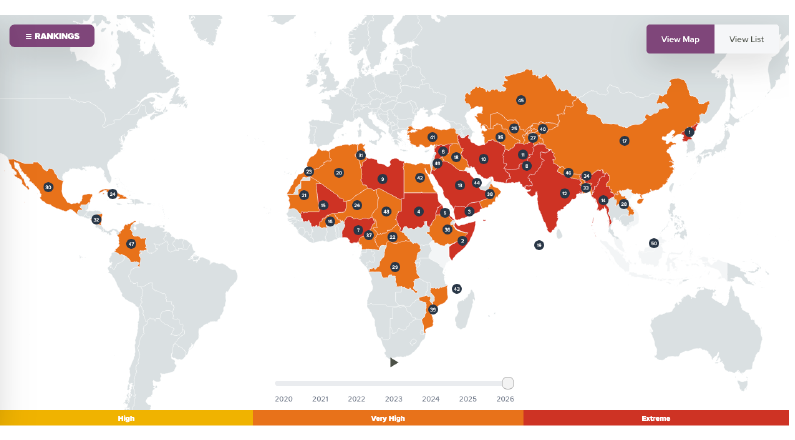
(ZENIT News / Rome, 01.18.2026).- The latest global data on anti-Christian persecution paint a picture that is both stark and unsettling. According to the World Watch List 2026, published by Open Doors on 14 January, the number of Christians living under high or extreme levels of persecution has risen to more than 388 million worldwide—an increase of 8 million compared with the previous year. In practical terms, this means that one in every seven Christians globally now faces serious discrimination, pressure, or violence because of their faith.
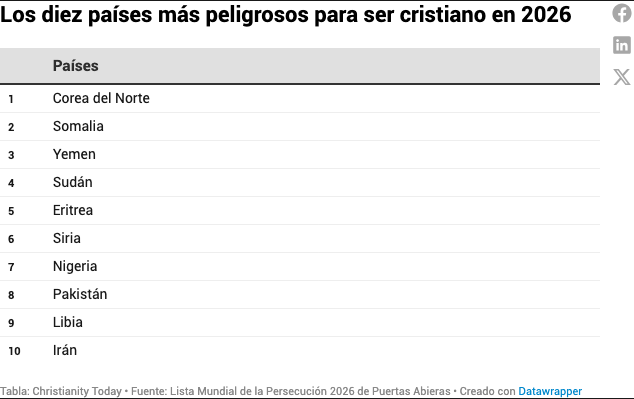
Cristian Nani, director of Open Doors, described the findings without ambiguity: “Sadly, this is another record year.” The figures behind that assessment reveal the human cost in sharper focus. Of the 388 million affected Christians, 201 million are women or girls, and at least 110 million are children under the age of 15. These numbers alone underscore how persecution increasingly targets the most vulnerable members of Christian communities.
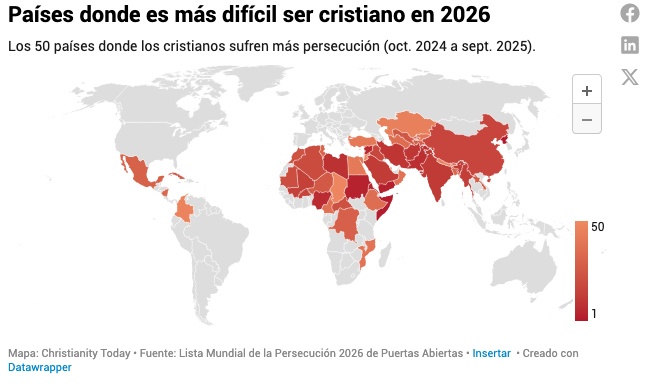
The World Watch List evaluates approximately 100 countries and ranks the 50 where Christians face the most severe conditions. In this year’s report, the number of countries classified as experiencing “extreme” persecution rose from 13 to 15. North Korea remains at the top of the list, holding the first position for the 24th time in the past 25 years.
An estimated 50,000 to 70,000 Christians there are believed to be imprisoned in labor camps, forcing the remaining believers to practice their faith entirely underground and giving rise to what Open Doors calls a “hidden Church.”
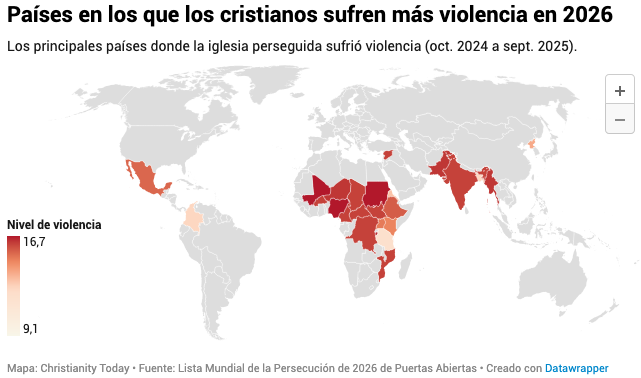
Behind North Korea, a pattern becomes clear. Three of the top five countries—Somalia, Yemen, and Sudan—are states with strong Islamic social frameworks combined with political instability and active extremist movements. In such contexts, Christians, particularly converts from Islam, face the risk of social exclusion, imprisonment, or death if their faith becomes known. Eritrea, often referred to as the “North Korea of Africa,” ranks fifth, where the government equates independent religious activity with political dissent.
Syria stands out this year for a troubling shift. Previously classified as “severe,” it has now moved into the “extreme” category. Open Doors estimates that only about 300,000 Christians remain in the country—hundreds of thousands fewer than a decade ago. According to Nani, the danger has increased because political power remains fragmented, leaving space for armed groups and local militias, as illustrated by recent clashes in Aleppo.
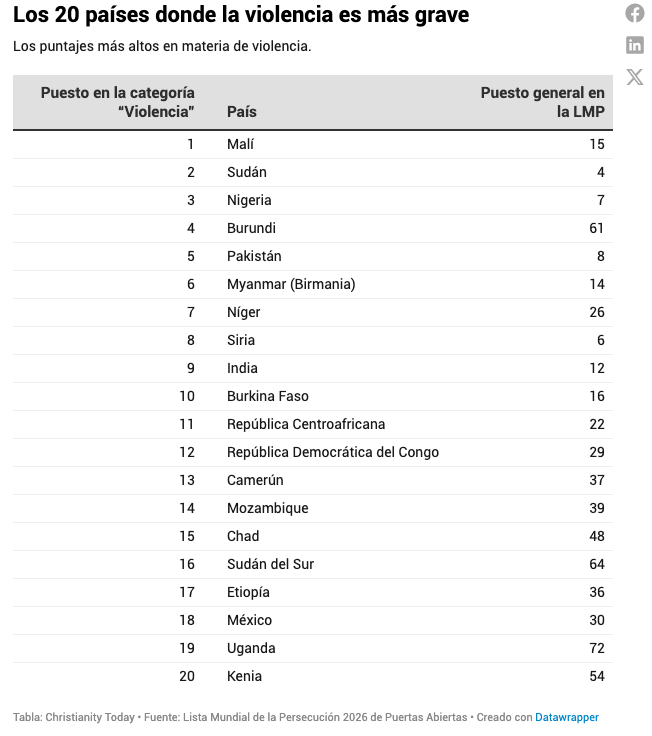
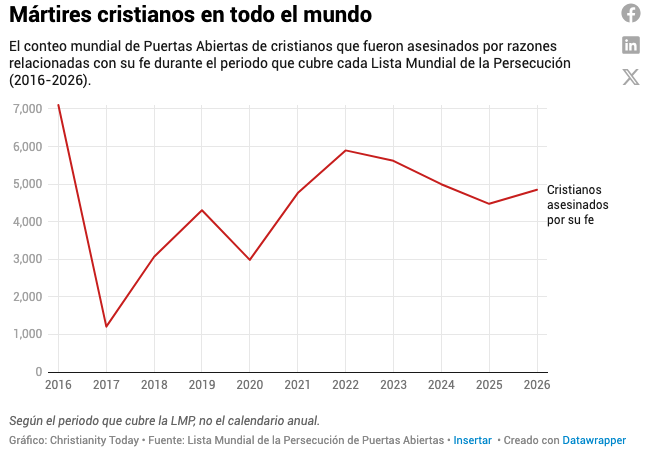
Violence statistics reinforce the gravity of the situation. After a temporary decline in 2025, the number of Christians killed for reasons related to their faith rose again, from 4,476 to 4,849—an average of 13 deaths per day. Nigeria continues to be the epicenter of lethal violence, accounting for 3,490 of those deaths, roughly 70 percent of the global total. Since 2020, conservative estimates suggest that more than 25,200 Christians have been killed in Nigeria alone.
Sub-Saharan Africa emerges as the central battleground in the 2026 report. The region has seen its average persecution score rise from 68 to 78 out of 100 over the past decade, while the violence indicator has surged from 49 to 88 percent of the maximum possible score. Ten years ago, six countries from the region appeared among the 20 most violent for Christians; this year, that number has doubled to 12. Sudan, Nigeria, and Mali are the only countries worldwide to reach the maximum violence score.
Sudan’s civil war, which began in 2023, has displaced nearly 10 million people—roughly the population of greater London or Bangkok. Hundreds of churches have been damaged or destroyed, and Christians have been directly targeted in Darfur, the Blue Nile, the Nuba Mountains, and even in the capital region. Rebel forces and government troops alike have been implicated in attacks on Christian institutions.
Nigeria’s crisis is driven by a lethal mix of land disputes between farmers and herders, jihadist insurgency, and religious intolerance. Despite being a democracy, the state has struggled to provide security across its territory, leaving entire regions—particularly the so-called Middle Belt—chronically unstable.
Yet persecution is not confined to contexts of Islamist extremism. In Ethiopia, ranked 36th, pressure comes primarily from the country’s dominant Orthodox Church, which is historically close to political power. Protestant communities face local hostility, and armed groups burned or looted at least 25 churches despite a formal ceasefire signed in 2022.
Elsewhere, government control rather than open violence defines the threat. In Algeria, systematic church closures have left an estimated three-quarters of Christians outside any organized community. China, ranked 17th, reached its highest-ever pressure score not because of increased violence, but due to tighter regulations on online religious activity. Preaching is now limited to registered platforms and state-sanctioned Catholic and Protestant associations, and clergy are required to publicly support the Communist Party. Independent churches that once gathered openly now meet in groups as small as 10 to 20 people.
The broader humanitarian impact is severe. Open Doors estimates that at least 224,129 Christians were internally displaced or became refugees during the period covered by the report, up from 209,771 the previous year. Nigeria, Myanmar, and Cameroon were the most affected. Cases of physical or psychological abuse rose sharply, from 54,780 to 67,843, while reports of rape and sexual harassment increased from 3,123 to 4,055. Forced marriages involving Christians also rose, from 821 to 1,147 cases, with Nigeria, Pakistan, and the Central African Republic at the top of that list.
Some indicators did show improvement. Attacks on churches fell from 7,679 to 3,632, and assaults on homes or businesses declined from 28,368 to 25,794. Kidnappings also decreased, from 3,775 to 3,302. However, Open Doors stresses that its figures are conservative estimates and likely represent only the minimum level of abuse, given the difficulty of data collection in conflict zones and cultures marked by fear and stigma.
There are also isolated signs of progress. Bangladesh dropped from 24th to 33rd place following a reduction in violence after political upheaval in 2024, while a landmark court ruling in Malaysia ordered the government to reopen the investigation into the 2017 disappearance of pastor Raymond Koh, imposing financial penalties that now exceed 7 million US dollars.
Still, the overall conclusion of the World Watch List 2026 is unmistakable. Persecution of Christians is not only widespread but increasingly complex, driven by fragile states, ideological extremism, authoritarian control, and social hostility. As Nani warned during the presentation of the report in Rome’s Senate, the world is witnessing the emergence of a “refugee Church”—communities forced to flee, survive in secrecy, or endure systematic pressure simply for professing their faith.
Thank you for reading our content. If you would like to receive ZENIT’s daily e-mail news, you can subscribe for free through this link.

Publicaciones relacionadas:
 USA: Transexual Woman Kills Three Children and Three Adults in a Christian School
 The 50 Countries that Persecute Christians the Most Today and The Role of Communism and Islamism
 Poland: half of the Catholic clergy have been attacked and/or assaulted in the last year
 Islam kills: 32 people are murdered every day in Nigeria just for being Christians, according to new research
