

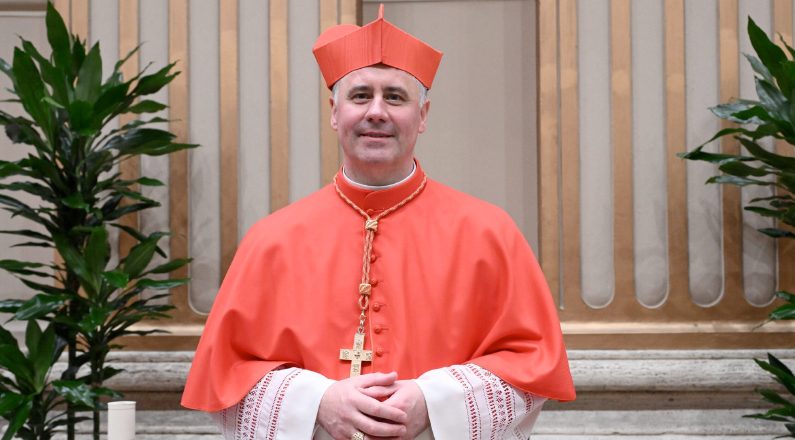
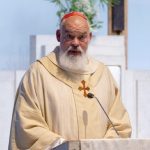
(ZENIT News / Vatican City, 07.07.2025).- On July 4, Pope Leo XIV officially acknowledged the transition in leadership at the Papal Basilica of Saint Mary Major, marking the end of Cardinal Stanislaw Rylko’s tenure and welcoming his successor, Cardinal Rolandas Makrickas, into the role of archpriest.
The change marks more than an administrative adjustment. It symbolizes a broader generational and geographical shift within the leadership of the Roman Curia, as Cardinal Makrickas—born behind the Iron Curtain in Soviet-occupied Lithuania—becomes the first Lithuanian to assume stewardship of the Liberian basilica in modern times.
Cardinal Makrickas brings a distinct trajectory to the post. Raised in the small Lithuanian town of Biržai, he experienced firsthand the oppressive constraints of Soviet atheism. «We felt the persecution of the Church intensely,» he once reflected, describing how his earliest catechesis had to be discreet, brief, and underground.
That early hunger for faith led him in 1990 to the seminary in Kaunas, just as Lithuania re-emerged from Soviet control. His academic path eventually took him to Rome’s Pontifical Gregorian University, where he studied philosophy and theology, and later earned a doctorate in Church History.
Ordained in 1996 for the Diocese of Panevėžys, he quickly emerged as a rising figure in the Lithuanian Church, helping lead preparations for the Jubilee Year 2000. But it was his entry into the Vatican’s diplomatic service in 2006 that dramatically broadened his mission.
From Bolivia to Washington, D.C., from Sweden to Georgia during wartime, Makrickas witnessed the global Church in some of its most challenging circumstances. His diplomatic service included delicate engagements with fractured societies and conflict zones, but also moments of triumph—such as helping coordinate Pope Francis’ 2015 visit to the United States.
Between 2017 and 2019, his work in Africa as chargé d’affaires in Gabon and later as counselor in the Republic of the Congo brought him into direct contact with the pastoral and logistical challenges of mission territories, where the Church often functions as the primary social safety net.
Back in Rome by 2019, Makrickas made history again, becoming the first non-Italian to head the administration of the General Affairs Section of the Secretariat of State, overseeing crucial internal functions of the Vatican’s governance. His reputation for administrative precision and discretion earned him new responsibilities—first as extraordinary commissioner for the assets of Santa Maria Maggiore, then as its coadjutor archpriest, and finally, as of December 2024, a cardinal of the Roman Church.
Fluent in English, French, Italian, and Spanish, Cardinal Makrickas is a seasoned polyglot as well as a bridge-builder between worlds—East and West, diplomacy and spirituality, bureaucracy and mission.
His predecessor, Cardinal Rylko, served during a time of significant transitions in the Church and oversaw major restorations and the deepening of Marian devotion at the basilica. Pope Leo XIV personally thanked Rylko for his years of service, while expressing confidence in Makrickas’ leadership as a continuation of renewal and openness.
Santa Maria Maggiore—home to the revered image of Salus Populi Romani and the oldest Marian church in the West—now enters a new era. Under the guidance of a cardinal who grew up hearing Mass in whispers and candlelight behind closed doors, the basilica may become an even more potent symbol of faith’s resilience and the Church’s global horizon.
Thank you for reading our content. If you would like to receive ZENIT’s daily e-mail news, you can subscribe for free through this link.

Publicaciones relacionadas:
 The Challenge of the Priest’s Loneliness Explained by the Cardinal Responsible for the Clergy Worldwide
 New Brazilian cardinal confirms: new Amazonian rite and viri probati are on the table
 Vatican Assembles Independent Tribunal to Try Former Jesuit Marko Rupnik
 The only cardinal in Iran was evacuated from the country and transferred to Rome: here is what is known
