

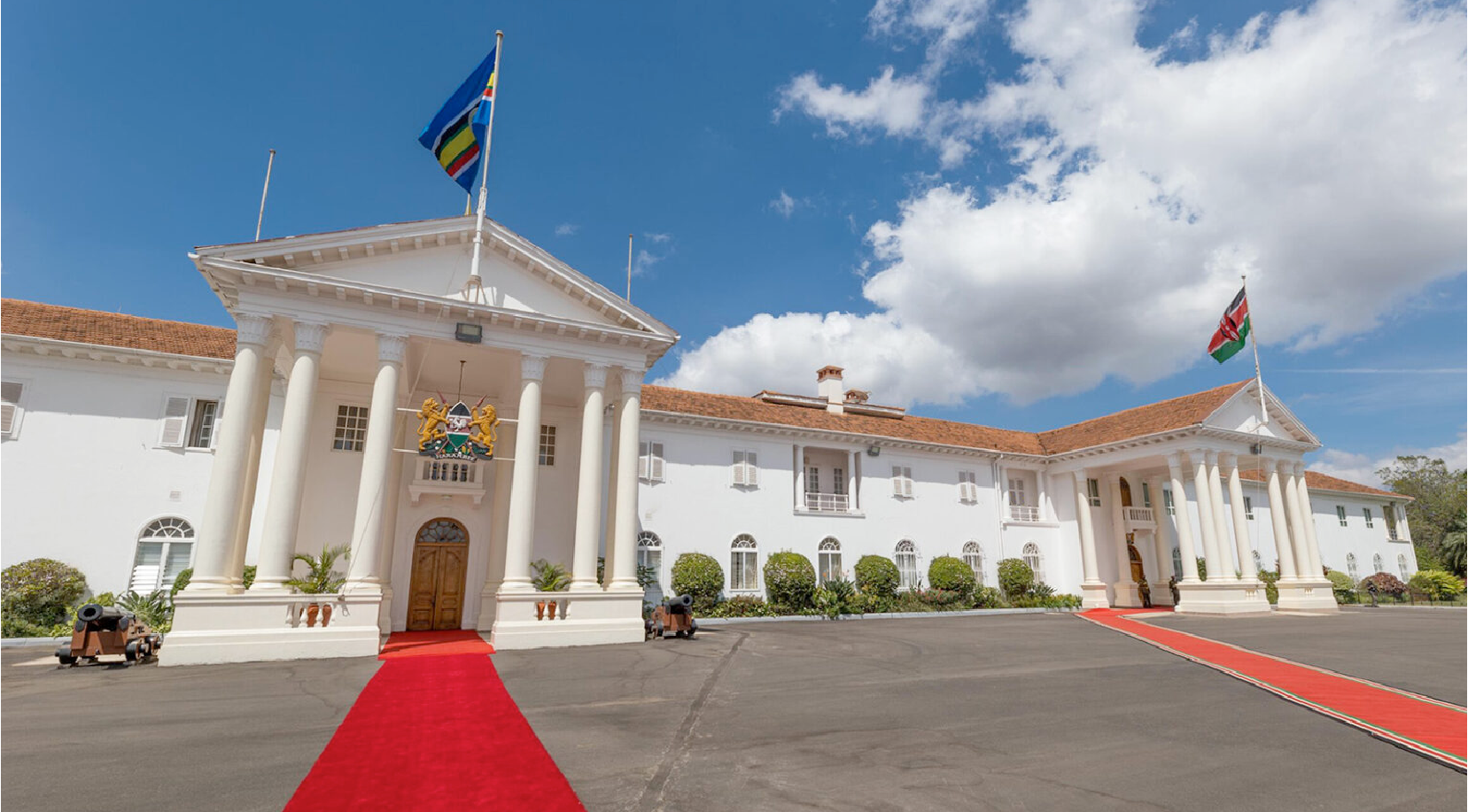
(ZENIT News / Nairobi, 07.19.2025).- In a move that has ignited sharp debate across Kenya’s religious and political landscape, President William Ruto has unveiled plans to build a monumental Christian church within the grounds of State House, the official presidential residence. The project—personally funded, according to Ruto—is intended as a bold expression of faith. But for many, it raises deeper questions about the constitutional promise of religious neutrality and the increasingly blurred line between personal belief and public office.
A devout evangelical Christian, Ruto has long integrated faith into his political persona. He often quotes Scripture at rallies, sings gospel music in public, and has even shed tears during religious services. The planned church, designed to accommodate 8,000 worshippers, would be the most visible symbol yet of his deeply religious approach to governance.
According to architectural renderings published by the «Daily Nation», the proposed structure features soaring columns, expansive windows, and twin rooftop crosses—an unmistakable mark of Christian identity on the very grounds of national executive power. The projected cost is at least 1.2 billion Kenyan shillings, roughly 9.3 million U.S. dollars.
The announcement has provoked mixed reactions, even among religious leaders. While some supporters hail it as a noble offering to God, others warn that it risks unsettling the country’s religious equilibrium. Reverend Joachim Omolo Ouko, a Catholic priest from Kisumu, questioned the legitimacy of such a project on government property. “State House is not the president’s personal estate,” he said. “It belongs to the people of Kenya.”
Anglican Archbishop Jackson Ole Sapit expressed concern about theological confusion. “A church represents the kingdom of God,” he noted. “But when it is built within the seat of political power, what kingdom does it truly reflect?”
Muslim leaders have also weighed in. Sheikh Abdallah Kheir warned that constructing a church at State House sets a precedent that could open the floodgates for demands from other faiths. “What happens if a Muslim president comes next? Will they build a mosque? This is not a door we should open,” he said. His concerns were echoed by Sheikh Abu Qatada, who called for equal representation and requested a mosque be included to reflect Kenya’s religious diversity.
Even the country’s atheist community has entered the fray. Harrison Mumia, president of the Atheists in Kenya Society, issued a public statement urging a halt to the project. “This is not just a personal religious gesture—it is a threat to the separation of church and state,” he said.
Kenya’s constitution explicitly prohibits a state religion. While about 85% of the population identifies as Christian, with Muslims comprising 11% and the remainder practicing other religions or none at all, the document was crafted to guarantee equal standing for all beliefs.
Ruto, however, remains defiant. “I won’t apologize to anyone for building a church for God,” he said at a public event. “If the devil is upset, so be it.” He emphasized that a modest iron-sheet chapel already exists at State House and insisted his only intent is to upgrade it—at no cost to the taxpayer.
This is not the first time an African head of state has stirred controversy by mixing piety with politics. Ghana’s former president Nana Akufo-Addo pushed for a national cathedral in Accra; despite claims of private funding, it has burdened the public budget. Equatorial Guinea’s President Teodoro Obiang oversaw construction of a vast basilica in his hometown, modeled after St. Peter’s in Rome, even as public services lagged. Mobutu Sese Seko of former Zaire built a private chapel for his wife’s mausoleum, and Algeria’s recent president spearheaded the building of the continent’s largest mosque.
In Kenya, the stakes are particularly delicate. Ruto’s ambitions coincide with growing concern over religious nationalism and its potential to deepen sectarian divides. As construction plans move forward, the church at State House may become more than a monument—it could stand as a lasting test of the nation’s commitment to pluralism.
Thank you for reading our content. If you would like to receive ZENIT’s daily e-mail news, you can subscribe for free through this link.

Publicaciones relacionadas:
 Pope Francis on Cardinal Ouellet: There Is Not Enough Evidence to Open a Canonical Investigation for Sexual Aggression
 In Face of the Assassination of a Presidential Candidate, Pope Sends Message to the Country and to the Politicians
 Catholic Church Generates 3% of Spain’s GDP in 2024 Thanks to Its Cultural Patrimony
 Communist China recognizes 94-year-old Catholic bishop Melchiorre Shi Honghzen
